Wednesday, April 22, 2020

Spoon Mementos


QUESTION: My mother loved to collect souvenir spoons. She had over 100 of them. She recently died and now I have these spoons. One of them is particularly strange. It’s a sterling silver spoon with the trademark of a witch riding a broomstick on the back. Was this one produced to celebrate Halloween? And when did people start collecting souvenir spoons?

ANSWER: Sterling silver souvenir spoons are great mementos of an earlier era. As George B. James Jr. wrote in his catalog, Souvenir Spoons, published in 1891, "Many a legend, which has long been forgotten in the town of its origin, many a beautiful story which has long since been lost, have been happily brought to mind, and tradition honored by its incorporation in the souvenir spoon."

Antiques historians believe the first souvenir spoons appeared in Europe and were modeled after the silver Apostle spoons, produced in the late 16th century as religious souvenirs. In those early times, when a person wanted a portable security it had to be either silver, gold, or jewels. Spoons were practical and portable, but, unfortunately, when melted down served as ready currency.

Some of the most skilled 19th century and early 20th-century silversmiths made souvenir spoons, commemorating everything from world fairs to cities to historical figures, Biblical characters, and even the witches of Salem, Massachusetts.

In the late 19th century, the Gorham Manufacturing Company produced a group of Apostle spoons in the United States that now sell for $125 to $175 each. The trademark found on these sterling silver pieces manufactured from 1848 to 1865 shows a lion facing left, an anchor, and a "G."

Often souvenir spoons were the first gifts given to babies by their godparents at christenings. The idea began in the Middle Ages—a child no sooner learned to feed himself or herself, use a spoon, than he or she began to acquire a knowledge of Scripture and ecclesiastical history.

In 1887, as souvenir spoons became the fad in European cities, Daniel Low, of Salem, Massachusetts, made a trip to Europe where he purchased spoons from skilled craftsmen. From these, he conceived the idea of a spoon embodying the traditions and legends of Salem. His son, Seth F low, designed the first "witch" spoon. Its handle had the figure of a witch and the word "Salem.”

The first witch spoon spawned the souvenir spoon craze of the late 19th-century in the United States. It was the first to be made in this country from a special die, of a design suggestive of some particular place, and it has since become the most celebrated of the souvenir spoons.

Victorian women proudly displayed their souvenir spoons when serving tea, after-dinner coffee, and other beverages. They often used them with their good silver and china, especially at holiday celebrations.  Souvenir spoons also showed off all the places they had been.


Students in the early 20th century were often given souvenir spoons featuring their alma mater. Many of these graduation spoons had a male or female figures in graduation garb on their handles.  Others had handles decorated with pens, books, and globes.

The souvenir spoon craze moved west with the settlers. Most western towns used sterling silver spoons to advertise their assets. One of the biggest producers of these spoons was Joseph Mayer & Bros. in Seattle. The Mayers company had been in business as the Empire Jewelry Company in the East, but, when it moved west, it changed its name to Joseph Mayer & Bros.

G.A. Schuman, who became manager was a designer and toolmaker who had experience with Gorham, Whiting and Tiffany. In addition to souvenir spoons, the Mayer firm also made jewelry and several patterns of flatware. One of Mayer's special designs was a commemorative spoon for Butte, Montana, with a miner forming the handle. Another carried an ostrich engraved in its bowl along with the words. "Los Angeles" and the figure of a woman picking fruit forming the handle.
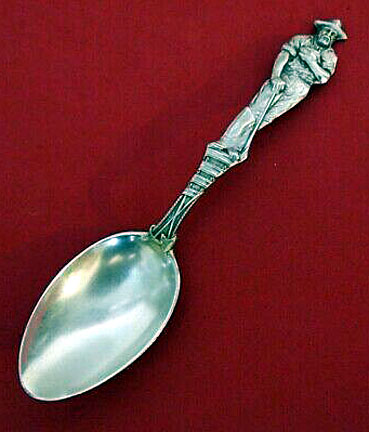
Both of the above spoons carry the Mayer's trademark of a crossed miner's pick and shovel above a rising sun. This mark originated with two of Joseph Mayer's younger brothers, who went to the Yukon where they opened a jewelry store instead of staking gold claims.

By 1909, Joseph Mayer & Bros. employed 100 craftsmen who manufactured souvenir spoons, along with sterling flatware and jewelry related items. The Mayers stamped their trademark on everything they made. In 1938 Joseph Mayer& Bros. became the El.Towle Manufacturing Co.

Mayer produced a lot of silver souvenir spoons because the process they used was mechanized, so it didn't cost much to produce each item. However, many pieces are skillfully engraved. Because so many were made and are still available today, they’re a popular collectible valued from under $20 to several hundred dollars.

Early souvenir spoons had the word “sterling” along with a trademark identifying its maker at the base of the spoon handle.

To read more articles on antiques, please visit the Antiques Articles section of my Web site.  And to stay up to the minute on antiques and collectibles, please join the over 30,000 readers by following my free online magazine, #TheAntiquesAlmanac. Learn more about  the Industrial Age n the 2020 Winter Edition, "The Wonders of the Industrial Age," online now. And to read daily posts about unique objects from the past and their histories, like the #Antiques and More Collection on Facebook.

Wednesday, April 15, 2020

Product Premiums—An Idea Whose Time Had Come


QUESTION: My grandmother has what she calls a “Larkin” desk. It doesn’t look like a normal desk but more like a tall oak bookshelf with a drop-down writing surface. She remembers her parents acquiring it around 1911.  Can you tell me more about it?

ANSWER: One of the most popular items from the Larkin Company was the drop-front combination bookcase/desk, also known as the Chautauqua desk. This desk became a common piece in homes at the beginning of the 20th Century.

In 1875, John D. Larkin opened a soap factory in Buffalo, New York, where he made two products— a yellow laundry soap he marketed as Sweet Home Soap and a toilet soap he called Crème Oatmeal. He sold both products using wholesalers and retailers. Larking originally sold his Sweet Home Soap to street vendors, who in turn sold it to customers along their routes. By 1878, he had expanded his product line to nine types of soap products.


His brother-in-law, Elbert Hubbard, the eventual founder of the Roycroft Arts and Crafts Community, came up with what he called "The Larkin Idea"—door-to-door sales to private residences. To establish brand identity, Hubbard, inserted a color picture with the company's logo into every box of soap as an incentive for customers to buy more soap. Housewives accumulated and traded these picture cards, and eventually the cards became more elaborate. This concept of offering a gift directly to customers was a new approach to marketing. And by the 1890's, Larkin’s premiums had become an overwhelming success and a vital part of the company’s   marketing plan.

The premiums Larkin offered included handkerchiefs with toilet soap, towels with soap powder, or one-cent coins. Eventually, Larkin inserted certificates into the packaged products which could be redeemed by mail at the company’s Buffalo headquarters. A $10 order of soap resulted in the awarding of a premium with a retail value of the same $10. By 1891 he placed his first wholesale order of items to be given as premiums, $40,000 worth of piano lamps. The next year he acquired 80,000 Morris chairs and 100,000 oak dining chairs—all to be given away with the purchase of soap.

Larkin and Hubbard knew the key to mass merchandising was to eliminate the sales force and sell directly to the consumer via direct-mail catalog. Larkin realized he would be better off if he made not only the products he sold, but also the premiums he distributed. His pitch was that since he manufactured the products he sold, unlike Sears & Roebuck and Montgomery Ward and sold them directly to the consumer, he was eliminating the "middleman" and giving the customer better value for the money. The Larkin Company motto became "Factory to Family." By the end of the 19th century, catalogs jammed people’s mailboxes.

The plan worked. Both his product line and his premium line expanded. By 1893, the Larkin Soap Manufacturing Company was sending semiannual catalogs to 1.5 million customers.

His first venture was the furniture assembly plant in Buffalo that made furniture from parts cut and milled in Tennessee. Here for the first time was a major catalog distributor who actually made the furniture they shipped. Furniture was one of the company’s primary premiums. Since Larkin was appealing to the mass market, he made sure to offer furniture premiums that appealed to ordinary people and not the wealthy.

His most famous premium was his oak drop-front desk with open bottom storage, first appearing in the 1901 catalog, that the company gave as a premium for a $10 purchase of soap. Constructed of either cold or quarter sawn oak plank, assembled with nail and glue construction, with a golden finish, each desk featured applied ash or maple molding and trim and back panels of three-layer plywood. Better desks also had stamped-brass escutcheons and brass hinges on the drop panel. Cheaper ones had iron-butt hinges. A somewhat oval French beveled mirror finished off each piece. Variations included a glass front case with a drop-front desk attached to the side, two glass front cases with a desk in the middle, or simply a drop-front desk with a small open bookcase below the drop and candle stands above it, with a mirror in the high . This small desk reflected the taste and style of the Golden Oak period of American furniture in a form modest enough fit into any middle-class home.

This type of desk became "Everyman's" desk and was a common item in most homes of the period. It became a trendy decorating item and remained so for many years. People began to associate Larkin's name to the form, even though his wasn’t the only company to manufacture them, and so evolved what has become known as the "Larkin Desk." Today, Larkin desks sell on eBay for around $400 and sometimes higher.

John Larkin and Elbert Hubbard not only provided the means for a growing American population to stay clean at a reasonable cost, but they also helped them furnish their homes for free.

To read more articles on antiques, please visit the Antiques Articles section of my Web site.  And to stay up to the minute on antiques and collectibles, please join the over 30,000 readers by following my free online magazine, #TheAntiquesAlmanac. Learn more about  the Industrial Age n the 2020 Winter Edition, "The Wonders of the Industrial Age," online now. And to read daily posts about unique objects from the past and their histories, like the #Antiques and More Collection on Facebook.

Thursday, April 9, 2020

Identification of Antique Pottery Begins with the Mark


QUESTION: I have what I believe to be an English ceramic plate with a mark that looks like a diamond with a bunch of letters and numbers in it. Can you tell me what that means?

ANSWER: The stamp on the back of your plate is known as a mark. Manufacturers of English pottery used this particular design between 1842 and 1883. The letters and numbers indicate the dates of the plate’s design registration with the British patent office. You can easily decipher this alpha-numeric code by checking the chart found on the Phoenix Masonry Web site or in Kovels' New Dictionary of Marks - Pottery & Porcelain: 1850 to the Present by Ralph and Terry Kovel (Crown Publishers, New York).

Pottery makers replaced this diamond-shaped registry mark with a sequential numbering system prefaced by the abbreviation Rd. No.  in 1884. Over the years, they modified the arrangement of the numbers several times, so it can be confusing. If you need specific information, you can contact the British Designs Registry Patent Office for dates registered in and after 1909 and the British Public Record Office for dates registered prior to 1909.


Sometimes, pottery and porcelain makers used word indications that spelled out the date. If the mark shows the country of origin, this means the piece dates after 1891, according to the U.S.  McKinley Tariff Law.

Often manufacturers worldwide employed words to describe their wares. These usually had start and end dates, making it easy to figure out the approximate date of a piece. For instance, the term "Nippon,” the Japanese name for Japan, indicates that piece of Japanese porcelain dates from 1891 to 1921 while "Made in Occupied Japan" shows that the piece dates from  1945 to 1952. "Semi-vitreous" means the piece appeared on the market after 1901 while "bone china" indicates that the piece dates generally from the 20th century.  The phrase "oven-proof' appeared on pottery and china after 1933, but "dishwasher proof ” didn’t appear until after 1955. Sometimes a location, such as "East Germany" can indicate a time period, which in this case extends from 1949 to1990.

If a piece of pottery or porcelain has a mark showing a design and/or maker’s name, this information may also help to date it. You’ll find loads of resources, both in print and online, to help you identify early English, European, and Asian pottery and porcelain marks.

In the United States, makers stamped patent numbers on the backs and bottoms of their pottery pieces. A patent number represents the very earliest an article could have been produced. For example, a patent number of 16,388 indicates the piece appeared after Jan. 1, 1857 but prior to Jan. 1, 1858. Therefore, it dates from 1857, the year of its patent registration. Should you discover several sequential patent number sets on one piece, you should look up the final set on a patent date chart to date the piece.

Marks on furniture, glass, and silver are another story. When a maker uses his name or logo, you may have enough information to track the date of manufacture. Often during the course of the run of a piece, the maker will use different names. Quimper pottery is a good example. As the companies consolidated the marks changed.

To read more articles on antiques, please visit the Antiques Articles section of my Web site.  And to stay up to the minute on antiques and collectibles, please join the over 30,000 readers by following my free online magazine, #TheAntiquesAlmanac. Learn more about "Coffee--The Brew of Life" in the 2023 Summer Edition, online now. And to read daily posts about unique objects from the past and their histories, like the #Antiques and More Collection on Facebook.