Wednesday, September 12, 2018

The Beauty of Ceramic Wall Art


QUESTION: At a recent antique show I saw a framed ceramic wall plaque that, according to the dealer, Rookwood Pottery had made. I know about Rookwood art pottery and own a couple of pieces, but I never knew the company made plaques. This particular one depicted a snow scene and came in a simple wooden frame. It seemed rather expensive to me, so I passed on it for now. What can you tell me about Rookwood plaques? Were they only produced for a limited time? And did they come framed or did people frame them?

ANSWER: Rookwood scenic plaques aren’t as well known as their art pottery. They were more artistic and more expensive than their art pottery pieces, so the average person didn’t usually buy them.

Rookwood Pottery perfected the production of ceramic tiles based on an ancient form of pottery craftsmanship. Many consider it to be America's finest pottery, beginning in the early 1900s and continuing through the 1930s.

Shortly after the Philadelphia Exposition of 1876, American ceramic artists began making utilitarian wares. But unlike utilitarian objects, Rookwood produced tiles for architectural and utilitarian reasons, while its plaques were purely decorative. The company produced plaques depicting landscapes, seascapes, and the occasional figural paintings from 1910 to 1930.

Primarily, Rookwood produced these plaques using slip decoration, finishing them in a vellum glaze. Most featured landscapes, and many took on a tonalist quality. Plaques displayed a variety of pastel colors, a few had snow scenes, and the majority had a bit of crazing resulting when the outer glaze contracts at a different rate than the underglaze painting or the ceramic body, rendering a lightly checked outer surface. Most early plaques had crazing. In later years, Rookwood learned how to make uncrazed plaques.

Rookwood produced many more ceramic vases and such than plaques, thus fewer people know about them. The original price hand-written on the back of an uncrazed plaque was usually higher in comparison to the price shown on the reverse of a crazed plaque.

Though the production of a plaque was simpler than that of a vase because an artist had a flat tile "canvas" on which to work, they did warp, but in spite of this, the value of plaques today exceeds that of their vase counterparts from the same time period.

Plaques are also more expensive because they’re classified as fine art. Rookwood made fewer of them than vases. A typical plaque originally cost around $175. Very few scenic vases with a vellum glaze would have been that expensive. Usually, the original price workers wrote the original price on the backs of tiles in pencil in the upper right-hand corner.

Artists who painted Rookwood plaques took their inspiration from local landscapes, with the exception of the Venetian scenes, painted by Carl Schmidt and Ed Diers. Though a plaque may have depicted a scene of snow-capped mountains, that certainly wasn’t part of the surrounding landscape, but more likely taken from a painting viewed at the Art Academy of Cincinnati and the Cincinnati Art Museum. located near the Rookwood pottery works. Early standard-glaze plaques, produced between 1900 and 1905, often feature Dutch or English gentlemen, as well as American Indians. The images of the European gentlemen came from famous paintings while those of the Indians probably came from photographs.

Around the turn of the 20th century, Rookwood produced faience plaques or tiles, usually made for installation into homes or commercial buildings. They almost always  covered these in a matt glaze, occasionally made with a painted and carved design, but primarily in a cloisonne fashion.

Rookwood plaques come in a variety of sizes, the smallest usually being 4 by 8 inches, and the largest, 14 by 16 inches. Most of the time, these plaques are uncrazed and unaffected by warpage. Because of their impressive size and fine decoration, they  bring a premium price today.

While artists who painted with oil on canvas could view the colors and brushstrokes as they produced them, those who painted Rookwood plaques with clay slip, couldn’t be sure how a color would look after firing. They may have applied the slip heavily, thus rendering “crawling” to the glaze. Perhaps the green trees would appear more blue, the pink sky too pale, or blue water some other shade.

Artists such as E.T. Hurley, Fred Rothenbusch, Ed Diers, Lenore Asbury, Sara Sax and Sallie did some of the best quality and most artistic work for Rookwood. Hurley was among the best at producing quality tonalist plaques, from nocturnal scenes to beautifully painted beech trees to landscapes with a vivid pink sky and exquisite mountain ranges.

Fred Rothenbusch produced some of the best large plaques. His color palette leaned towards deep purples, dark blues, and light rose. Ed Diers painted great landscapes and was one of the best at painting trees. Some of his plaques included forest interior scenes with bold tree trunks and an almost three-dimensional quality. Lenore Asbury also painted distinctive trees and employed a wonderful range of colors and was one of the best at painting tonalist landscapes. Carl Schmidt was famous for his Venetian scene plaques.

Some collectors seek plaques by a certain artist. Others go by theme or other criteria.  For instance, some want snow scenes while others prefer harbor scenes. Some want only uncrazed examples, and some want colorful ones.


To read more articles on antiques, please visit the Antiques Article section of my Web site.  And to stay up to the minute on antiques and collectibles, please join the other 18,000 readers by following my free online magazine, #TheAntiquesAlmanac. Learn more about Colonial America in the Spring 2018 Edition, "Early Americana," online now.

Wednesday, September 5, 2018

Bottles, Bottles, and More Bottles


QUESTION: My father loved to collect old bottles. He would take me and my sister out on bottle hunting expeditions, digging for them or looking for them in old garbage dumps. We gathered every old bottle we could find without paying much attention to the type or age. I particularly liked the colored ones. Now that I’m older, I’d like to start to seriously collect bottles. I’d like to add to the few I still have but really have no idea of what to collect.  Can you help me?

ANSWER: Bottle collecting is a fun thing to do, especially if you have children. But serious bottle collecting can be addictive.

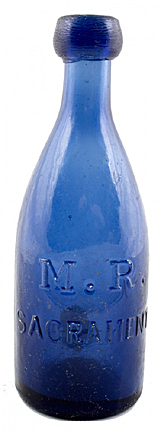
Bottle collectors find beauty and rarity in old, dirty, empty glass bottles made to hold food or beverages a century or more ago. They scour flea markets at sunrise, auctions until midnight, and go digging in old garbage dumps and cisterns—all for that elusive bottle to add to their collection.

To non-bottle collectors, bottles are confusing and at the same time fascinating. They see old bottles, priced from a few cents to incredible amounts of money with no apparent rhyme or reason, at most antique venues. The fascination kicks in when they see a collector pick up that old dusty bottle on a sales table, turn it around in the light as though it were a flawless diamond, and murmur how they’ve been searching for it for a long time.

Even the term “bottle collector” is itself a misnomer. Bottle collectors collect everything from soda and beer bottles to food or medicine ones to flasks, as well as canning and storage jars. Some collect stoneware jugs, advertising bottles, trade signs, and bottle openers.

Bottles come in all shapes and sizes. Jugs from the early part of the 19th century were more chestnut-shaped. Flasks were vertically oval and often embossed with designs such as eagles and cornucopias on the front and back. Early whiskey bottles were either flask-shaped in the early part of the 19th century or iron pontiled (held by an iron rod after blowing) by the time of the Civil War or barrel shaped during the last quarter of the 19th century. Bitters bottles had a vertical rounded rectangular shape with a flat front and back, usually embossed with the name of the bitters and the company. Some bottles had impressed glass seals with the name of the company added to them. And some whiskey bottles came wrapped in wicker.

Bottle collectors classify bottles based on what the bottle originally held. Most categories of bottles fall into one of the following broad groups—medicine, soda, beer, food and spirits. Within each of these categories, however, there are a number of subcategories.


For example, in the medicine bottle-collecting specialty, there are some collectors who specialize on a particular type of medicine, such as  cures or bitters. Others might specialize in medicine bottles that have their original labels or that still have their original content. However, it’s now illegal to buy or sell any medicine bottles with their original contents.

Most bottle collectors are specialty collectors who can look at a bottle and tell when the company that made it was in business, what other addresses the company used, what other products the company made, which glass company made the bottle, and even what other colors that particular bottle came in. They spend hours researching, looking through original records, business directories and other documents in their quest for information about companies that have been out of business for a long time.

Although many collectors specialize by bottle type, others specialize in a different way. For example, some people collect bottles that were made in their hometown or home state, regardless of whether the bottle originally held spirits, milk or medicine. Others collect bottles that have their name or interesting pictures, such as lions or eagles, embossed on them. There are collectors who select only bottles manufactured by certain glass houses. Others collect solely on the color of a bottle, so that a cobalt blue fruit jar shares display space with a cobalt blue soda bottle.

Some bottle collectors are generalists, who choose to collect a few key examples from many different specialties.

But collecting bottles can be a two-edged sword. On the one hand, it's difficult to go to a yard sale, flea market, auction, or antique show without seeing dozens of bottles for sale. Everyone seems to have some stored away in basements, displayed on shelves or windowsills, or taking up space in garages. This sheer volume of bottles available on the market certainly makes it easy to amass a large collection in fairly short order, and at fairly low prices.

Unfortunately, this abundance of supply causes some problems. Many novice bottle collectors find themselves in a quandary soon after beginning to collect, when their display space disappears before they have exhausted their collecting budget. This abundance of supply also causes problems for advanced collectors as well. Due to the volume of bottles manufactured during the past two centuries, no single bottle price guide pictures, describes, and prices all of the ones you might find in just one typical day at a large flea market. Thus, finding the value of a bottle can be a real challenge.

Learn more about the restrictions on collecting medicine bottles by reading "Take Caution Selling Medicine Bottles Says DEA" in #TheAntiquesAlmanac.

To read more articles on antiques, please visit the Antiques Article section of my Web site.  And to stay up to the minute on antiques and collectibles, please join the other 18,000 readers by following my free online magazine, #TheAntiquesAlmanac. Learn more about Colonial America in the Spring 2018 Edition, "Early Americana," online now.


Tuesday, August 28, 2018

Sit Back and Get Comfy


QUESTION: While out antiquing recently I discovered a beautiful sofa that would add a lot of class to my living room. It’s in great shape, although it may eventually need to be reupholstered. The dealer said it was in the American Empire style. Although I like older things, I’m not very familiar with all the styles of furniture, especially those from the 19th century. What can you tell me about the American Empire style? Do you think this sofa will be a good investment? It isn’t all that comfortable, but I have a overstuffed one in my family room, so this one would be for more formal visits.

ANSWER: The American Empire style is one that isn’t particularly familiar to even moderate antique enthusiasts. It was more of a transitional style, and its pieces come in a wide variety of designs and ornateness.

But before looking at the American Empire style, let’s take a look at how the sofa evolved. People didn’t even know what a sofa was before 1700. They reserved chairs for important guests. Less important ones sat on stools and benches.

By the 18th century, chair makers began to pad the seats of their chairs. Some even padded the backs, but chair backs of the time were still straight and stiff. When the Queen Anne style appeared around 1750, chairs became a bit more comfortable because their backs were curved.

The word sofa itself comes from the Arabic ‘soffah’, which refers to a raised part of the floor covered with rugs and cushions, while the word couch comes from the French word ‘coucher’ and literally means ‘to lay down’.

The first true sofa was the camel-back, so named for the padded hump in its back. The back, seat, and arms also had sufficient padding, making it the most comfortable seat in the room. Thomas Chippendale designed elegant camel-back sofas with simple, thick square legs that gave them stability.

By the dawn of the 19th century, the Federal style had come into vogue. Sofas became straighter, but the seats were narrower and harder. This was the age of good posture—no slouching was allowed. People had to sit up straight. Both the furniture and the clothing they wore dictated it. People back then couldn’t lean back and doze off like they can today.

By the 1830s, the Empire style had gotten a hold in Europe. It took a decade or so for it to travel across the Atlantic Ocean to America. Empire sofas went a step further and rounded the back cushion so people could not lean back.

By the 1850s, people wanted more comfort in their sofas. Sofa makers angled the backs gave their pieces thicker cushions. But even these sofas still had carved wooden pieces that poked and prodded if a person didn’t sit straight.

The Mission style of the early 20th century didn’t improve much on the comfort scale. Sofas in the first two decades featured heavy, square wooden frames with a padded seat and perhaps a few loose cushions for comfort.

It wasn’t until the 1920s that the overstuffed, deep-cushioned sofa appeared. This style has existed until today in one form or another. The large, L-shaped super overstuffed versions found in today’s home are a far cry from the camel-back sofas of the 18th century.

American Empire is a French-inspired Neoclassical style of American furniture and decoration that takes its name and originates from the Empire style introduced during the First French Empire period under Napoleon's rule.


It gained its greatest popularity in the U.S. after 1820. Many examples of American Empire cabinetmaking are characterized by antiquities-inspired carving—gilt-brass ormolu, and decorative inlays such as stamped-brass banding with egg-and-dart, diamond, or Greek-key patterns, or individual shapes such as stars or circles.

The most elaborate furniture in this style appeared between 1815 and 1825, often incorporating columns with rope-twist carving, animal-paw feet, anthemion, stars, and acanthus-leaf ornamentation, sometimes in combination with gilding and vert antique, an antique green simulating aged bronze. A simplified version of American Empire furniture, often referred to as the Grecian style, generally has plainer surfaces in curved forms, highly figured mahogany veneers, and sometimes gilt-stenciled decorations. Many examples of this style survive, exemplified by massive chests of drawers with scroll pillars and glass pulls, work tables with scroll feet and fiddleback chairs.

American Empire sofas are in high demand today. Fine examples can sell for anywhere between $10,000 and $30,000. Of course, that’s for those in excellent condition and fully restored. So yes, buying one would be a good investment, as long as it’s held for at least 10 years.

To read more articles on antiques, please visit the Antiques Article section of my Web site.  And to stay up to the minute on antiques and collectibles, please join the other 18,000 readers by following my free online magazine, #TheAntiquesAlmanac. Learn more about Colonial America in the Spring 2018 Edition, "Early Americana," online now.
Wednesday, August 22, 2018

Gone Fishin'


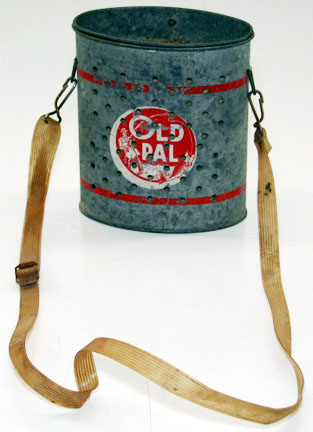
QUESTION: My grandad loved to fish. He took me along at a very young age. My job was to carry the bait. The thing I carried it in was green and shaped like a bullet and had holes all over it. I used to feel very important carrying it. Then he taught me how to bait my own line and from then on I became hooked. What he didn’t tell me was that he had a small collection of unique containers called minnow buckets. It wasn’t until later that I found out. When he died, I got his collection of minnow buckets. Being an avid fisherman myself, I’ve always wanted to add to his collection but didn’t know much about them. What can you tell me about minnow buckets? Would it be worth my while to add to his collection or aren’t they really worth much?

ANSWER: Collecting sports-related memorabilia has his the big time. Though the market is small compared to regular antiques, it, nevertheless, is a lively one. The pastime of fishing has long had a variety of interesting objects to collect. And one of the most interesting—and most obscure—is the minnow bucket.

Keeping bait alive is important for the fisherman. Early sporting goods companies produced a variety of buckets, floats and other ingenious devices for this purpose. While today's fishermen use state-of-the art aerated buckets to keep minnows alive, fisherman of the 1880s had to be more inventive.

One of the best minnow buckets made was the oval No. 1, made by the Hall Manufacturing Company of Cinncinnati, Ohio in the 1880s. The largest made, measuring 5½ inches tall by 16 inches wide by 10 inches deep, this innovative minnow bucket had a middle compartment for minnows and two hinged end compartments for other baits or ice to keep the water cool. It cleverly telescoped when two wing nuts were loosened and the inner pail was pulled upward.

Hall made five different styles of telescopic buckets. They came in a japanned green finish or in oxidized copper on tin. The green japanned No. 1 bucket originally sold for $3.90 and the copper version sold for $4.50, both expensive at the time. A Hall No. 1 tin-plate bucket today in very good condition sells for over $300 while the copper version would be more than double that.

Another unique early bait container is the Lucas No. 28L rectangular floating bucket with a 10-quart capacity, measuring 11 inches high by 10½  inches wide and 6 inches deep. Advertisements claimed that its shape was more convenient to carry and more compact, thus taking up less room, and a fisherman could carry it in a suitcase. The Lucas rectangular bucket in a dark green japanned finish, with room for ice above the insert liner, sells for over $400.

For those fisherman doing stream fishing, there were several styles of trolling minnow floats—the Novelty Live Minnow Float, which held 10 quarts and measured 24 inches long by 77 inches in diameter and weighed 3½  pounds, and the Hartford Minnow Float, made by Shinners-Russell Company of Hartford, Wisconsin, which was 28 inches long by 7½ inches diameter and weighed 4 pounds. Designed to be trolled behind a boat, they both had torpedo-shaped bodies with conical ends.

The Hartford Minnow Float had air chambers at each end and a bottom ballast to keep it right side up while being towed.  Perforated in the rear to aerate the minnows, it’s forward portion was not, which protected the minnows while the fisherman trolled the float. The Hartford float sold for $2.50 and was available from the late 1890s through 1920. In very good condition, it now sells for $100 to $300.

Deshler Mail Box Co. of Deshler, Ohio, made the Jones Aquarium Minnow Pails in B-and 12-quarts capacities from 1911 to 1937. These were "race track" oval minnow buckets that contained an air chamber that you pressurized with a bicycle pump. It forced a stream of air bubbles through the water for four to six hours aerating the minnows and keeping them alive and active. The air chamber also kept the Jones minnow bucket afloat if the angler wished to use it in a lake or stream. They came in a dark green japanned finish with striping and ornamental artwork. The value of a Jones Aquarium Minnow Pail in very good shape is over   $200.

A second example of a compressed air self-aerating model is the Air-Fed Minnow Bucket made by the Air-Fed Manufacturing and Stamping Company of Quincy, Illinois A brass air primp was attached to the outside of this bucket. Made of galvanized steel with a green finish and an attractive gold label, it came in two sizes, 8 and 10 quarts, from the 1920s through the early 1930s. Today, one in very good condition would cost $100 to $150. This Air-Fed Minnow Bucket has an interesting warning on the label—“The air chamber in this bucket has been tested to 25 lbs. Never pump it more than this amount of pressure. DO NOT FILL AT A FILLING STATION. Test pressure after eight strokes of the pump.”

Geuder, Pasachke and Frey Co. made Cream City buckets, some of the most attractive minnow buckets ever produced. Early Cream City minnow buckets are the most sought after. These were tin-plated and featured a japanned finish with classic trade names such as Victor, Good Luck, Security, Progress, Perfection, Favorite and Climax, and each model came with appealing Victorian designs and stenciling. Many of the buckets came with the Cream City name, but the company shipped some to customers who wanted only these special classic trade names on their private-label buckets. Again, depending upon condition, some of the rare early tinned Cream City buckets can sell for $200 to $300 and more.

Galvanized buckets started to gain popularity between 1910 and 1920. Galvanizing is the coating of iron or steel with rust-resistant zinc, generally by plunging the item into a bath of melted zinc. The rust proofing characteristics of galvanized buckets lasted longer than japanned tin-plated steel. Cream City eventually started making galvanized buckets as well, and these were available in round and oval shapes up to 20 quarts. Galvanized buckets generally came with single-color black stencils with simpler designs. Their values run from $50 to $100 depending upon condition and rarity of the model.

The Shakespeare Company of Kalamazoo, Michigan, also marketed minnow buckets starting in 1916. Their extensive line of nine different styles appears to have been made by Cream City. Six of the series were tin-plated steel and japanned finished in dark green with gold striping, and three series were painted galvanized steel. These early Shakespeare minnow buckets are rare and sell for $100 to $300 based on condition.

Individual blacksmiths and tinsmiths made copper minnow buckets for local orders only. They can sell for $200 to $1,000, depending on their condition.

So you see, minnow buckets have quite the history, and the values are going up all the time. But collecting them can get pricey, so make sure your budget can withstand the extra strain.

To read more articles on antiques, please visit the Antiques Article section of my Web site.  And to stay up to the minute on antiques and collectibles, please join the other 18,000 readers by following my free online magazine, #TheAntiquesAlmanac. Learn more about Colonial America in the Spring 2018 Edition, "Early Americana," online now.