Monday, August 17, 2015

A Tool for Every Purpose


QUESTION: I’ve always liked old tools and would like to start collecting them. Can you offer any advice on how to get started?

ANSWER: For any collector, liking something is the most important thing. You should collect what you like. Doing so will build and keep your interest in your collection for a long time. That’s the difference between collecting and assembling a group of like objects. In the former, you have vested interest while in the latter you’re just adding them to a shelf or cabinet.

Old tools not only have value, they also have historical interest. You should always be asking how old they are, what condition they’re in, and how rare they are?

When it comes to tools, age is a major element. This doesn’t necessarily mean a tool’s actual age. What’s most important is age related to the particular type of tool. Planes are a good example. Many years before companies began manufacturing planes out of metal, they made them of wood. It’s very easy to find a wooden plane that’s well over 150 years old that, in good condition, may be worth only $25 dollars. The more modern version, which isn’t as old but is made of metal, can be worth many times that amount particularly if it’s one of the early models. So just because you have an old tool that you can date to the early 1800s, doesn’t necessarily mean you have a very valuable tool

The most important point to consider with tools is condition. This is the area among collectors where more confusion exists than any other. Look at how what you have  relates to what was originally made. This can be looked at in two ways. First, is what you have totally complete? Are all the parts, cutters and anything else that came along with the original tool still there? One of the best examples of a tool that’s commonly for sale without all the parts is the Stanley 45 multiplane. The basic Stanley 45 came with 18 to 23 cutters, two lengths of arms, depth stops and in some cases a cam rest. Very seldom do you find a complete Stanley 45 for sale, yet in many cases, the asking price is that of a complete one.

After you’ve determined a tool’s completeness, the next thing to look at is its actual physical condition. Cracked or chipped handles or even handles that have been glued back together reduce the value. In some cases, people will substitute a handle or a part from another tool that looks about right. While this might make the tool useable, it detracts from the value for the true collector. Finish is also important. Having the original label still in place and the original metal and wood finish makes a tool more valuable. What detracts most from the value is when you can see signs of wire brushing  or that the tool has been painted black or covered with some kind of other coating.

The "rareness" of a tool, as with other antiques, is also very important when determining its value. This typically comes down to how many have survived and are available for sale. In some cases there may be a limited relationship to how many were actually made. A good example of this is the foot-powered tools that were common in the late 19th and early 20th centuries. During World War II scrap metal drives, people donated many of these to be melted down for the war effort. Partially as a result of this, these foot-powered. tools are sometimes hard to find. In other cases, a particular style or type of tool may have only been manufactured for a limited period. This may be a result of a company going out of business, the tool not selling well or some external events such as a war that caused manufacturing priorities to be redirected. In most cases, it can usually be concluded that the more rare a tool is, the more it’s worth.

Tools, obviously, come in all shapes, sizes, and sorts. Each tool has been designed for a different job and so the variety is endless. In fact, even longtime experienced tool collectors will often run into something they haven't seen before. To make sense of all this variety, tool collectors have established categories of tools to help them focus their collections. In the broadest categorization, they divide tools into groups by the material they work—woodworking tools, metalworking tools, basket making tools, leather working tools, etc. They also further defined tools within each of these categories. For instance, in the woodworking tool category, there are edge tools, boring tools, measuring tools, woodworking machines, and so on. Within the machinist tool category, there are calipers, gauges, indicators, etc.

Tools can also be categorized in ways outside their intended purpose, such as by tool makers, patented tools, aesthetic tools, tools from a particular era or generation, tools made in a particular geographical area, tools made from a certain material, and miniatures.

Collecting tools can be daunting—and expensive—if you don’t focus on a particular type early on. But whatever type you choose to collect, always buy the best you can afford.


Wednesday, August 5, 2015

Elephant Mugs and More


QUESTION: I recently bought a small mug in the shape of an elephant at a monthly flea market. It has GOP 1968 embossed under the top edge. On the bottom it says "Frankhoma" What can you tell me about this cute little mug?.

ANSWER:
The mug you found was a souvenir of the Republican Party Women, created by John Frank.

After graduating from the Chicago Art Institute, John Frank moved to Norman, Oklahoma., in 1927 to establish the first Ceramic Art Department at the University of Oklahoma. In 1933 he started his own pottery company to create a line of fine art ware and sculpture that ordinary people could afford to buy. A year later, Frank's wife, Grace Lee, suggested the company name should incorporate both their family name and the last letters of their state, thus the company officially became Frankoma Pottery.

The Franks and their new business moved about 20 miles south of Tulsa to Sapulpa in 1938, but soon hardship followed. Their first building, constructed partially by Grace's father, burned down shortly after their arrival. Despite the economic hardships caused by the fire and the Great Depression, the Franks followed their vision and rebuilt.

Instead of reissuing early sculptures, such as figurines, ashtrays and vases, the Franks decided to make bookends, candleholders, wall vases, face masks and plaques following the fire. Frankoma also became the pioneer in colored tableware with bold designs in vibrant Southwestern colors such as Prairrie Green and Desert Gold. From 1942 until 1988 Frankoma created a line of wagon- wheel dinnerware that became its signature product. The Pottery also produced dinnerware in other patterns, including Mayan-Aztec, Plainsman, Lazybones, and Westwind.

In 1968 John Frank designed an elephant mug as a fundraiser for the National Republican Party. The following year it became a collectible series. The Frank’s daughter, Joniece, designed the first Democrat donkey mug in 1975. The company produced other collectibles,  including 14 Teenagers-of-the-Bible plates issued from 1972 until 1982 and Christmas plates,  first issued in 1965. From 1955 until 1967, Frankoma also manufactured earrings, pins, and tie clasps and the bolo tie designed by John Frank, who had received an award for jewelry design in 1927.

The type of clay and trademarks help collectors identify old and new Frankoma pieces. John Frank experimented with many types of clay from different areas of Oklahoma. From 1933 until 1954 he used tan clay found near Ada, Oklahoma. Collectors now call pieces made with this clay Ada Clay.        

In 1954 he switched to a brick red firing clay located a few miles from the factory in an area known as Sugar Loaf Hill. Collectors call this Sapulpa Clay Pre-1980. In the 1980s, additives affected the red brick color of the clay, and it became either a light pink or a light orange. Collectors refer to this as Sapulpa Clay Post-1980. The changes in the clay also affected the color of the glazes. Today, Ada clay pieces are generally worth the most.

Collectors today regard the pieces with Frank's initials "JNF" or '"JF” as the most desirable. During 1933 and 1934, Frank marked his firm’s wares with one of three marks—“FRANK POTTERIES NORMAN OKLAHOMA,” “FRANK POTTERIES NORMAN OKLA” or “FRANK POTTERIES.” It wasn’t until he incorporated Frankoma Potteries in February 1934 that he used a rubber stamp with the of the word “Frankoma.” He didn’t use it for long, so it’s quite rare. From late 1934 until 1954 the company used an impressed mark.

Frank also used what collectors call the cat mark from 1934 until it was destroyed in the 1938 fire. Known as the “Pot and Puma” logo, it was the company's first trademark and featured a large ceramic vase with a Taylor pacing cat in the foreground. It can be found on larger pieces. After he rebuilt the company after the fire, Frank again used an impressed Frankoma mark but this time the “O” was oblong, and not round. This Frankoma mark continued to be hand impressed until the early 1950s when the trademark was often inducted in the mold along with the mold number. However, some of the pieces made at this time had no marks since Frank never modified their molds. He often personalized pieces he gave as gifts to friends, family and special customers. His etched message and signature is definitely the most valuable mark.

After Frank’s death in 1973, his daughter Joneice took over, but in September 1983, fire once again claimed the Frankoma Pottery. The following year, after reopening, she had to declare bankruptcy. Two more owners took over the molds and tried to keep the pottery going, but in 2011, the company finally went on the auction block.

Tuesday, July 28, 2015

It's All in the Details


QUESTION:  I have what I was told is an antique Chippendale China Trade Corner chair which is unfortunately in very poor condition—the finish has been removed and it’s missing a side panel . It does have what appears to be an original leather seat cover. I’m curious to know if a piece of furniture in this condition is worth anything, and if it’s worth restoring? Also, I’m curious about the history told to me many years ago by a dealer. He seemed to think the chair was a Chippendale copy that was made in Asia (china) and sent to America by clipper ship. That seemed like a plausible story at the time. What do you think about that?  

ANSWER: From its construction and the lack of detailed carving, I can tell that your chair isn’t an 18th-century Chippendale but a Colonial Revival chair from the 1880s or 1890s. Whether or not it came from China, I’m not sure. The carving on the knees of the legs and on the rail at the top of the chair are shallow, more incised with a router than carved with a chisel.

The goal of Colonial Revival pieces was to make them in the style of the original, but usually the manufacturer was a bit lacking in correct details. And it’s the details that distinguish authentic, handcrafted reproductions, such as those commissioned by Winterthur Museum and Colonial Williamsburg, from poor examples made in factories.

The China Trade flourished from the end of the American Revolution into the 19th century. Wealthier Americans, not wanting anything British, sought items made in China which simulated those they had previously imported from England. High on the list were fine porcelains, especially the blue and white variety. And while the Chinese also made and exported some furniture imitating the designs of Thomas Chippendale, they didn’t create exact reproductions, but only approximations of his designs. In any event, what they did produce was elegant and first rate, not a cheap knock-off.

This corner chair, while possibly made in China, most likely appeared toward the end of the 19th century, perhaps in the 1890s. What differentiates it from authentic 18th-century examples is the lack of detail.

Before looking at this chair, however, it’s important to know the difference between an exact, authentic reproduction, like those commissioned by Winterthur Museum and Gardens or Colonial Williamsburg, and the stylized ones of the late 19th and 20th centuries. Skilled craftsmen often create the former to exact detail using handcrafting tools and original techniques while factory workers using machines produce the latter for the mass market.

Details on authentic reproductions reflect the originals. But those on stylized versions are either lacking or not rendered sharply. Carvings, usually done by routers, aren’t as sharp and three-dimensional as those on the original pieces.

For example, the chair rail on this corner chair ends in a smooth curved knob while the same ends on an authentic Chippendale corner chair are ergonomically carved to fit the middle two fingers of each hand, thus making it easier for a person to stand up from the chair. Also the added portion on top of the rail is smooth and elegant on the original and crude and carved lightly on this one.

This chair needs major restoration. However, the cost may be higher than the chair is worth. The leather seat isn’t worth saving. Its too damaged. However, you could have the chair upholstered again in leather. The only way to replace the missing back splat is to have a carpenter make an identical one, a job that isn’t cheap. If it were an authentic 18th-century piece, then it would be worth saving.

Tuesday, July 21, 2015

Pack 'Em Up


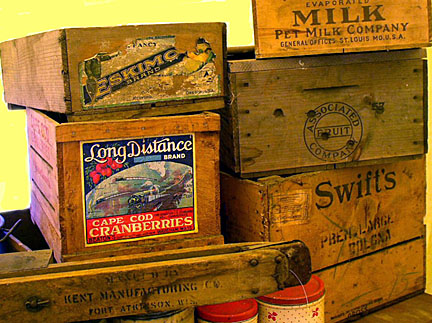
QUESTION: As I was sorting through things in my attic, I came across a couple of old wooden crates. One of them has "National Beer" written on the side in fancy letters while the other seems to have been for packing pears. Are these just junk or should I consider using them in some way? Do they have any value at all?

ANSWER: Today, we have all sorts of plastic containers to hold foods and other goods. But back in the good ole days—as late as the 1930s—goods came packed in wooden crates. Everyone knows the colorful ones used by the fruit industry to pack fresh fruit, but, in fact, there were as many different crates as their were products sold in general stores.

Old wooden crates tend to evoke feelings of nostalgia—of the simple, good life. And thanks to interior decorators, they’ve become a versatile source of inspiration for creative furniture, decorative home accents, and inventive storage solutions.

Wooden crates go back to the time of the general store. Norman Rockwell reminded everyone of the nostalgia of those bygone days in his paintings, depicting men sitting by a warm, pot-bellied stove in the general store, smoking a pipe, reading a newspaper, with a dozing dog stretched out on the floor. In the 19th and early 20th century, especially in rural locations, the general store acted not only as a source of dry goods and food ingredients, but as a social center as well.

Like the modern supermarket, the general store sold the essentials for living. Storekeepers displayed their goods mostly in packing crates with the lids pried off, so customers could buy the contents straight from the crate. Everyone knew what was in each box because each crate showed its contents in bold stenciling on the sides or with a brightly colored paper label.

Lucky customers may have been able to wrangle a packing crate from the storekeeper and turn it into a handy kitchen cabinet, bookcase, or vegetable rack. People back then reused everything, and wooden crates were no exception.

More unusual, and highly sought after, are the pieces of folk art furniture built around these boxes`making them into extremely decorative storage units for collections of anything from fishing lures to rubber stamps and other paraphernalia.

In the early part of the 20th century these units were made by encasing wooden cheese boxes or Baker's' chocolate boxes, adding knobs and a coat of paint. Men made these utilitarian storage units to keep their woodworking or metalworking bits and pieces together in one place.

In the last quarter of the 20th century these engaging folk art pieces have become highly prized, usually expensive, decorator items for a country look in the home. They now take their place in sitting rooms, dining rooms and kitchens, no longer relegated to the work room or garage.

In 1847, a stamping process became available that produced tin cans cheaply. Canneries proved to be invaluable during the Civil War and just five years after the war, 34 million cans of food were on the market throughout the United States. By 1878 canning factories proliferated all over the country, and almost every type of food could be found in a can. Many of the early cans were decorative and made in fanciful shapes to induce sales as some people were suspicious of canned foods. Canneries shipped their products in nothing other than wooden stenciled crates.

By the 1880s there were almost four million farms and about half of the world's annual yield of precious metals being panned or mined in America. More and more factories  turned out packaged goods such as whiskey, soap, stoves, clocks, watches and cast-iron items like doorstops and banks, as well as pots and skillets, for the home. All these goods came packed in wooden crates.

By the end of that decade, refrigerated railroad cars were hauling fruits and vegetables from California and Florida to New York. Seafood traveled to Chicago and freighters  carried food goods around the world. For the first time, Easterners could buy Hawaiian pineapples and Maine residents could buy Florida fruit.  All shipped in wooden cases with brightly colored labels. Today, these are all very collectible.

Soon catalogs, known as “Farmer's Bibles" and "The Nation's Wishbook," appeared. Each new issue contained even more and better things. These books changed the way America shopped in the late 19th century. The railroad depot replaced the general store, as people awaited the delivery of their large goods by freight train. One thing that didn’t change was that goods still came in wooden crates.

Of all the old-time packaging methods, the one that has mostly been ignored by collectors is wooden crates. It's true that for many years, decorators have been taking apart early shipping crates and just using the stenciled sides or ends to create "atmosphere" both in homes and restaurants. However, it has only been in the last few years that collectors have recognized the historical significance, decorating possibilities, and value of these wooden boxes from a bygone age. 

Tuesday, July 14, 2015

Victorian Hair Recycling


QUESTION: I bought an unusual item at a yard sale last weekend. It’s a small round container, which I believe is made of some sort of plastic, that has a lid with a one-inch hole in its center. Can you please tell me what this object would have been used for?

ANSWER: You bought a hair saver, an item that isn’t seen anymore. Hair savers, once found on the top of most dressers and vanities, were small containers with a finger-wide hole in the lid, through which women poked pieces of their hair. Made of a variety of materials, including glass, silver, bronze, and later celluloid, a form of early plastic, some of the nicest ones are of hand-painted porcelain.

After brushing her hair before bed each evening, a Victorian woman would remove the accumulated hair from her brush and comb and place it through the opening of the receiver for storage.

She could use the accumulated hair to stuff into small bags of sheer netting to make a ratt which looked like a tube of sausage. A woman would insert a ratt into her hairstyle to add volume and fullness, especially for popular styles like The Pompadour or The Gibson. Hair could also be used as stuffing for items like pin cushions or small pillows. Unfortunately, it was too knotted and broken to use to make jewelry, which was popular in the 19th century.

Since Victorian women didn’t wash their hair as often as they do today, they often used fragrant oils to add scent and shine to their hair. The residual oil made the hair an ideal stuffing for pincushions because it lubricated the pins, making it easier for them to pierce material. Also, because hair was softer and less prickly than pinfeathers, it was ideal to use for stuffing small pillows.

Glass hair receivers often had brass or silver tops. Though manufacturers produced hair receivers in a variety of shapes and sizes, most are round or oval. They consist of the receiver bottom and a removable top with a round hole in the middle through which to put the hair. Some were made with graceful legs or pedestals to rest upon, but most have flat bottoms. The more unique ones are in the shape of animals and other figures.

Artisans working for companies such as Limoges, Noritake, O.S. Prussia, R.S. Prussia and Wistoria hand-painted porcelain pieces with floral or Oriental designs on both the receiver and top. Simpler ones featured merely a gilt border around the edge of the top.

Because articles made of hair were most popular prior to the 1891 McKinley Act, many older hair receivers show no mark of maker or country of origin. Pieces made after this date bear Japanese and European markings.

Prices for hair receivers, based upon condition, intricacy of design, whether it’s hand-painted or not, manufacturer, and age, vary widely. Celluloid and plastic bring the lowest prices, usually $15 to $30, while hand-painted porcelain pieces from a major manufacturer in excellent condition can bring $65 to $100. Many beautiful single pieces average $50 to $75, while sets containing other dresser items usually start around $100.