Tuesday, September 12, 2017

Harmonica Memories


QUESTION: When I was about six years old, my dad gave me a harmonica. It was just a basic one, nothing special, but to me, it was very special. This was back in the mid-1950s and westerns were big on T.V. I watched several of them in which the cowboys would be sitting around the campfire and one of them would invariably be playing a harmonica. I loved that harmonica. What can you tell me about the history of the harmonica? I’m considering starting a collection of them and would like to know what types to collect.

ANSWER: Most harmonica collectors can trace their interest in them to their childhood. Fathers would often give their sons a harmonica—it was definitely a boy thing—when they were five or six years old.

The modern harmonica was invented in Germany. However, the distinctive element that makes a harmonica play—the "free reed" that vibrates to produce a tone as wind passes over it—dates to a Chinese instrument called the sheng, supposedly invented by an empress named Nuwa around 3000 BC.

This deceptively simple, portable instrument—also known. as the mouth organ, mouth harp, pocket piano and tin sandwich—does span a surprisingly broad range of American culture. It has been said there are as many harmonicas in the United States as other kinds of musical instruments combined, although they aren’t as visible today as they once were.

Besides the standard versions, harmonicas have featured such entertainment icons as Mickey Mouse, Popeye, Roy Rogers, the Lone Ranger, to name a few, as well as sports figures such as Stan Musial, an avid harmonica player who published a song book. Novelty harmonicas come in a variety of shapes, including crabs, alligators, a cob of corn, even guns.

A basic Hohner Marine Band 10-hole diatonic harmonica can often be found for around $20-$25. One could collect just Marine Band models, in fact, for this name has been applied to at least 30 different models over more than 100 years, each available in a variety of keys and packaged in an array of boxes. Some collectors specialize in particular models.
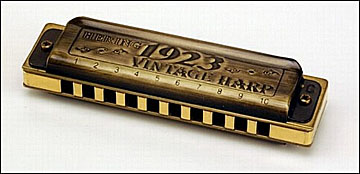
Most collectible harmonicas sell for $45 to $200. A small number go for $200 to $400, and there are just a few higher than that. As with all collectibles, their rarity, age and condition are important.

The Holy Grail of harmonica collecting is the Pipeolion by the C. Weiss Company, a 10-hole, 7-inch model with sounding pipes that fan out from the body.  About eight are known to exist.

Beginning harmonica collectors often have difficulty determining the age of a particular model.  In fact, they may be fooled into thinking a harmonica is older than it is because some companies, especially Hohner, stamped  a variety of 19th and 20th-century dates on the cover plates of most of their harmonicas. These don't indicate when the harmonica was made, but rather important dates in company history, such as the founding of the Hohner factories, or in some cases when the company won a prize, such as the Grand Prix Paris of 1917.

But reasonably accurate dating is possible by carefully examining both the external and internal structure of a harmonica. Some manufacturers stamped their instruments with registration numbers that can be tracked. Early harmonicas had reed plates made of lead, with nickel-plated covers of stamped steel or tin. Reeds and covers became brass in the late 1800s or early 1900s. Celluloid cover plates became common on some harmonicas in the early 1900s, and both bright metallic colors and a streamlined look clearly mark harmonicas made in the Art Deco 1920s and 1930s.

The material of the central body, or comb, of a harmonica evolved, as well. Early on, pear wood was the standard, but swelled and become rough with moisture over time. Very old instruments sometimes show the marks of whittling or trimming to alleviate this problem. Mahogany and other hardwoods proved more durable. And synthetic bodies, sometimes translucent, took over on less expensive models beginning in the 1950s.

 To read more articles on antiques, please visit my Web site.  And to stay up to the minute on antiques and collectibles, please join the other 17,000 readers by following my free online magazine, #TheAntiquesAlmanac.

Tuesday, August 29, 2017

The Shimmer of Marble Glass


QUESTION: I was browsing at a flea market recently and discovered a beautiful green glass vase that looked like marble. The dealer didn’t know anything about it and said she had picked it up at a garage sale. I’ve never seen anything like it. It had veins like marble and shimmered in the sunlight. I had to have it. And now that I do, I’d love to know more about it. Can you tell my anything about this marble glass? How old is it and where was it made?

ANSWER: It’s seems that you’ve purchased what’s commonly known as “malachite” glass. The mineral malachite is a green copper carbonate stone which occurs naturally and has concentric layers. It’s especially prevalent in Russia and was a favorite of the czars. The inventors of malachite glass intended it to simulate marble. Many 19th-century glassworks used the term and each created their own variation on this theme. Those items made of this type of glass from the former Czechoslovakia go by another name—Ingrid.

Ingrid is the name of a series of artistic pressed glass items created by Henry Schlevogt and named for his daughter. Henry was the son of Curt Schlevogt, who around 1900 founded a firm in Jablonec, Bohemia, to produce glass beads and buttons. His wife, Charlotte, was the daughter of Heinrich Hoffmann, the owner of a glass company that made and exported sculptures, beads and hollowware.

But Henry knew that the "beads and buttons" business was a difficult one because of the tough competition from so many companies in the area and from other countries. He wrote to his daughter, Ingrid, that knowledge he gained in other countries had led him to create items that were so beautiful that the price wouldn’t matter.

At the Spring Trade Fair in Leipzig in 1934, Schlevogt introduced a line of ornamental crystal sculptures, and the same year presented the line at the Chicago World's Fair. The Ingrid brand was born. And while it was Curt Schlevogt who designed most of the molds used to make the glass, it was Henry who knew how to promote their new line of glass. Ingrid was so well received at the Fair that the firm began producing it on a large scale.

Schlevogt reached out to designers working with the Wiener Werkstatte, including Franz Hagenauer, Ena Rottenberg, and Vally Wieselthier, and also to designers who worked for other major glass firms, such as Bruno Mauder, Eleon von Rommel, and Alexander Pfohl. The result was a complete line of ornamental sculptures, perfumes with figural daubers and/or impressed stoppers, liquor sets, toilet sets, devotional items, figurines, table ware, and vases.

Henry Schlevogt utilized the technology at the Riedel glassworks in Polubny, Czechoslovakia, to make this artistic, marbled, pressed glass. But just because his firm pressed the glass into molds, didn’t mean that it was of inferior quality. The glass, itself, was pure. Workers ground out the mold marks and frosted or polished the surfaces. They even engraved some of the details.

The most common items are those made of jade green and lapis blue marbled glass. The company’s 1939 catalog shows more than 200 crystal and another 80 jade/lapis items.

Schlevogt's crystal perfumes aren’t as easily identified. Some appear in the firm's catalogs, but the vast majority have been included in the broad category of Czechoslovakian glass in most listings. The designs for perfumes included bottles in various Art Deco shapes, and stoppers with relief-pressed nudes, couples, flowers, and butterflies.

By 1936, Schlevogt had business representatives in several European cities. When the Czechoslovak pavilion won a Grand Prize at the 1937 Paris World's Fair, Schlevogt's ornamental sculptures by Ena Rottenberg and Josef Bernhard were part of the reason. By 1940, the Schlevogt firm owned more than 1,300 glass molds, coin molds, and hand presses. It had its own cutting, sandblasting, and acid-etching workshops, but continued to have the glass shapes pressed at the Riedel firm.

The Czechoslovak government nationalized the glass industry after World War II and sentenced Henry Schlevogt to prison in Siberia. After his release in 1948, the Communist government in Czechoslovakia t banished him. He first went to Austria, then accepted an offer to manage the glassworks in Romilly-sur-Andelle, France. He sold this firm in 1972 and died in Paris in 1984.

Collectors need to be cautious, however, since the Ingrid molds have been used continuously. In addition, unauthorized versions of Ingrid items have been made from reverse-engineered molds.

To read more articles on antiques, please visit my Web site.  And to stay up to the minute on antiques and collectibles, please join the other 17,000 readers by following my free online magazine, #TheAntiquesAlmanac

Tuesday, August 22, 2017

Tea for Two or More


QUESTION: I recently started going to antique shows. I’m new to antique collecting and find the whole thing fascinating. On a trip to a recent local show, I saw several unusual boxes. The dealers told me they were tea caddies. All of them had locks. Can you tell me a little about these unique boxes? I’d love to collect them, but they seemed rather pricey.

ANSWER: Tea caddies are one of the more unique items available to antique collectors. They’re good to collect because they don’t take up too much room, but their age and quality can make them prohibitively expensive, especially for the beginning collector. Before discussing tea caddies, themselves, it’s important to know how the tea trade began and why each of the caddies had locks.

People have been drinking tea since 2737 BC, when, according to legend, a few leaves from a nearby tree blew into Chinese Emperor Shen Nung's pot of boiling water. Apparently, the Emperor took a sip of the  brew, only to discover that it was both delicious and refreshing.

Tea brewing and drinking evolved into a ritualistic exercise. During the Ming Dynasty from 1368 to 1644, people brewed the delicate leaves in vessels with lids in which they steeped them in boiled water. Early 17th-century Dutch and Portuguese silk and spice traders tried to introduce Chinese tea to Europe, but it took time to catch on. Even the English, known for their love of a "cuppa," waited until the mid-17th century before trying it. Since tea was expensive, only the aristocracy could afford to drink it.

People believed it was therapeutic as well as delicious. Asians had known the health benefits of tea for thousands of years. And even though Portugal and Holland imported tea 50 years ahead of England, tea remained a precious commodity, so people used it sparingly.

The first recorded sale of tea in England occurred in 1657. At first it was available only in apothecaries, coffee houses, snuff shops and through shops catering for ladies needs. However by the second half of the 18th century smuggled tea was so widely available, that even respectable people bought it illegally for less money.

William Pitt tried to address this problem in his Commutation Act of 1784, which reduced taxes on tea and halved its price. The legitimate imports quadrupled making tea more accessible to a wider section of society.

It wasn’t until the 1750s that tea caddies became a home style accessory. The word caddy derives from the Malay word "kati," meaning a measure of weight about 3/5 of a kilo. The 17th century tea containers were bottle shaped tea jars in china, glass, silver, enamel and straw-work covered metal.

Cabinetmakers began to make tea caddies out of wood in box form beginning in the late 1820s. The made the first ones of mahogany in the shape of small chests which contained three metal canisters. They generally came in two styles—simple and ornate.

Both styles shared certain characteristics. Both had handles on top and stood on either bracket feet or a plinth-style base. They had stepped lids and molding of some sort along the edges. Usually, these caddies had straight sides. The fancier tea caddies often had gilded brass mounts and feet. As time went on, cabinetmakers introduced new designs, woods and shapes to their caddies.

Tea caddies came in three sizes—single, double, and triple.

Single caddies could be square, polygonal, oval, or elliptical and sometimes  urn-shaped. Tops were mostly flat with sometimes a small loop handle or finial in the center. Escutcheons of inlaid ivory, bone or boxwood surrounded the keyhole. Inside they had a free standing lid. Sometimes, the tops were shaped like pyramids, continuing the proportions of the side panels.

Double caddies were usually oblong sometimes octagonal or oval. They had two lids, or two removable canisters with hinged tops. Some had one lid and a space for a glass bowl that people usually used for storing sugar. Others had a second bowl for mixing the blend of tea.

Triple caddies had either two lids, three lids, two canisters, three canisters or two lids or canisters flanking a space in the center for a glass bowl. They had rectangular shapes and rarely contained two glass jars and a bowl.

Cabinetmakers covered the more elaborate tea caddies in luxurious veneers. Cutting veneers by hand was a highly skilled job. The veneers were much thicker than those used today. This created a problem because moisture could be absorbed into the veneer’s edge. To solve this problem, cabinetmakers edged their caddies with strips of contrasting plain wood, usually holly or boxwood or in herringbone designs.

Caddies made of plainer mahogany often had marquetry decoration. Makers inserted per-made panels, mostly of oval shape, of marquetry or penwork enhanced marquetry, onto the box by cutting the veneer to the required shape. The most common designs were in the Neoclassical style of flora, urns, garlands, paterae, lyres, stylized baskets, birds and mythical beings.

To read more articles on antiques, please visit my Web site.  And to stay up to the minute on antiques and collectibles, please join the other 17,000 readers by following my free online magazine, #TheAntiquesAlmanac.


Tuesday, August 15, 2017

Shaken Not Stirred


QUESTION: A couple of years ago, I happened to be browsing in my local Goodwill Store and noticed an elegant cocktail shaker. Its chrome exterior glistened in the light of the florescent bulbs overhead. The price tag said $3. How could I resist? I couldn’t and didn’t. Now I have a small collection of this elegant barware. Since I’m not really a drinker, I don’t know much as mixed drinks, especially martinis. I’d like to know who made the first martini and how the cocktail shaker came into being. What can you tell me about these elegant items?

ANSWER: Cocktail shakers weren’t always this elegant. The first shakers were hollowed out gourds. Back in ancient Egypt and Mesopotamia they served to mix liquids together and as such were a practical accessory for books back then. But they lacked the style of 20th-century shakers.

Collectible cocktail shakers arrived just after the invention of the martini. However, there seems to be some controversy as to just when that happened.

It isn’t known for certain who first mixed and served the first martini. The best guess places this great event in late 19th-century America. There are several theories as to its origin. One  credits a bartender named Jerry Thomas at San Francisco's Occidental Hotel in the 1860s with mixing a special drink for a traveler bound for the nearby town of Martinez. But for some reason, Thomas didn’t include the recipe for a martini in America's first cocktail book, How to Mix Drinks, or The Bon Vivant's Companion, that he first published in 1862, until the 1887 edition.

There are those, however, who insist that the martini, consisting of equal parts of gin and dry vermouth, was a New York invention, probably first mixed at the Knickerbocker Hotel by bartender Martini di Arma di Taggia. But if both sweet and dry vermouth were used, then the honor could belong to William F. Mulhall, who served drinks of this sort at Hoffman House, also  in New York City, in the 1880s.

Ever since those first concoctions, martinis have been a stylish drink, appreciated not only for the kick they deliver, but also for the accessories used in their preparation and enjoyment. The first recipe calling for an accompanying olive can be traced to 1888, with the v-shaped martini cocktail glass appearing early in the 20th century. Bartenders who made early martinis  either stirred the liquors together or poured them from one glass to another to mingle them together.

By the time that Prohibition came to an end in 1933, people throughout the nation enjoyed drinking martinis. Often viewed as the drink of trendsetters and glamour seekers, martinis became associated with movie stars, including William Powell and Myrna Loy. People at the time saw martinis as very American, urbane, high-status, masculine, optimistic, and adult— a drink for the wealthy and the powerful, or those aiming for that status. 

Wealthy bon vivants of the 1920s shook theirs up in silver, while their less affluent counterparts turned to glass or nickel-plated models. By the following decade, mass- production made shakers a reality for those with fewer means, manufacturing the shakers in chrome-plated stainless steel.

Every maker of decorative home furnishings made cocktail shakers in the 1920s and 1930s, from Tiffany to aluminum manufacturers. While the Chase Chrome Company, Revere Brass and Copper, and Farber Brothers were leaders in the production of metal shakers, Hazel Atlas, Imperial, Duncan Miller, and Cambridge Glass made them of glass.

As the demand for barware grew in the 1930s, the designs became more varied. Makers produced sleek shakers from silver and silver-plate. Some even sported Bakelite handles and trim. The shakers themselves featured Art Deco designs, from airplanes to dirigibles, dumbbells to golf bags. Some even took on the shapes of modern buildings.

The golden age of cocktail shaker design came to an abrupt end with the beginning of World War II. Metals were earmarked for the production of armaments, and cocktail shakers no longer seemed a priority to a country at war.

While cocktail shakers can be found at garage sales, flea markets, and thrift shops for under $10, the better designed ones can sell for four or five figures.

To read more articles on antiques, please visit my Web site.  And to stay up to the minute on antiques and collectibles, please join the other 17,000 readers by following my free online magazine, #TheAntiquesAlmanac.

Monday, August 7, 2017

Periodicals of the Times


QUESTION: I have some old almanacs dating from the late 1700s and early 1800s. Can you tell me if these have any value, and if so, where might I sell them?

ANSWER: Unfortunately, just because something is old doesn’t make it valuable. This especially applies to old books and periodicals. Of course, different people have varied reasons for purchasing old periodicals such as these. Before we talk about their possible value, let’s take a look at how this type of printed matter got started.

During the Colonial period of the United States, people got their news from small one-sheet flyers and four-page newspapers. During the 1750s and 1760s, these often appeared only once a week, but as the population grew and towns developed, the daily newspaper came into existence. Printing technology also improved, allowing small publishers to print larger numbers of their papers.  Some of these early almanacs had a political bent. Such was the case for Porcupine’s Political Sensor, a short-lived monthly periodical succeeded by the daily newspaper The Porcupline’s Gazette, both published in Philadelphia by William Cobbett.

The Porcupine’s Gazette ran for 770 issues. Cobbett, the prolific, controversial and often contradictory, and anti-authoritarian writer, wrote under the pen-name of "Peter Porcupine." In 1796, a few years after he arrived in the United States, he began a monthly periodical called the Porcupine’s Political Censor, which he used to poke fun at his political opponents, usually those supporting a pro-French or Jeffersonian- Republican sentiment. Cobbett published his Censor until March 1797, when he replaced it with the Porcupine's Gazette. The first issue appeared on March 4, 1797, the day of John Adams’ inauguration. It had a subscription base of about 1,000 readers, which more than doubled within a few months. By November 1797, Cobbett was printing 3,000 copies a day.

Cobbett used the newspaper to support the Federalist party and to strike out against the French and their American supporters during the period of increased tensions between the United States and France. His contentious articles thrived in the politically charged atmosphere, though Cobbett often found himself on the receiving end of libel suits. He filled his newspaper with articles on national and local politics, foreign policy, news from Europe, and economics. Today, issues of the Gazette provide a rich source of information on daily life in Federal Philadelphia, with each issue containing commercial ads and notices, reports of arrivals in the port of Philadelphia, local prices for goods, advertisements for schools and doctors, and much more.

Another form of printed matter was the almanac. These were smaller in size and usually had a number of pages. They were the first periodicals and usually appeared less frequently, often just once a year. They contained articles of interest to the rural society, including information about the weather and farming techniques, plus some local stories.  A good example of this type of periodical was The Burlington Almanack, published by Isaac Collins.

Collins was a printer, publisher, bookseller and merchant in Colonial New Jersey. He’s most noted for this New Jersey Gazette and New Jersey Almanack, which followed his original one, The Burlington Almanack, a periodical for west-central New Jersey that ran from 1770 to 1777.

He was a firm believer in the freedom of the press and had even refused to reveal his source of a pseudonymous article even though the New Jersey legislative council demanded it.  He stood on his grounds as a faithful guardian of the liberty of the press and would not reveal his source unless the source gave him permission. He wrote many persuasive articles on the principle of freedom of the press

The Port Folio was another political periodical, published by Joseph Dennie,  an American author and journalist who was one of the foremost men of letters of the Federalist Era. He originally wrote for various periodicals in Massachusetts but in 1800 moved to Philadelphia to found the Port Folio, along with Philadelphia bookseller Asbury Dickens. Writing under the pseudonym Oliver Oldschool, Esq., Dennie composed and published in 1803 a scathing attack on Jeffersonian democracy, for which he was brought up on charges of seditious libel.

The last of your periodicals is The American Magazine, first published in the fall of 1757 and only running for 12 issues and a supplement.

While all of these periodicals are historically important, their condition is rather poor. Even more so than with other antiques, the condition of books and other printed matter is very important. Collectors seek out those in the very best condition. But that doesn’t say that no one would be interested in your items. All of them contain a wealth of information about life and culture, as well as the political climate, of the time. Historians and writers working on historical novels and history books would find their contents invaluable.

Selling your periodicals will be challenge, however. It will take a very special person to buy them and finding that person may be difficult.

To read more articles on antiques, please visit my Web site.  And to stay up to the minute on antiques and collectibles, please join the other 17,000 readers by following my free online magazine, #TheAntiquesAlmanac.