Showing posts with label pine. Show all posts

Monday, March 23, 2026

From Hunting Tools to Folk Art


QUESTION: My grandfather was an avid duck hunter. To help him catch his prey, he used decoys. Some of them were rather plain but one was fancier than the rest, painted in full color and detail. Since I always admired them, he left them to me when he passed away last year. I still admire them and would like to know a bit about decoy history. Also, I’d like to possibly add to the ones he left me. 

ANSWER: Collectible decoys run the gamut from fancy ones made by famous carvers to plainer ones made by hunters, themselves. It all depends on how much you can afford to spend and what type of decoy—there are several—you want to add to those from your grandfather. But before you consider purchasing any, it’s a good idea to consider their history.

Long before English colonists arrived in America, Native Americans used natural materials like mud, fowl carcasses, and bulrushes to create imitations of birds for hunting. Later, colonists began to copy this technique. These imitations, or decoys, successfully attracted live birds, which the hunters would then kill or capture.

But the decoys used by Native Americans weren’t the detailed ones known today. Instead, they were approximations of the form and plumage of the type of birds being hunted. Hunters would weave bullrush into the shape of a bird or form a duck out of clay and stretch the skins of previous kills over the form. Often, they would weave feathers into the decoy and painted the heads and necks to match the colors of type of birds being hunted.

When Europeans first colonized North America, wildfowl filled the skies. Unfortunately, early settlers watched the birds fly over but didn’t know how to get them. In Europe, fowling was a sport for the landed gentry. Since ordinary people didn't own land for hunting, they never learned how to do it. Their guns didn't have the range or accuracy to bag high-flying birds, plus they had no bird-dogs to fetch their kill. 

Colonists copied the Native American's hunting technique, placing groups of decoys, called "rigs," in estuaries and marshes to attract birds. They made their decoys in two basic forms—floaters and stickups. Floating decoys attracted swimming gamebirds, such as ducks, gulls, and swans.  

Typically, they carved the bodies from a solid piece of pine or cedar, then hollowed them out to make them lighter to carry. They carved the heads separately and attached them with wooden dowels. Once assembled, they painted the decoys to match the hunted fowl. They added weights to the bottom of each decoy so they would sit low in the water without flipping over. Hunters made stickups in similar fashion, but made them to represent shorebirds such as sandpiper with legs added and pushed into the muddy shore.

During the second half of the 19th century, demand for game birds and their feathers exploded. Railroads enabled the fowl to be shipped quickly to markets. Victorian millinery fashions made heavy use of decorative bird plumage. Manufacturers produced decoys by the thousands to meet the demand. There were no restrictions on hunting, and market hunters collectively killed thousands of birds a day.

The Migratory Bird Treaty Act of 1918, between the United States and Great Britain, acting on behalf of Canada, specifically protected migratory birds being decimated by over-hunting. It made it illegal to pursue, hunt, take, capture, kill, or sell migratory birds. Plus the statute didn’t discriminate between live or dead birds and/or bird parts including feathers, eggs and nests.

Consequently, hunters had little need for thousands of decoys. In 1928, the U.S. Congress banned the hunting of shorebirds  Decoy carvers could still make and sell their products anywhere, but there was little need for them. By the 1950s, mass-produced plastic decoys eliminated the need for hand-carved decoys. And by 1960, hand-carved hunting decoys had become a tool of the past. Decoy carving had instead become a folk art. Many hunters discarded or burned their wooden decoys, which at the time seemed worthless. 

To make a decoy, a carver would form the general shape of the decoy’s body using a hatchet and then fine-tune it with a long drawknife. He or she—a few carvers enlisted the help of their wives—would create the head separately from a smaller block of wood using an axe, rather than a hatchet. Then the carver would whittle the head down with a jackknife and attach it to the body using nails or long spikes.

Finally, the carver would sand, prime, and paint the finished decoy in natural colors to lure fowl effectively. By the time of the Civil War, this technique had matured almost to an art form.

While carvers produced different species of decoys—duck, geese, shorebirds, and more, shorebird decoys tend to be more scarce.

Commercial hunters often owned hundreds of decoys, which they would set out in large numbers to attract as many birds as possible. As sport hunting became more prominent among the wealthy, some carvers began making fewer decoys but of higher quality for this new clientele. Sport hunters wanted decoys that were beautiful, not just useful. Eventually, some carvers began making decoys for purely decorative reasons.

Decoys varied in style from region to region, as the environment and species of a given area dictated their design. Decoys in Maine, for example, were often tougher and more rugged in order to withstand the rough waters of the area. Even within regions, decoy designs varied. Some makers built theirs to float, which would attract large fowl like ducks and geese. 

Another group of decoys included stationary “stickups,” which stood on legs in the ground. Still others were two-dimensional profiles also designed as stickups. Some of these stickups stood nearly four feet tall, and floating decoys could be just as long.

Duck decoys weren’t seen as collectors’ items until the 1960s. The market first started with small, niche groups of enthusiasts throughout the United States in the 1950s and 1960s who began collecting antique duck decoys. When Hal Sorenson of Burlington, Iowa, published a magazine called “The Decoy Collector’s Guide,” everything began to change.

Unusual poses (sleeping, swimming, and feeding) are more difficult to render. Such decoys are generally more valuable.

The list of carvers seemed endless, but some names stood out above the rest. Perhaps the most famous practitioner was Elmer Crowel, a masterful carver and painter who lived in Cape Cod, Massachusetts. His decoys generally had carved wings and glass eyes, and he often used a rasp to imitate feathers on the back of his decoys’ heads and on their breasts. In 2000, a preening Canada goose that he carved sold at an auction for $684,500, the current world record for a decoy.

Other notable carvers included Lathrop T. Holmes, who used a limited but expressive palette of colors. “Gus” Wilson’s attention to detail was almost unrivaled, while many of the approximately 10,000 decoys in 50 years made by the Ward Brothers of Maryland were purely decorative. Charles Perdew and his wife, Edna, were a team—he carved and she painted. And Ken Anger perfected the technique of using a rasp to make his decoys look soft and realistic.

In addition to hand-carved decoys, some of the high-quality decoys produced in late-19th-century factories are also highly collectible. The main factories included Mason, Victor, Dodge, Stevens, Peterson, Evans, and Reynolds. Most of these factories used either a duplicating lathe, an assembly line, or both.

To read more articles on antiques, please visit the Antiques Articles section of my Web site.  And to stay up to the minute on antiques and collectibles, please join the over 50,000 readers by following my free online magazine, #TheAntiquesAlmanac. Learn more about "Colonial America" in the 2026 Winter Edition, online now. And to read daily posts about unique objects from the past and their histories, like the #Antiques and More Collection on Facebook.


Friday, September 13, 2024

Furniture on the March


QUESTION: My great grandfather was an officer in the British Army. He owned a chest that has been in our family ever since. The unusual thing about this chest is that it comes apart into several sections. We’ve always wondered why. What can you tell me about his chest?

ANSWER: With the rise and expansion of the British Empire in the 19th and 20th centuries the demand by the military for portable furniture increased. People referred to any furniture specifically designed to break down or fold for ease of travel as campaign furniture, specifically designed to be packed up and carried on the march. 

Campaign furniture has been used by traveling armies since the time of Julius Caesar, known to carry elaborate furnishings on his month-long military campaigns.

From foldable work chairs and desks to portable wooden mosaic floors, the interior of a Roman general’s tent would have been lavishly decorated. In order to simulate the comforts of home while on the move, those furnishings needed to be easy to pack up and transport. A prominent example was the curule seat, the traditional chair of Roman magistrates and field commanders, which could be folded up for transportation. But in modern times, it came to be associated with British Army officers, who sought to create a palatial feel while on the road. 

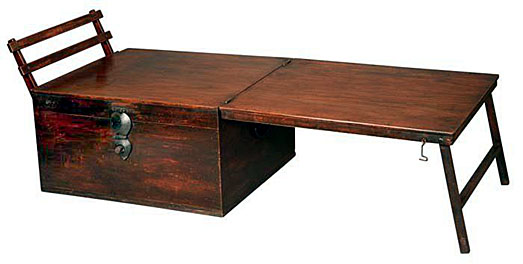
The most common type of campaign furniture was the chest of drawers, often referred to as a military chest or campaign chest. Most often made of mahogany, teak,  camphor, cedar, or pine, it broke down into two sections and had removable feet. This type of chest also had brass corners and strapwork to offer some protection while traveling. 

Some pieces of campaign furniture also had brass caps on the tops of legs, hinges in unusual places, protruding bolts, or X-frame legs depending on the functionality of the piece. However, some pieces were designed to be up to date and fashionable, looking much like domestic furniture. Ross and Company of Dublin were innovators of campaign furniture design and much of their work is obviously Victorian in period.

Campaign furniture came in a variety of forms, from portable beds to collapsible candlesticks. The numerous items specifically made for travel include a variety of types of bed from four poster or tent beds to chairs that would extend for sleeping; large dining tables, dining chairs, easy chairs, sofas and couches, chests of drawers, book cabinets, washstands, wardrobes, shelves, desks, mirrors, lanterns and candlesticks, canteens of silver, cooking equipment, toiletry equipment, and box-seats for chamber pots were all made to be portable.

There seemed no limit to the number of items an officer would take with him if he could afford to. How well his tent was outfitted could indicate his social standing.

By the mid-19th century the demand for campaign furniture encouraged manufacturers to invent unusual and interesting pieces that offered ease in dismantling or the compactness of their storage. Makers produced tables cleverly hinged to fold down into a box the size of a briefcase. Chess board boxes would contain tripod legs and a telescopic column to convert into a table. Chairs would break down to a minimal size, and often converted into a sedan-chair. The need for each piece to pack up quickly into a portable package with minimal complication drove innovation. By the late 19th century, over 85 manufacturers were producing campaign furniture in the London area alone. That period also saw campaign furniture growing increasingly unique and opulent.

Much of the early portable furniture would have been made to order. Soldiers often asked their local cabinet makers to take a domestic design and adapt it for travel. As demand grew, a number of well known designers, including Chippendale, Sheraton and Gillows, considered portable furniture. The end of the 18th century witnessed the rise of specialist makers, with Thomas Butler and Morgan & Sanders being the most recognized. The number of such specialists increased during the 19th century.

The beginning of the 20th century saw changes in the way armies conducted war. During the Boer War in South Africa, the British realized that their adversaries could move quickly and discovered that their own mobile units weren’t quite as mobile as they had thought. The early 20th century also saw the rise of the motor car which meant that travel was faster, making it less of a necessity for officers to equip themselves for a long journey, creating less of a demand for campaign furniture.

To read more articles on antiques, please visit the Antiques Articles section of my Web site.  And to stay up to the minute on antiques and collectibles, please join the over 30,000 readers by following my free online magazine, #TheAntiquesAlmanac. Learn more about "In the Good Ole Summertime" in the 2024 Summer Edition, online now. And to read daily posts about unique objects from the past and their histories, like the #Antiques and More Collection on Facebook.


Wednesday, September 21, 2022

Simplicity and Comfort Rolled into One


QUESTION: Some time ago, I bought a simple chair at a country estate auction. I love that chair but know very little about it. Someone told me that my chair was Shaker. Since I didn’t know much about the Shakers, I couldn’t tell. It just looked like a simple country chair. What can you tell me about my chair? 

ANSWER: Your chair certainly looks like a Shaker chair. But you need to know a bit about the Shakers to know for sure. 

Mother Ann Lee, who led the Shakers to America in 1774, had enough to do to get her sect organized. She began with a community in Albany, New York, and sent out missionaries to establish Shaker communities elsewhere in New England. But it wasn’t until Mother Lee had died and another generation of leadership took over the Shakers that the idea of producing items for sale as a way of supporting the communities came to be.

The Shakers attracted skilled cabinetmakers and craftsmen to their ranks, so it was a natural to use their skills to produce furniture for the communities. By this time, the Shakers were totally self-sustaining. In the early 19th century, the sect began to attract large numbers of people, mostly those who were discontent with society in general or were out of work. The communities offered security and food and lodging to people who might otherwise not have had it.

To support all these people became a major problem. So the elders of each community came up with ways to produce items for sale. Some made chairs, others produced seeds, clothing, especially wool capes, or took in mending and such. Many members were very creative and invented unique items such  as the electric washing machine. They were extremely organized as well, so mass-producing items like chairs wasn’t a problem.  

Those who called themselves Shakers—officially the United Society of Believers in Christ’s Second Appearing—eventually numbered over 17,000. As the number of communities, referred to by the Shakers as “families,” their furniture making flourished. At their peak of production, the Shakers produced chairs at more than 50 locations. From their first base in New York, the Shakers expanded their communities to Connecticut, Massachusetts, New Hampshire, Ohio, Indiana, Kentucky, and even Florida.

The Shakers made many of their chairs along straight and simple lines to be light weight, strong, easy to clean, and comfortable, not every piece of furniture made by Shaker hands is a design masterpiece: Some pieces were poorly crafted. Some were beautifully crafted but poorly proportioned. And some exhibit such bare-bones functionalism that they’re awkward and ugly. Often they’re barely distinguishable from country furniture of the same time and place. Indeed, unscrupulous dealers and auctioneers often promote plain country pieces as Shaker and sell for several times more than they would otherwise bring.

For use in their communities, the Shakers created three kinds of chairs—dining chairs, side chairs and rocking chairs. They designed the dining chairs with low backs so that they would stand clear under the table when not in use. Or they could be hung on a peg rail against the wall while someone cleaned the floor. And to make sure the chair seats stayed clean, they hung them upside down. 

Side chairs came in several different styles. A sister’s chair had a lower seat than the brother’s chair. The dining chairs had two back slats while the side chairs usually had four, all of which were slightly slanted for extra comfort.

As early as the 1820s, many communities began mass producing chairs for both community use and for sale. They used the same designs from the 1840s to the early 1900s. Chairs produced in the early 19th century were mostly for community use. But during the last quart of the century, the Shakers heavily marketed their chairs to the “Outside World.”

The chairs that the Shakers designed to be sold to the public were lean and severe and produced in huge quantities that ended up on back porches and summer cottages across America. Their popularity led other manufacturers to copy their look, and these pseudo "Shaker" chairs appear in quantity at country auctions and small antiques shows. Each of the endless variety of styles has its own Shaker-designated model number. Most were originally stained dark brown, and slat-backs predominate. 

Even though the largest Shaker chair didn’t weigh over 10 pounds and the smallest less than 5 pounds, both could support the weight of the largest person. 

Each community made their chairs a bit different from those of other communities, changing or adding little details. And while they all began with the same design template, each community’s craftsmen added their own touches for their community. For instance, many people believe that all Shaker chairs have tiny acorn finials and arms that terminate in mushroom-shaped turnings. Not so. It’s possible to tell which community made which chair by the shape of the finial alone. The back slats were also often slightly different. The Number 7 rockers, for example, have mushroom arms, four slats, and a shawl rail connecting the backposts that replaces the more common finials. The Shakers often attached a decal identifying the piece as Shaker to the back of a slat or leg. But pieces meant solely for use within the Shaker communities didn’t have decals. 

During the second half of the 19th century, the Shakers painted some of their chairs and woven brightly colored tapes into their seats. Often they combined colors, such as red and black and tan and maroon. Most colors, however, had more conservative names like Trustee Brown, Meetinghouse Blue, and Ministry Green.

In addition to the colorful tape, the Shakers also used cane, rush, and woven splint for their seats.

The woods used in chair construction varied according to the regional supply. But it was always of top quality and well cured. The most commonly used woods included walnut, cherry, butternut, and birds-eye maple, as well as pine and fruitwood if the others weren’t available.

Although for years Shaker chairs never sold for more than $500, now even the most common three-slat rockers bring $600 to $800 or more. Some even go as high as $1,700 to $2,200. 

Pieces from Kentucky, Ohio, and Indiana—often less austere, less "Shaker-looking" than their eastern counterparts—often have a Victorian feel and sometimes resemble local country furniture even more closely than classic eastern designs. .

The quality of many reproductions of Shaker chairs, made using the same tools and techniques, is often so good that they sell for as much as the originals.

For over a century, the creation of Shaker chairs was but a simple fulfilling of the motto of their faith, “Hands to work and hearts to God.”

To read more articles on antiques, please visit the Antiques Articles section of my Web site.  And to stay up to the minute on antiques and collectibles, please join the over 30,000 readers by following my free online magazine, #TheAntiquesAlmanac. Learn more about art glass in the 2022 Summer Edition, with the theme "Splendor in the Glass," online now. And to read daily posts about unique objects from the past and their histories, like the #Antiques and More Collection on Facebook.


Thursday, October 21, 2021

Knock on Wood


QUESTION: Before the pandemic, I had been going to antique shows, especially those that featured more primitive pieces. One of the things that caught my eye was the variety of wooden objects, utensils, and containers on display. I’ve always liked the look of natural wood and think that I might start a collection. But there were so many different items that I don’t know where to start. Can you help me/

ANSWER: As with any type of collection, it’s important to collect what you like. A way to narrow this down a bit might be to think about what you like to do. Are you an avid cook that delights in all sorts of kitchen gadgets? Do you like unique containers? Do you like to work with woodworking tools? Once you decide what category of wooden items you’d like to collect, then, and only then, should you begin purchasing items for your collection. Also, it’s important to set a budget limit—know what you can afford—especially in the beginning. 

Woodenware generally consists of utilitarian items used in the everyday lives of 18th- and 19th-century Americans. Also known as treenware, from the word "treen," an old usage for "from trees." Wood was the component in the construction of many necessities in early American life.

Craftsmen used pine, a soft wood that was east to work with, for making woodenware and boxes. Dough boxes, trenchers—large oval or rectangular serving or preparation bowls---and small boxes made of pine are a favorite of collectors. They also used cherry, poplar, and butternut but didn’t use oak very often.

Fine examples of handmade, early American burl bowls can reach prices of over $1,000. A burl is an abnormal growth on a tree, occurring on a limb or the trunk. It’s harder than the normal wood of the tree. Due to its hardness, woodworkers often burned the piece of burl in the center, than dug it out with tools, finishing it to form the implement. Heavy and tough, the burl exhibits a beautiful and unusual appearance, becoming even more attractive over time when a patina forms. Burl items seem less likely to crack over time than the items made from normal wood. Some larger wooden-ware items may exhibit a partial burl in their construction.

Probably the most common examples of woodenware found were made for food preparation and storage. Family members fashioned many of these items by hand, but unfortunately, they discarded them when they were no longer usable. Hand-planed and carved marks are sure signs of handcrafting, as is a non-symmetrical design. Bowls and dry measures are probably the most common pieces of early manufactured woodenware. But finding a maker’s name on an item is rare.

Butter molds and stamps are another type of woodenware often seen. However, plates, utensils, and cups are scarce and command higher prices. Though handmade bowls sell well, manufactured bowls from the late 1800s and early 1900s are more common and affordable. Most desirable of the manufactured bowls tend to be the unusually large examples, of over 18 inches in diameter.

Designed to hold all types of dry goods, such as flour, cornmeal and other grains, pantry boxes are popular among woodenware collectors. They especially like the covered oval boxes with finger lapping made by the Shakers. The finger lapping helped the boxes keep their shape over time. Makers usually painted many of these. Like most items, it these boxes retain their original paint, the value increases dramatically.

Woodenware also includes items, such as shovels, buckets, tools, and barrels, used in daily life. Coopers made staved buckets and barrels. They constructed the majority of them with iron bands, and occasionally used wood bands.

Grain shovels, hay forks and rakes were some old farm implements made from wood. 

Makers cut early pieces from one piece of wood, with the grip, handle and shovel constituting one piece. Later, they made them from two pieces, joined with nuts and bolts  Farm implements, like rakes, forks and shovels, received a good bit of hard use, and often exhibit wear and tear.

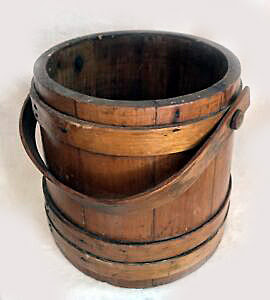
Staved firkins, or sugar buckets, used to hold sugar and other dry goods, and had a  cover, swing handle, and wood bands. Wider at the base than at the top, these buckets came in several sizes. Painted examples are the most valuable. Other utilitarian pieces included sap buckets, used for collecting sap for maple syrup making, kerosene buckets, and drop handle water pails.

Woodenware was made to be used, often strenuously and regularly. Wear and use marks not only add to the intrigue of the piece, but also help in differentiating it from a recently made one. Chop marks usually cover the interior of bowls and trenchers. Stir sticks will be stained from soups and jams. Farmers scraped grain shovels thousands of times against barn floors. In addition, the wood has probably been exposed to a wide range of weather conditions over the years, as people often stored pieces in barns, attics, and cellars. And because some of the earliest pieces of American-made woodenware were quite thin, cracks and breaks were inevitable.

Woodworkers used different finishes on various types of woodenware. They left kitchen implements natural, though the exteriors of bowls and trenchers may have been painted or stained. Cooking oils and fats gives them a smooth, rich patina. Constant handling of the item also contributed to a well-worn look. Original finishes and paints add to woodenware’s value. Old red, blue or mustard paints are especially desirable. 

To read more articles on antiques, please visit the Antiques Articles section of my Web site.  And to stay up to the minute on antiques and collectibles, please join the over 30,000 readers by following my free online magazine, #TheAntiquesAlmanac. Learn more about the Sears Catalogue and the items sold in it in "Sears' Book of Bargains" in the 2021 Fall Edition, online now. And to read daily posts about unique objects from the past and their histories, like the #Antiques and More Collection on Facebook.

Tuesday, February 19, 2019

Victorian Cottage Charm


QUESTION: I have a four-piece bedroom set that I believe may be Cottage Victorian. My mother bought it in a second hand store in Pennsylvania over 56 years ago, when I was around 8 years old. I still use it, but I have considered letting it go. But before I do anything with it, I want to learn more about it. Can you help?

ANSWER: Your bedroom set is in exceptionally good condition. It’s made in a style known as Cottage Victorian. What’s also interesting is that you have the entire set. And because it has been in constant Victorian furniture became popular in the United States, particularly along the East Coast, after the Civil War. Pieces began appearing in workshops and then homes of the wealthy in places like Martha's Vineyard, Cape May, and the Berkshires. But the popularity of these items didn’t remain exclusively with the upper class. As the middle class grew, equally elegant, but relatively reasonably priced versions began to appear in the homes of the nation’s growing work force, particularly in Pennsylvania and New England.

Homeowners purchased Victorian Cottage furniture in mostly bedroom "suites,"sold as coordinating groupings consisting of a double bed, a washstand, a dresser or vanity with an attached mirror, a small table, a straight chair and a rocker, and often a wardrobe. In this case, the set consists of four pieces. Cabinetmakers used pine or other inexpensive wood, then painted the entire piece with several layers of paint. The finished sets were colorful and whimsical. But not all sets were painted.

Cottage Victorian beds have high, decorated headboards, some as high as six feet. Finials and medallions constituted what little carving there was on most pieces. Most of the decoration took the form of painted flowers, fruit, and other plants, featuring a large painted bouquet-like medallion in a central panel on the headboard and a smaller, matching one on the foot-board.

Originally, local cabinetmakers, most of whom didn’t have any formal training, built these pieces from designs in pattern books, but towards the last two decades of the 19th century, manufacturers began to mass produce them. This set is one of those.

Those made by untrained cabinetmakers had decoration applied to them in a primitive, folk art sort of way. More expensive sets featured scenes of sailing ships or local wildlife. The same decorative motif appeared on all the pieces of a furniture suite. Those that were painted had a background color of tan, pale blue, pale green, pink, mustard yellow, and sometimes chocolate brown.


One of the biggest misconceptions was that Victorian homeowners loved the appearance of natural woods in their furnishings. That preference didn’t appear until the early 20th century. Cottage Victorian furniture was usually painted to brighten people’s dark, oil-lamp lit homes. As a result, many pieces of painted furniture have been stripped and finished to the often not so beautiful bare wood by well-meaning dealers and collectors.

Cabinetmakers fitted drawers and cabinet doors with wooden knobs instead of metal hardware. Even the boldly colored paint, didn’t have the look of value to it. Those pieces of Victorian Cottage furniture that have survived intact usually have a crackled surface from age-shrinkage, with flakes in spots due from dryness.

Manufacturers produced sets like this one as cheaply as possible. Made usually of pine with machine turned legs and finials, they featured as little structural decoration as possible. Even painted motifs were kept to a minimum to reduce the time it took to do them. Some even feature stenciled designs, so that the maker didn’t have to pay more for trained artists.

To the untrained eye, Victorian Cottage furniture looks as if it should be sold as junk or stripped to the bare wood. But this style of furniture has a charm all its own.

To read more articles on antiques, please visit the Antiques Article section of my Web site.  And to stay up to the minute on antiques and collectibles, please join the other 18,000 readers by following my free online magazine, #TheAntiquesAlmanac. Learn more about religious antiques in the special 2019 Winter Edition, "The Old West," online now. And to read daily posts about unique objects from the past and their histories, like the #Antiques & More Collection on Facebook.