Wednesday, July 31, 2019

The Sport of Kings


QUESTION: I love horses. When I was about 8 years old, my dad took me to a horse race. Ever since I’ve gone to horse races whenever I can, especially some of the famous ones like those if the Triple Crown. I especially like going to the Kentucky Derby. Over the years, I’ve collected an assortment of memorabilia from these races—tickets, programs, souvenirs. I’ve never seen anything written up about them, so I’m not sure if any of this stuff is even collectible. Can you tell me what might be collectible? I’d love to get serious and start a real collection.

ANSWER: True, there hasn’t been much written about horseracing collectibles. But as with any other sport or event, there’s certainly plenty of memorabilia floating around. While the items you have directly relate to specific races, there are others that relate to specific horses and race tracks. To understand just what treasures are out there, we have to go back to see how this all started.

The history of racing on mounted horses dates back to ancient Greece and Rome. But it was the English in the 12th century that began to selectively breed horses. In 1110, Henry I, King of England, imported an Arabian stallion from Spain, which he mated with English mares to breed horses suitable for warfare. As the breeding continued, the horses evolved into sleek racers.

Informal races between purebred mounts became popular, and in 1174, Smithfield Track, the first public racecourse built since Roman times, was constructed in London. The race horses eventually became bred out or “thoroughly bred.” Breeders realized that they couldn’t make them any better or faster through breeding and thus called them thoroughbreds. Thoroughbred racing subsequently became a favorite pastime of English nobility and was soon dubbed “the sport of kings.”


In 1730, a Virginia plantation owner imported a 21-year-old stallion named Bulle Rock. his arrival marked the beginning of many mares and stallions being imported to the colonies for the purpose of racing and breeding. Major horse centers developed in New York, Pennsylvania, Virginia, Maryland, and the Carolinas, and even presidential candidates caught the fever.

America's interest in horse racing continued unabated, and its passion for the pastime was evidenced by more than 750 lithographic prints produced by the firm of Currier & Ives. One of the most famous horses of the mid-19th century was Lexington, bred by Dr. Elisha Warfield, who historians consider the Father of the Kentucky Turf. Currier & Ives published the print “The Celebrated Horse Lexington by "Boston" out of Alice Carneal, circa 1855.”

During the Civil War, all horseracing stopped because both armies needed many horses for battle. But in 1867, the first running of the Belmont Stakes occurred in New York, and racing gradually spread south and west. The first Kentucky Derby happened in 1875, and in 1894 the Jockey Club, patterned after the British Jockey breeding of thoroughbred horses while maintaining high ethical standards in horse racing, was formed and incorporated in New York State. Although the Jockey Club brought order to the sport, by the turn of the 20th century a reformist sentiment that disapproved of gambling was gaining momentum. Many states made bookmaking illegal, and by 1908 only 25 American and six Canadian racetracks remained open. By 1913, racing had returned to Belmont Park, Elmont, New York, and although World War I diminished the amount of racing activity, the pastime continued.


From 1919 to 1920, a colt named Man o' War dominated the American horse racing scene, setting several American track records. He won by as much as 100 lengths, and lost only once in 21 starts in 1919 to a horse named Upset. After amassing nearly $250,000 in winnings, Man o' War’s owner retired him to stud in 1920. Racing enthusiasts consider Man o' War to be the greatest race horse that ever lived. Other  horses of the 20th century that have great collectiblity include Secretariat, Seabiscuit, Citation, and Kelso.

The book and subsequent film about Seabiscuit catapulted him to the spotlight and his collectibles soared in popularity. Today, the program from his final race at the 1940 Santa Anita Handicap sells for over $1,000.

In fact, racehorses are the primary influencer in the value of a racing program. Due to their age, Man o' War programs seldom turn up, and collectors should expect to pay $3,000 to $12,000 depending on the race and condition of the program. Although Secretariat progras are more common, they stilml. command high prices. His 2-year-old races in 1972 start at $300 and a mint, unused Kentucky Derby program will still fetch $250, even though thousands were printed.

Condition, age, rarity, race, and to a much lesser extent, the actual racecourse. Here, Kentucky Derby programs are winning by a wide margin. Pre-1929 Derby programs are extremely rare, and start at over $2,000. Programs from Triple Crown winning years— the year in which one horse wins the Kentucky Derby, the Preakness, and the Belmont Stakes—go for five times what the same program goes for if there’s no winner.

Unfortunately, betting, itself, is a high-stakes sport, resulting in a number of fake collectibles. One item that’s particularly prevalent in the fake market is the lapel pin, first produced in the 1980s. Each of the major races now has one of these little souvenirs. For instance, fake ones exist for the 1985 and 1986 Breeder’s Cup, but the lapel pins weren’t even made for it until 1988.

There’s an endless variety of authentic items available for those who love the sport. Posters, prints, weather vanes and sculptures depicting racehorses are always of interest, as are race-specific items, such as Kentucky Derby glasses. There are even elaborate board games, such as the Saratoga Sweepstakes Horse Racing Game with coin dispenser, six numbered horses and riders, and three iron gates and a finish line.

To read more articles on antiques, please visit the Antiques Article section of my Web site.  And to stay up to the minute on antiques and collectibles, please join the other 18,000 readers by following my free online magazine, #TheAntiquesAlmanac. Learn more about western antiques in the special 2019 Spring Edition, "Down to the Sea in Ships," online now. And to read daily posts about unique objects from the past and their histories, like the #Antiques & More Collection on Facebook.  

Thursday, July 25, 2019

How Much is This?


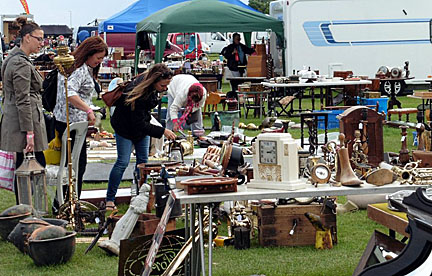
QUESTION:  I went to a favorite flea market of mine last Saturday. A lot of the same dealers display some of the same things they’ve had for sale for the last several years. While I don’t mind asking the price of an item, I got really annoyed when I heard a dealer quote another customer a lower price after he had quoted me a higher one for the same item a few minutes before. Is this becoming a regular practice or was it just this dealer?                              

ANSWER: While most dealers price their goods beforehand, a few don’t. Take Mr. I-Don’t-Price-Anything—Mr. Idpa for short. This rather smug dealer always seems to offer interesting items, none of which shows a price. So customers are forced to ask, “How much is this?”

There’s usually a slight pause as Mr. Idpa sizes up the customer.  By the way she’s dressed, perhaps he thinks she has a Lexus parked in the lot. If so, he’ll immediately raise his price by as much as 50 percent, even before he says anything.

This same dealer not only makes up prices as he goes along, but also refuses to bargain when asked for his best price. If he had been the only dealer doing this, customers would probably just pass by his space. But, unfortunately, he isn’t.


The following week, a new dealer set up next to Mr. Idpa, and like him, she hadn’t priced her goods. Another dealer she knew stopped by to say hello. “I don’t understand why no one has asked about my chairs,” she said. She had four well-used ladderback rushed chairs arranged out in front of her tables, each nicely draped with colorful silk scarves.

“Perhaps it’s because you don’t have any prices on your items,” her dealer friend replied.

Some dealers think prices might scare customers away. But they don’t. Customers need a place to start—a pricing reference point. When a customer approaches a dealer’s tables and sees something he or she likes, they look at its price to see if it’s within their budget.

Those who are serious collectors come to flea markets looking for items to add to their collections—for the right price, of course. If a dealer overprices an item, they’ll move on because they know more or less how much the item is worth. But if the price is within their range, they can begin a conversation with the dealer about it.

Once in a while, these non-pricing dealers forget to take the previous price tag off an item after they purchased it elsewhere. A customer comes along, immediately sees that price and approaches the dealer asking if he or she can do any better. After a little haggling, the customer walks away with the item, satisfied that they received a good price.

Buying antiques and collectibles is one thing, but selling them is quote another. Let’s see what happens when the shoe is on the other foot. Let’s take a look at the right way to price items, but before we do, let’s take a look at how not to.

Another dealer at a different flea market had a number of U.S. stamps for sale, all packaged in groups by age. Among his collection of stamps for sale was a little “stock” book with four manila pages with overlapping strips into which he had inserted an assortment of U.S. commemorative stamps. Stamp collectors use these little books to transport stamps to shows or to store a particular group for further study. The dealer had placed two stickers on the cover. One said “$3.50 net with book” while the other said “$4 postage.” At first glance, the $4 sticker stood out, so a customer might think that the stock book with stamps was $4.

Noticing the customer’s interest in the stock book, the dealer directs him a plastic bin with other packages of stamps. Not seeing anything that he wanted, the customer began leafing through the plastic pages of stamps in a looseleaf binder. The customer chose four of them, each with a sticker that said “$2 postage.” The dealer told the customer he could have the stock book filled with stamps and the two pages for $10. That seemed like a good price, so the customer said he would take the lot.

“That will be $13.50,” said the dealer.

“How can that be?” said the customer.

“Oh, $10 is the face value of the postage. The stock book is an additional $3.50,” replied the dealer. Needless to say, the customer walked away empty handed. The dealer wasn’t at all pleased. If he had put a definite price on each of his items, there wouldn’t have been a controversy. Instead, his stickers were vague and communicated the wrong message.

So what is the best way to price antiques and collectibles so they do sell? First, price isn’t the same as value—it’s usually about half that. So while many people use an antiques pricing guide to look up their items, what they’re really looking at is a value guide. The authors of these guides research the value of a particular item by checking the most current amounts the item fetched both at auctions and in shops, then they average the different amounts together.

The market value of an antique is what someone is willing to pay for it. And just because an items lists for $25, for example, doesn’t mean that a person will be able to charge the same amount for it, especially if they’re selling their item at a market entry-level venue like a yard sale or flea market. To sell successfully at these places, prices need to be lower than the guide amount.

Some antique and collectibles sellers take a shortcut and go directly to eBay to check prices. While prices are current there, many have been inflated by the “entertainment” factor. Many eBay shoppers look upon “winning” an auction much as they would winning a game of chance at a casino. At a regular auction, the highest bidder “buys’ the item while on eBay, the highest bidder “wins” the item. Generally, this drives final prices up.


However, the number of auctions has decreased on eBay in recent years while the number of “Buy It How” sales have increased. But even beyond using pricing guides and eBay to research prices, a seller should check the prices of similar items in the same sort of selling venues near them—that is at local garage sales and flea markets. This is known as pricing what the market will bear. Sellers can’t charge more than people are willing to pay in a particular area. Items just won’t sell, no matter how valuable they may be.

To read more articles on antiques, please visit the Antiques Article section of my Web site.  And to stay up to the minute on antiques and collectibles, please join the other 18,000 readers by following my free online magazine, #TheAntiquesAlmanac. Learn more about western antiques in the special 2019 Spring Edition, "Down to the Sea in Ships," online now. And to read daily posts about unique objects from the past and their histories, like the #Antiques & More Collection on Facebook.  


Wednesday, July 17, 2019

Having a Little Fun


QUESTION: My mother loved to collect pottery odds and ends. Just about every week she’d stop at the Thrift Store in town and find something or other. One of the quirkiest pieces she found was a cup and saucer with an abstract design painted on it in bright colors. The stamp on the bottom says it’s by Clarice Cliff. I never heard of this artist. Is she American? Was this a type of novelty pottery? Please tell me what you can about her and her work.

ANSWER: Clarice Cliff was an English ceramic artist who created works from1922 to 1963. She began working in the pottery industry when she was just 13. She first gilded pieces, adding gold lines on traditional wares. Once she mastered this she learned freehand painting at another pottery while studying art and sculpture at the Burslem School of Art in the evenings.


Cliff was ambitious and acquired skills in modeling figurines and vases, gilding, keeping pattern books and hand painting ware, including outlining, enameling, and banding while working as an apprentice. In the early 1920s the decorating manager Jack Walker brought Cliff to the attention of one of the pottery’s owners, Colley Shorter, who offered Cliff an apprenticeship.

By 1925, she had begun modeling stylized figures, people, ducks, as well as floral embossed Davenport ware. But in 1929 at the same time as she started the colorful cubist and landscape designs, Cliff's modeling took on a new style, influenced by European Art Deco designers Désny, Tétard Freres, Josef Hoffmann and others, that she had seen in design journals.

A.J. Wilkinson’s gave her a second apprenticeship in 1924 where she worked primarily as a “modeler” on conservative, Victorian-style ware,. Eventually, the owners of Wilkinson’s recognized her wide range of skills and, in 1927 gave her own studio at the adjoining Newport Pottery which they bought in 1920. Here, she decorated some of the old defective “ghost,” or white ware in her own freehand patterns. For these she used on-glaze enamel colors which enabled a brighter palette than underglaze colors.

Cliff creatively covered the imperfections in the pieces in simple patterns of triangles, in a style that she called “Bizarre.” The earliest examples had just a hand-painted mark,  usually in a rust colored paint—“Bizarre by Clarice Cliff,” sometimes with “Newport Pottery” added underneath. To everyone’s surprise, it was an immediate hit. Soon, a young painter named Gladys Scarlett began helping her with the ware. Soon the company produced a more professional “backstamp,” which displayed Cliff's facsimile signature and proclaimed "Hand painted Bizarre by Clarice Cliff, Newport Pottery England." Bizarre became an umbrella name for her entire pattern range. The pottery referred to the first pieces Cliff produced as “Original Bizarre.”

In March 1927, Colley Shorter, one of the pottery’s owners, sent Cliff to the Royal College of Art in Kensington, London, to study in March and May.


After her studies at the Royal College of Art, Cliff’s shapes from 1929 onwards had a more Art Deco influence, often angular and geometric. Abstract and cubist patterns appeared on these shapes, such as the 1929 Ravel on Cliff's Conical-shaped ware, which was an abstract leaf and flower pattern named after the composer. Ravel was another of Cliff's Bizarre shape ideas which became popular in the 1930s.

In 1928 Clarice produced a simple, hand painted pattern of Crocus flowers in orange, blue and purple, each flower being constructed with confident upward strokes. Then green leaves were added by holding the piece upside down and painting thin lines amongst the flowers. Being made from the individual brushstrokes, the Crocus pattern was clearly completely hand-painted, and the vibrant colours instantly attracted large sales.

Crocus was unusual in that it was produced on both tableware, tea and coffeeware, and 'fancies', novelty items made primarily as gift ware. The pattern had many colour variations, including Purple Crocus (1932) Blue Crocus (1935), Sungleam Crocus (1935) Spring Crocus. It was even produced after the war, the final pieces with Clarice Cliff marks being made in 1963, though Midwinter (who bought the factory) continued to paint it to order until as late as 1968.

By 1929, Cliff's team of decorators had grown to 70 young painters, mostly women which she nicknamed her “Bizarre girls.”


Clarice Cliff’s visually explosive designs of the 1920s and '30s—her defining period of creativity according to many collectors—were never exported from her Staffordshire-based studios to the United States. However, it’s Americans, including a number of celebrities, who are among the most competitive buyers of her way-out wares. Further outrageous patterns, vividly colored, such as Melon and Circle Tree appeared in 1930.

"Having a little fun at my work does not make me any less of an artist, and people who appreciate truly beautiful and original creations in pottery are not frightened by innocent tomfoolery," said Cliff in an interview.

To read more articles on antiques, please visit the Antiques Article section of my Web site.  And to stay up to the minute on antiques and collectibles, please join the other 18,000 readers by following my free online magazine, #TheAntiquesAlmanac. Learn more about western antiques in the special 2019 Spring Edition, "Down to the Sea in Ships," online now. And to read daily posts about unique objects from the past and their histories, like the #Antiques & More Collection on Facebook.