Wednesday, September 11, 2019

Calling Mr. Watson


QUESTION: I have one of those large black rotary telephones. Are those collectible now that we have such advanced technology?

ANSWER: You might want to consider holding on to your black phone for a while as they and many 20th-century models are coming into their own as collectibles.

“Mr. Watson, I need you.” When Alexander Graham Bell, the Scottish-born American inventor, scientist, and teacher of the deaf who’s most noted for his invention of the telephone in 1876,  spoke those now famous words to his colleague during the first telephone call on March 10, 1876, he had no idea where that would lead us. Today, many people have smart phones that do just about everything except make a cup of fresh coffee, although I suspect they’ll soon offer an “app” for that, although national brand coffee shops now have apps to order and pay for coffee right from a smartphone.

But what about all the phones that came before the smart ones. The long-time standard Western Electric 302 black rotary phone, introduced in 1937, is probably the most well known. Some people have game rooms in their homes in which they install a working pay phone. These workhorses, once owned by AT&T, were meant to last a long time.

When people think of old telephones, however, they usually imagine the Western Electric 102 candlestick-type phone, which went into use in 1927. Today, you can purchase an original for a modest $469 at the TelephonyMusuem online.

In the 1930s, Western Electric produced 202 model with an oval base, and later a sleeker handset, now selling for $289. Both the 102 and 202 models required a ringer, which customers had to buy separately. The large rotary 302 phone was the first to house the ringer in the phone. It was made from metal until World War II and sells for $199, then from plastic, selling for $169, until the late 1950s. Western Electric stamped the date of production on the base of its phones, so it’s easy to tell the age of the unit.
One of the big problems in collecting old phones is that many of the more unique ones have been reproduced, in working order, of course. While the originals sell for as much as $500, the reproductions sell for half that. Vintage phones from the 1920s can sell for as much as $2,000. So it’s important to watch for reproductions being sold as originals, especially on auction sites like eBay.

And don’t forget the sleek and colorful Princess phone, introduced in 1959, and the Trimline phone with dial in the handset, dating from 1965. Both replaced the stodgy desk phones of the past. Rotary dials continued to be offered even after touch-tone came out because phone companies charged an extra fee for touch-tone service and many customers didn't want to pay for it. The hotter the color of a Princess phone, the higher its price. The more common colors—pink, red, peach, and black—in touch or rotary sell for about $200 each while green, beige, white, aqua and yellow command prices of $150 and up.. The most common Princess phone in ivory sells for no more than $119. Most of the Princess phones require a $30 transformer to light the dial.

Collecting old phones isn’t difficult, but like clocks, you can have just so many in your house.

To read more articles on antiques, please visit the Antiques Article section of my Web site.  And to stay up to the minute on antiques and collectibles, please join the other 18,000 readers by following my free online magazine, #TheAntiquesAlmanac. Learn more about western antiques in the special 2019 Spring Edition, "Down to the Sea in Ships," online now. And to read daily posts about unique objects from the past and their histories, like the #Antiques & More Collection on Facebook.

Thursday, September 5, 2019

Do Old Stock Certificates Have Any Investment Value?


QUESTION: I’ve been unpacking some old boxes of things left to me by my father. In one of them I discovered some old stock certificates. Are they worthless or do they have investment value?

ANSWER: Old stock certificates, especially those from defunct companies, are only worth the paper that they’re printed on. But some, especially those with signatures from famous people, famous companies, or those involved in major scandals, can be worth quite a bit.

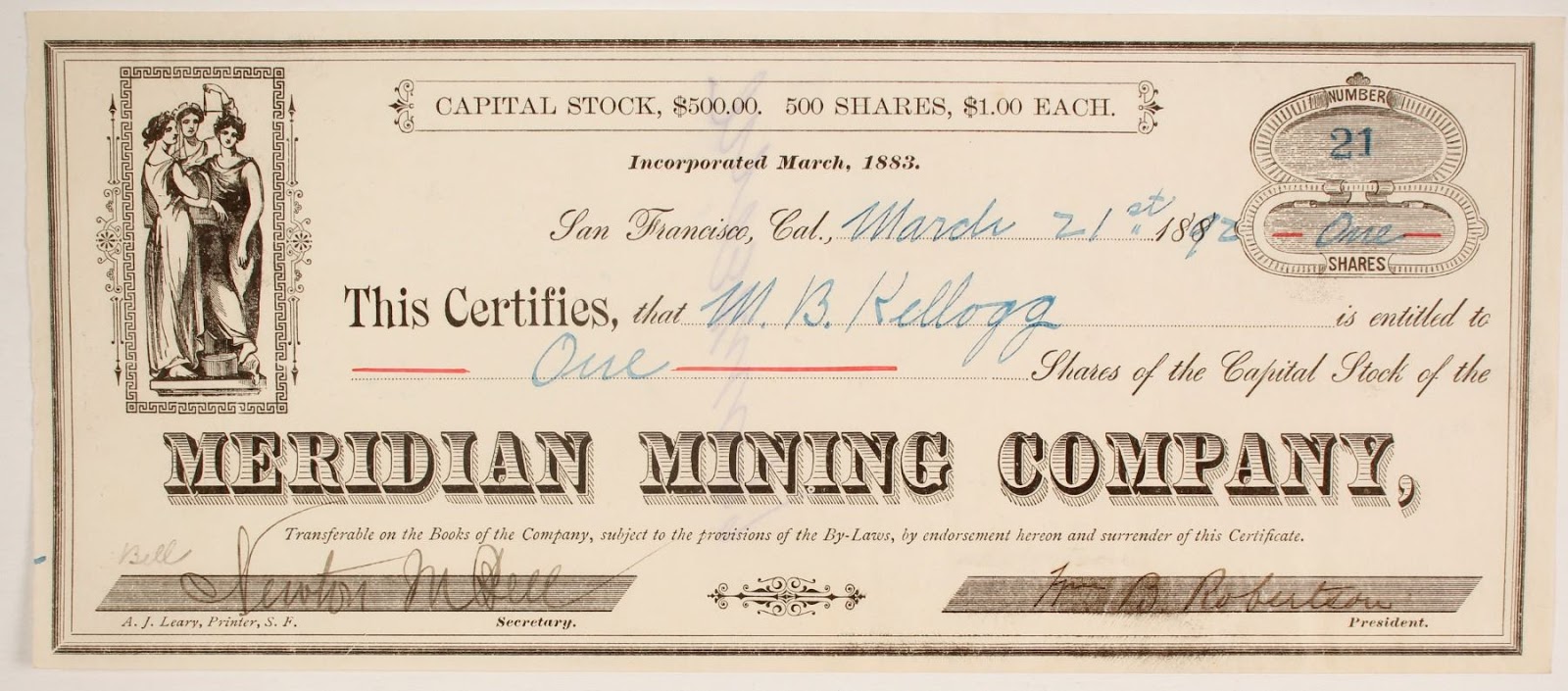
What exactly is a stock certificate? A stock certificate is the physical piece of paper representing ownership in a company and includes the number of shares owned, the date, an identification number, usually a corporate seal, and signatures. They’re larger than a standard letter-size piece of paper and many also have elaborate engraved designs to discourage counterfeiting.

Stocks represent partial ownership in a company. Today, most companies keep records of ownership electronically but some allow their shareholders to request a paper version. Each certificate starts out as a standard design to which the company adds the date of issue, identification number, and other information, including the printed signature of the chief executive. Executives on older certificates signed them in ink.


According to financial historians, partnership agreements dividing ownership into shares began to be used in northern Italy during the Middle Ages. However, these early shares were only intended to be in effect for a short time and only included a small group of people. Eventually the idea of shareholding spread to Belgium, and it’s believed the concept caught on in the trading town of Bruges. It was here that the idea of the stock exchange originated.

Eventually, shareholding took its next big step in Amsterdam in the early 17th century when the Dutch East India Company, formed to encourage trade in spices from Indonesia, issued shares that were tradable. The company compensated its shareholders well for their investments. In 1621, the market saw the issuance of shares for the Dutch West India Company, and much financial innovation ensued. Stock exchanges in the New World didn’t appear until 1790 in Philadelphia and then two years later in New York.

Collectors love canceled stock certificates because of their beautiful and elaborate graphics, as well as their connection to the historically significant companies they represent.

Old certificate values vary depending on their rarity, beauty, collector interest, historical importance, and  autographs, and industries for which they’re issued. Like all collectibles, supply and demand determine value.  Interesting pieces create a lot of demand while supplies vary.

What affects the market for stock certificates? Above all, general economic conditions tend to influence the prices of old stock certificates because many collectors of them are also involved in the real stock market. The law of supply and demand, as with other collectibles, governs this market as well. And Internet auctions have increased not only the availability of old stock certificates but their ease of purchase.

What determines the pricing of old stock certificates? Two important price boosters are signatures of important people and newly formed companies. For example, a Standard Oil Company certificate that John D. Rockefeller signed is worth nearly $8,000 today. Prices have leveled off in the last few years and finding rare certificates at reasonable prices has become a real challenge.


As with postage stamps, pricing can be affected by the rarity of a certificate—the rarer it is, the higher the price. An autograph of someone famous of the stock company with which he was involved also raises the price. Whether a stock certificate has ever been issued also influences it value, as does its age and decoration. The location and history of the company don’t affect the price of a certificate as much as, say, its condition and whether its cancelled or not.

However, no one point is always in control of a certificate’s value. For example, a Cody-Dyer Arizona Mining & Milling stock certificate, from a failed gold mine, signed by Buffalo Bill Cody currently is currently valued at approximately$4,000, while a rare unsigned Buffalo Bill's Wild West Co. stock certificate sold for $20,000 at auction in 2008.

As with any collectible, you should always collect stock certificates that are in excellent condition, have been issued, and are uncancelled. You should also collect certificates from industries that you’re familiar with or in which you’re interested. Early companies issued their stocks in small quantities, thus limiting the number of their certificates in today’s market. But there are lots out there for sale at low to reasonable prices.

To read more articles on antiques, please visit the Antiques Article section of my Web site.  And to stay up to the minute on antiques and collectibles, please join the other 18,000 readers by following my free online magazine, #TheAntiquesAlmanac. Learn more about western antiques in the special 2019 Spring Edition, "Down to the Sea in Ships," online now. And to read daily posts about unique objects from the past and their histories, like the #Antiques & More Collection on Facebook.


Wednesday, August 28, 2019

So You Want to Sell Antiques


QUESTION: I love antiques and have been collecting them for over 25 years and have so many things that my house is bursting at the seams. I’m ready to retire and have been thinking about opening my own antiques shop. Is this a good idea?

ANSWER: Lots of people dream about going into business for themselves. For some, it seems like a way out of the corporate rat race. For others, something to do in retirement. And while an antique shop may seem like an uncomplicated, quiet business to get into, it’s far from it. Remember, first and foremost, selling antiques is a business—with the emphasis on selling.

Many people think because they’ve been buying up a storm at yard sales and flea markets that they can turn around and sell what they’ve bought. Sure, you can put some items up on eBay to sell, but to be successful at selling on eBay, you first have to know what people are buying. Salesmanship is a skill that needs to be learned. And loving antiques has nothing to do with it. In fact, the worst reason to open an antique shop is that you love antiques and have been collecting them for years.

Most people come to consider opening their own antique shop by chance rather than on purpose. More often than not, their road to becoming their own boss begins at local yard or garage sales where they buy items that they like for their home. Eventually, they find themselves buying similar items and eventually begin a collection. This collection leads to exposure to other items which leads to another collection and, soon, another. By now their house is so full that in order to continue collecting, they must resort to selling some of the pieces that perhaps aren’t as good at their own yard or garage sale.

While yard and garage sales are where many antiques and collectibles enter the market, prices can be limited here because buyers are looking for bargains. So ambitious wannabee dealers seek out flea markets where they cannot only sell their items for higher prices but are also exposed to collectors seeking those items. Thus, begins the route to becoming an antiques dealer.

Unfortunately, that isn’t the best route, and it’s why most new dealers fail in their first year or two. While they may get a better feel for what to buy for their collections, they don’t learn to buy salable items—ones that their customers won’t be able to resist.

Many dealers begin by selling antiques part-time. Some of them use this as a sideline business to supplement their regular job. Others see it as a profitable hobby, a way to have the fun of working with antiques and make a little money on the side. A few dealers started out buying and selling antiques simply because their own collections became too large.

To have a successful antiques business, whether selling in a shop, at shows, flea markets, or online, you need to know what people want to buy and then buy those items. What usually happens is that the items people want to buy aren’t the ones they, as dealers, personally like to buy, so they avoid them. For instance, today, the trend is towards collecting items from the 1930s and 1940s. The wannabee dealer, however, likes Victorian antiques and can’t stand Art Deco.

Remember, selling antiques is a business. That means keeping records, learning how to display things so they sell, and developing a network of sources to buy new inventory. The IRS doesn’t look kindly on people who just play around.

For those who really wants to sell antiques, it’s best to start small. Renting a space at a small flea market is informal enough to provide exposure to customers, yet simple enough that prices remain reasonable. A table and a few boxes of items will go a long way. After selling at several of these small sales, often at church festivals or community days, the novice antiques dealer can move up to larger flea markets. If still successful, then the next step is to perhaps inquire about selling at an antiques coop. Here, a dealer rents a space in an indoor antiques mall and shares the duties of staffing the mall.


What many dealer wannabees don’t understand is that it’s vitally important to rotate their inventory. Antiquers tend to go back to the same flea markets or antique malls over and over. If they see the same items for sale each time they go, they’ll just walk right on by. The trick is to rearrange the items on sale and exchange some for new ones. By rotating items in and out of display, it looks like the dealer has more for sale.

Before attempting to open an antiques shop, a dealer needs to have been in the business for some time. As a shop owner, there are many more responsibilities, as well as higher rent to pay. So it’s imperative that he or she understand the business, have good contacts, and a ready market for their antiques.


The best way to develop an understanding of this business is to talk to dealers. Many will be willing to share their knowledge and expertise of the business.

To read more articles on antiques, please visit the Antiques Article section of my Web site.  And to stay up to the minute on antiques and collectibles, please join the other 18,000 readers by following my free online magazine, #TheAntiquesAlmanac. Learn more about western antiques in the special 2019 Spring Edition, "Down to the Sea in Ships," online now. And to read daily posts about unique objects from the past and their histories, like the #Antiques & More Collection on Facebook.