Friday, January 1, 2021

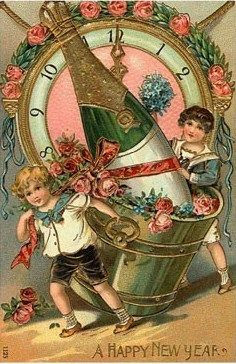
Greetings to the New Year


QUESTION: I collect greeting cards. And recently while searching for some old Christmas cards I could purchase for my collection, I discovered some New Year’s greeting cards. I never knew that people sent cards at New Years. What can you tell me about this tradition?

ANSWER: People in the 19th and early 20th centuries sent greeting cards for a number of holidays, including Thanksgiving, Easter, Christmas, and yes, New Years. That was before modern communications made it easier to pick up the phone—or today a cell phone—and speak directly with the another person. Also, mailing greeting cards was inexpensive since the U.S. Post Office hadn’t begun its wild ride of price increases. And today, it’s also possible to send a digital greeting card through the Internet. But let’s take a look back at how the practice of celebrating the New Year began.

New Year's Day, also simply called New Year's, is observed on January 1, the first day of the year on the modern Gregorian calendar as well as the Julian calendar. But it wasn’t always on that day.

In pre-Christian Rome under the Julian calendar, the day was dedicated to Janus, god of gateways and beginnings, for whom January is also named. As a date in the Gregorian calendar of Christendom, New Year's Day liturgically marked the Feast of the Naming and Circumcision of Jesus, which is still observed as such in the Anglican Church and Lutheran Church. The Roman Catholic Church celebrates on this day the Solemnity of Mary, Mother of God.

The practice of celebrating the New Year whenever that occurred dates back to 2,000 B.C.E. in Mesopotamia, when people celebrated it in mid-March around the time of the vernal equinox.

The early Roman calendar designated March 1 as the first day of the year. The calendar had just 10 months, beginning with March. That the new year once began with the month of March is still reflected in some of the names of the months. September through to December, the ninth through to the twelfth months of the Gregorian calendar, were originally positioned as the seventh through to the tenth months. Septem is Latin for "seven"; octo, "eight"; novem, "nine"; and decem, "ten.” Roman legend usually credited the second king Numa with the establishment of the two new months of Januarius and Februarius. These were first placed at the end of the year, but at some point came to be considered the first two months instead.

But in 567 C.E., the Council of Tours formally abolished January 1 as the beginning of the year. At various times and in various places throughout medieval Christian Europe, the new year was celebrated on December 25 in honor of the birth of Jesus, March 1 in the old Roman style, March25 in honor of Lady Day and the Feast of the Annunciation, and on the movable feast of Easter. No wonder the world seemed confused.

It was the custom among 7th-century pagans of Flanders and the Netherlands to exchange gifts on the first day of the new year. But as it turned out, European Christians also celebrated the new years on that date because  New Year's Day fell within the 12 days of the Christmas season in the Western Christian liturgical calendar.

However, it was the Japanese who originated the custom of sending written New Year’s greetings during the Heian Era, lasting from 794 to 1185 C.E. During that time, the nobility started to write such letters to people who lived too far away for the usual face-to-face New Year greetings.

Though the use of the Gregorian Calendar dates from 1582, when Pope Gregory XIII declared it to be used, it wasn’t until 1752 that Britain adopted it. 

The practice of sending New Year’s greeting cards probably didn’t begin in the United States until the 1870s. It took several decades before the practice of sending Christmas cards had caught on, and soon sending greetings for other holidays followed. 

The first cards were simple postcards, with a greeting printed on one side and a place for the receiver’s address on the other. But it wasn’t until 1915 that folded greeting cards, first created by Hallmark, began to appear.  

To read more articles on antiques, please visit the Antiques Articles section of my Web site.  And to stay up to the minute on antiques and collectibles, please join the over 30,000 readers by following my free online magazine, #TheAntiquesAlmanac. Learn more about "Celebrating an Olde Fashioned Holiday" in the 2020 Holiday Edition, online now. And to read daily posts about unique objects from the past and their histories, like the #Antiques and More Collection on Facebook.

Wednesday, December 23, 2020

And the Stockings Were Hung by the Chimney with Care


QUESTION: When I was a kid, I used to get so excited hanging a stocking with my name on it on our stair railing on Christmas Eve. We didn’t have a fireplace, so no mantel. When I became an adult, I used to see handmade Christmas stockings at church bizares and at yard sales and began to buy the ones I liked the most. Now I have quite a collection. During the holidays, I hang some of them on the railing of the stairway and other locations in my house. But how did this custom get started? Andare Christmas stockings good collectibles?

ANSWER: Before getting into the history of the Christmas stocking tradition, it’s important to put the collecting of these stockings in perspective. While people actively followed this tradition throughout the 19th century, children back then used their own stockings for the most part. At the height of the Victorian Era, specially made Christmas stockings began to appear, often made in crazy quilt designs using scraps of cloth leftover from making clothes.

But ordinary children’s stockings couldn’t hold much in the way of treats—perhaps some fruit and candies. It wasn’t until the mid-20th century that larger commercially made Christmas stockings began to appear in stores. However, those with a craftier bent still made their own stockings from felt or velvet, decorated with appliques. 

Though historical origins of the Christmas stocking exist, many historians believe its beginnings date back to a legend involving St. Nicholas. As he was passing through a village, he heard about a nobleman whose wife had recently died of an illness, leaving him and his three beautiful daughters in despair. Devastated by his wife's death, he squandered all his wealth and property, forcing him and his daughters to move into a lowly peasant’s cottage. His daughters, each ready to marry, couldn’t do so because he had no money to give them dowries.

St. Nicholas knew that the father would be too proud to accept money from him, so he came up with a plan to help him secretly. One night after the daughters had washed out their clothing, they hung their stockings over the fireplace to dry. That night St. Nicholas stopped by the cottage after the family had gone to bed. He peeked in the window and saw the daughters' stockings hanging by the fire. St. Nicholas reached into his pouch and felt three small sacks of gold. He threw one of them through the window, providing a dowry for the eldest girl, then provided dowries for the other two daughters in the same manner on subsequent evenings. 

On the third evening, the father caught Nicholas throwing the third sack of gold, and thanked him for his generosity. In some versions of this story, Nicholas throws the sacks of gold down the chimney, and they fall into each of the daughter's stockings, hanging to dry by the fire. This is a bit implausible since the stockings would have been hanging above the fire and not anywhere near the chimney opening in the fireplace.

Another interpretation of the stocking custom says that it began in Germany where children would place their boots, filled with carrots, straw, or sugar cubes, near the chimney for the flying horse of a legendary figure named Odin, who would reward the children for their kindness by replacing his horse Sleipnir's food with gifts or candy. 

After the adoption of Christianity in medieval times, Europeans began honoring St. Nicholas on December 6. In the Netherlands, Belgium, and Germany, folk traditions developed around the idea of St. Nicholas bringing treats to children on St. Nicholas's Eve. Parents told their children to leave their shoes by the fire on that evening so that the Nicholas could climb down the chimney and fill them up with fruit, nuts, and cookies. Some parents substituted stockings for shoes.

Eventually, people moved the tradition of giving gifts to children from St. Nicholas Day to Christmas. In Germany children began to hang stockings at end of their beds on Christmas Eve so that Christkindel or the Christ Child could fill them with treats as he voyaged from house to house. As Germans emigrated to America in the 19th century, they brought the stocking custom with them.

Part of the fun of collecting old and vintage Christmas stockings is in displaying them during the holidays. While most commercial stockings aren’t worth very much, collecting them is akin to collecting old Christmas balls. So as you hang your stocking on the fireplace mantel or the stairway, think of St. Nicholas. 

MERRY CHRISTMAS!

To read more articles on antiques, please visit the Antiques Articles section of my Web site.  And to stay up to the minute on antiques and collectibles, please join the over 30,000 readers by following my free online magazine, #TheAntiquesAlmanac. Learn more about "Celebrating an Olde Fashioned Holiday" in the 2020 Holiday Edition, online now. And to read daily posts about unique objects from the past and their histories, like the #Antiques and More Collection on Facebook.

Wednesday, December 16, 2020

The Lifelike Detail of Hutschenreuther Figurines


Two Boys and a Bird

QUESTION: I love to browse online antique auctions. Recently I came across an incredibly detailed figurine, the description said it was made by Hutschenreuther. I collect porcelain figurines but have never heard of this manufacturer. Can you tell me more about this company?

ANSWER: Although the Hutschenreuther name has been around for over 150 years, it’s’ less well known than say Meissen. Movement, grace and lifelike detail are what  make these porcelain figurines unique.

Carl Magnus Hutschenreuther’s father owned a porcelain painting studio, and his mother's family owned a porcelain factory, both located in Wallenorf, Germany. By the time he was 18 years old in 1812, Hutschenreuther was already dealing in porcelain he had decorated.

During a business trip to Hohenberg in northeastern Bavaria, Hutschenreuther discovered a clay that was excellent for making porcelain. He became so inspired that he decided to return to Hohenberg and apply for permission to build a porcelain factory.

But Hutschenreuther encountered nothing but red tape. The local government turned him down in 1816 because of the protests of neighboring hammer mills fearing an expected wood shortage. The following year he tried again to get permission to build a kiln, and the ministry turned his request down with no explanation. Finally, after nearly six years of constant efforts and continuous protests from neighboring communities,  Hutschenreuther, the town council granted a license to build a porcelain factory in Hohenberg in 1822.

Figure frog

 made china available to the general public for the first time. The firm began making pipe bowls, dolls heads, bathing dolls, and dinnerware with as few as 10 workers. By 1841 the company employed 55 workers, including Hitschenreuther's young sons Lorenz and Christian. 

After Carl Hutschenreuther's death in 1845, his wife, Johanna, took over the management of the factory. His talented Lorenz decided to go out on his own and open his own factory in the town of Selb. He put the new factory into operation with 511 emplyees in 1859.

The Lorenz and Carl Magnus Hutschenreuther porcelain factories' coexisted as two independent businesses. When Lorenz died in 1886, his sons Viktor and Hugen took over his company, enlarging the firm through the creation of new factories and the acquisition of others during the first part of the 19th century.

Woman Dancing

Lorenz’s sons created a special art division in the Seib factory in 1917. The driving force behind this expansion was Emil Mundel, director of the firm. In 1922, he brought the famous sculptor Carl Werner in as technical and artistic director of the art division. Later that year, sculptor Karl Totter began working there.  

Both Hutschenreuther factories became known for their high quality dinnerware and figurines. The Selb factory produced the highly prized Art Deco figurines at this time. Local artist Hans Achtziger’s designs shaped the look of the firm. In 1956 the young sculptor Gunther R. Granget joined the team. Trained by Tutter and Werner, he dedicated himself to the creation of animals and birds, and today his limited edition figurines bring prices in the thousands.

Art Deco Nude

The Hutschenreuther figures designed by Tutter and Werner exhibited some of the best features associated with the Art Deco movement—restrained elegance, suggestions of speed and movement and the spirit of freedom and optimism in the future. As nude and semi-nude figures of women were favorite artistic subjects of the time, the Hutschenreuther artists created a number of lovely female figurines. Their poses varied from languid, reclining positions to ones movement. Grace and speed were exhibited by I figures in various dance positions. 

Many figures can be found kneeling or standing with arms stretched forward to symbolize movement into the future. Some of the best known Hutschenreuther sculptures have the figure holding or standing on a ball. This globe or sphere indicated an .awareness and interest in the world at large. The ball was painted gold and made a striking contrast to the stark white or flesh tones of the figure.

Bremen Town Musicians

Animal sculptures were inspired from the world of nature and carefully re-searched. Birds, such as the American Eagle designed by Tutter, had such realistic detail one can almost believe the feathers are real. To create the magnificent swan group, Hans Achtziger spent intensive study of the characteristics and movement of live models. Members of the cat family, deer, gazelles and dogs projected the Art Deco image of speed, grace and sleekness. 

Cupids and children were popular subjects with Hutsehenreuther artists, the ' glowing white porcelain showing off the qualities of innocence and purity. The molds were meticulously formed to show the curls in a child's hair or the dimples in a chubby knee.

To read more articles on antiques, please visit the Antiques Articles section of my Web site.  And to stay up to the minute on antiques and collectibles, please join the over 30,000 readers by following my free online magazine, #TheAntiquesAlmanac. Learn more about the Retro style in the Fall 2020 Edition, online now. And to read daily posts about unique objects from the past and their histories, like the #Antiques and More Collection on Facebook.