Wednesday, March 8, 2023

A Juicy Solution


QUESTION: I was visiting my grandmother the other day and noticed that when she needed some lemon juice for a dish she was preparing, she pulled out a funny looking contraption, placed half a lemon on it, and pushed down on the lemon while turning it slowly. The juice from the lemon flowed into a grove at the bottom. She then poured the juice into her pan and continued cooking. What is this device called and did everyone use them back in the day?

ANSWER: Younger Americans think lemon juice comes from those cute plastic lemons---or from fancy and expensive electric stainless steel appliances that sit on their kitchen counter. Many have never had to squeeze juice by hand, but it wasn't so very long ago when that's exactly what everyone had to do in order to have the lemon juice for a dish or a refreshing glass of OJ. But instead of an electric appliance, people used a reamer.

The French made the earliest reamer, registered in 1767, of nickel silver and porcelain. First produced in Europe, reamers later appeared in the U.S. European reamers were  some of the finest ever created, including those produced by the finest china companies, such as Limoges, Royal Bayreuth, R.S. Prussia, and Meissen.

Though Charles L. Tiffany offered a reamer at his Tiffany and Company store in New York in the early 1880s, the first juice extractor patented in the U.S. was on May 30,1865. This was actually a wooden juice press.

The hand-held lemon squeezer created by George Cornford patented the first hand-held, clear glass lemon squeezer on August 19,1884, and it resembled a darning egg. 

Before the turn of the 20th century, more inventors patented designs for their own juice squeezers. R.E. Bristow of Rockford, IIlinios, registered "The Ideal" on January 31, 1888. John Easley of Manhattan registered a hand-cranked reamer on July 10, 1888, which was the first of his many patents until 1900. In fact, reamer designers of the early to mid 1880s created intricate mechanical designs culminating in the creation of a model that first cut the fruit in half and then extracted the juice.

But these were too sophisticated for the average user. By the late 1880s and early 1890s, designs reverted back to single-piece glass reamers. The registered patent designs of Thomas Curley, whose design was called, what else, the "Curley." Easley came out with a three-piece model, and the Holmes Company gave the world the “Holmes,” which was made of glass. Still the design that finally remained for years to come was Arthur Bennet’s “Lemon Squeezer,” patented on February 16, 1909.

This one brings to mind the classic juice reamer. Made of one piece of glass, the "Lemon Squeezer" had a pointed, grooved center for twisting the fruit on to remove its juice. The juice ran into the shallow dish below the reamer part. The "Lemon Squeezer" also had a handle to 'hold for pouring and a spout.

The first reamers or juicers were for extracting lemon juice for cooking or for flavoring, not necessarily for juicing oranges for making orange juice. Though oranges are available year round now, in 1900 they were exotic and expensive.

But that changed in 1907 when Sunkist, established as the trademark for the California Fruit Grower's oranges, appeared on the market. By 1916, Sunkist began offering glass reamers as a way to promote their oranges. But orange juicers and lemon juicers weren’t the same. Lemon juicers didn’t need a "bowl" or area on the juicer to hold a large amount of juice, but the orange reamers did, which brought about a major change in the style of reamers.

Sunkist was the leader in design changes. Besides offering reamers with "juice receptacles," many of the Sunkist reamers also had embossed lettering, spelling out "Sunkist Oranges and Lemons" or "Sunkist-California Fruit Grower's Exchange.” Sunkist vigorously promoted them through department and variety stores, grocery outlets and by mail-order. Sunkist continued to offer reamers, many made by the McKee Glass Company, until 1961.

By the 1920s and 1930s, reamers became more colorful with the introduction of Depression Glass. In 1922, the Fly Glass Company introduced Pearl Glass, and by 1925 reamers could be purchased in a variety of colors, from Vaseline glass to amber, pink, and emerald green glass. The Great Depression produced more glass reamers  than ever before or after.

There were other produced in the 1930s, including the 'Servitor," the "Handy Andy," and the "Jiffy Juicer."  Though china reamers had been produced in Europe years before, it wasn’t until 1927 when Goebel registered their German ceramics and chinaware in the U.S. Though Goebel didn't begin making ceramic juicers in the U.S. until the late 1920s, ceramic reamers had been produced in America from 1910 and continued through 1938. In fact, by the end of the 1930s, the production of colored glass reamers had declined. 

The end of the reamer era occurred in 1939 as frozen orange juice hit grocer’s freezers.  Today, glass and ceramic reamers are the most popular with collectors.

To read more articles on antiques, please visit the Antiques Articles section of my Web site.  And to stay up to the minute on antiques and collectibles, please join the over 30,000 readers by following my free online magazine, #TheAntiquesAlmanac. Learn more about "folk art" in the 2023 Winter Edition, online now. And to read daily posts about unique objects from the past and their histories, like the #Antiques and More Collection on Facebook.


Monday, February 27, 2023

The Classic Windsor Chair


QUESTION: We’ve had a Windsor chair in our family as far back as I can remember. I believe it belonged to my great-great grandmother. Today, I use it as a chair at my computer desk. What can you tell me about this chair?

ANSWER: You have a standard bow-back Windsor chair, the kind found in just about every upper class household in Colonial America. While most people consider them delicate antiques, they’re quite sturdy and have many uses. 

One of the most graceful and usable of all traditional chairs, the Windsor is also the most successful piece of furniture in American history. Its origins, however, are English, dating back to the turned and joined stools of 16th-Century England. The name probably derives from Windsor, where a prolific chairmaker  produced and sold the chairs in the 18th Century. He sent them down the Thames River to London where people referred to them as coming "up from Windsor."

Wheelwrights rather than cabinetmakers made Windsor chairs in England. They remained farmhouse or tavern furniture for a long time. But here in America, homeowners embraced the Windsor as a sort of all-around chair. They could be stored in a hallway and brought into any room that needed more seating when guests arrived. They could be easily carried. And they could be brought outdoors to provide seating on the lawn on hot summer days. Even the most prominent members of Colonial communities used them. George Washington seated his guests on the East portico of Mount Vernon in 30 Windsor chairs.

As a piece of furniture, the Windsor holds historical significance. Thomas Jefferson sat in a bow-back. writing-arm Windsor while composing the first draft of the Declaration of Independence in late June of 1776. And when Benjamin Franklin and other members of the Continental Congress voted to secede from the mother country on , July 1, 1776 in Independence Hall, they sat in bow-back Windsors.

There are eight different kinds of American Windsors, including the low-back, or Philadelphia Windsor, named for the city where a craftsman constructed the first Windsor in the colonies, the comb-back, fan-back, bow-back, loop-back, arch-back or New England armchair, rod-back, and arrow-back. Each had its distinct use. Windsor makers socketed all parts together except for the shaped arms of the fan-back, arrow-back, and rod-back chairs. On these, they doweled the inner ends of the arms or screwed them to the back uprights.

Windsor makers preferred pine, whitewood, and basswood for seats, hickory or ash for spindles, maple. yellow birch, or beech for turned legs. stretchers, and supports, and hickory, oak, ash, or beech for hoops. bows, or combs. And because of this, makers gave their Windsors several coats of dark green paint. In the 19th century, small factory workshops produced Windsors of pine and maple. And even to this day, craftsmen still use the same time-tested techniques for constructing reproduction Windsors. 

Most people are familiar with the low-back, barrel-shaped chairs used from the mid 19th to the early 20th century. These were actually descendants of the earliest low-back Windsor chairs made in America. However, these don’t usually appear in historical house museums from the Colonial period. Made from 1725 to1760, this Philadelphia style chair had blunt-arrow legs—turned legs with a cylindrical lower section and ball.

The comb back was the second type of Windsor chair made in the Colonies. The crest rail with its spindles resembled a wide-toothed comb, hence the name. In both England and America, the Windsor became known as the stick chair. The wide saddle seat is half round with a straight front. The deeply curved one-piece arm terminates in knuckled-curved ends and is supported at front by baluster-turned uprights. The back is formed of nine bulbous spindles that pass through the arms and extend upward into a wide comb with volute ends.

Fan-backs had tall spindles flanked by stiles and came in both armchair and side chair styles. 

Legend says that an archer’s bow influenced the design of the bow back Windsor. Realistically, it probably evolved from the comb back. Also known as the hoop-back or sack-back, this Windsor was the most commonly used in America and England from 1740 to 1800 because of its elliptical seat and seven tapered spindles that pierce a semi-circular arm rail and bowed top rail. 

During the 19th century, the Windsor chair had become more decorative, including those with arrow-shaped splats and paint-decorated 

To read more articles on antiques, please visit the Antiques Articles section of my Web site.  And to stay up to the minute on antiques and collectibles, please join the over 30,000 readers by following my free online magazine, #TheAntiquesAlmanac. Learn more about old-time winter objects in the 2022/2023 Winter Holiday Edition, with the theme "Winter Memories," online now. And to read daily posts about unique objects from the past and their histories, like the #Antiques and More Collection on Facebook.


Tuesday, February 14, 2023

A Spoonful of Love


QUESTION: There are many ways of saying “I love you,” but one of the most unusual is the love spoon. I recently saw several of these in antique shops while traveling through Wales. About all the dealers could tell me about them was that they were gifts of love from a suitor to his true love, a tradition that has existed in Wales for several centuries. I bought one to take home, even though it seemed to be overly priced. What can you tell me about Welsh love spoons?  

ANSWER: Rural lovers with their hearts set on a plain milkmaid would probably have been unable to buy a loving gift for Valentine’s Day back in the in the late 18th and 19th centuries. So they fashioned tokens of their love from whatever was close at hand, using whatever skills they had. Often these gifts might have been small personal items, such as knitting sheathes, stay busks and lace bobbins. But the gift that seemed to have stirred young girls’ hearts the most was the Welsh love spoon.

No one knows why the Welsh made these love spoons. However, there was an earlier tradition among Scandinavians of giving love spoons. However, today most people associate the love spoon with the Welsh.

So why give a spoon? For centuries the humble spoon was one of the most familiar of  household utensils. The practice of storing spoons fitting snugly together prompted people to give a romantic meaning to the word in the 18th century. The delightfully descriptive word “spoonways” eventually embraced the human desire to emulate the closeness of these spoons in bed. The Victorians went further and used the verb “to spoon” to describe courting. In fact, the phrase continued in use well into the 20th century with popular song writers who found it a useful for its ability to rhyme with words such words as moon, June, swoon, and honeymoon.

It’s difficult to be precise about the origins of love spoons. However, enough of them inscribed with a date survive to enable collectors to trace their styles. One of the earliest recorded dates to 1667.

Most of the spoons on the market today date from the late 18th and 19th centuries. Although generations of spoon carvers would have copied styles and designs, dating them is difficult. Those spoons with a broad, flat  pierced handle seem to come predominantly from North Wales, while those that display clumsy carving and a lack of proportion tend to come from Pembrokeshire. The lucky young girl who received one really didn’t care where it came from. 

What’s certain is that such prized possessions would have been displayed in a place of honor and no doubt the most eligible girls could acquire a small collection of these spoons before choosing their mates. The. infinite variety of styles and designs found in Welsh love spoons means that there are no two alike. Their great charm rests in what  they represent and the symbolism in the motifs that carvers used to create them.

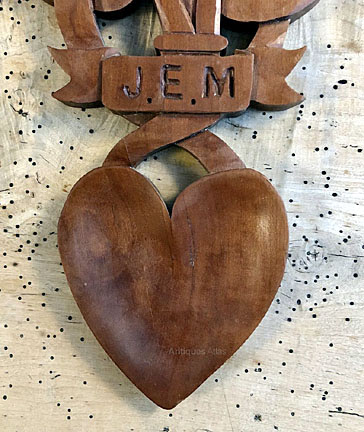
The most common of these motifs was naturally the heart. Two hearts intertwined contained even more obvious meaning. Closely associated with the heart, and almost as common, was a motif that looked like a fat comma. This symbol comes from the ancient Egyptians sign for the soul. Thus, hearts and commas declare heart and soul. Keyholes represent another powerful motif, offering a way into the suitor's heart. And even other spoons feature a small muse, and occasionally a key that really helped make the suitor’s feelings known. 

Still, the formalities had to be observed and many love spoons incorporate chains—not simply to demonstrate the skill of the carver—but to indicate the chains that bind a marriage. Shoes and boots also appear frequently on love spoons. The origin of this motif is a reference in the Bible in which the exchange of a shoe signified agreement of a marriage contract.

Carvers often incorporated initials with or without dates, and sometimes created spoons with a deeper, oblong window cutout into which a suitor inserted a piece of paper inscribed with names, dates, or drawings. Likewise, carvers sometimes added shards of broken mirrors. Why they did this is unclear. Perhaps it was to add a note of brightness to their spoon design, for none of these shards was large enough to serve as a looking glass. 

And while they used the most accessible and workable materials to carve their spoons, carvers used a variety of woods, especially easily carved sycamore and fruitwood. 

Occasionally, they created spoons from more exotic woods and materials, such as mahogany, ivory, or whalebone. This suggests that a sailor could have carved the spoon while on a voyage to a distant land. Sailors also seemed more likely to have embellished their spoons with inlaid colored wax or tiny brass pins. Some went even further and incorporated a lantern or cage containing free-moving balls into the handles, showing off the skill of the carver. 

The skill of some of these spoon makers was extraordinary, with the manual dexterity to produce even the most basic spoons. It’s also possible that an especially talented spoon carver could have made spoons for others in his area, accounting for the similarity of designs in spoons from certain places.

Because love spoons now fetch higher prices both in the United Kingdom, the United States and Canada, it would be easy to give them an importance beyond their humble origins. Essentially, love spoons were simply a declaration of love, pure and simple.  

To read more articles on antiques, please visit the Antiques Articles section of my Web site.  And to stay up to the minute on antiques and collectibles, please join the over 30,000 readers by following my free online magazine, #TheAntiquesAlmanac. Learn more about old-time winter objects in the 2022/2023 Winter Holiday Edition, with the theme "Winter Memories," online now. And to read daily posts about unique objects from the past and their histories, like the #Antiques and More Collection on Facebook.