Tuesday, September 26, 2017

Gotta Light?


QUESTION: I used to be a smoker, so I’ve owned my share of cigarette lighters. Most of the recent ones were of the disposable variety, but I had some earlier ones that were sort of unique. My favorite was one shaped like a little pistol.  Recently, I started seeing some of the earlier lighters for sale on eBay. I think I’d like to start a collection, but I’m not sure where to begin. Can you help me?

ANSWER: As with any collectible, the more you know about it before you start collecting, the better.

First invented in 1823 and improved in the 1880s, pocket cigarette lighters were as common as wallets by the beginning of the 20th century. Basic vintage lighters were mechanical, in which a spark from a flint striking a wheel ignited a wick or created a flame above a gas valve. Semi-automatic ones had a wheel which also opened the fuel-source cover while automatic ones had a push-button that did everything.

The first manual lighters, called strike lighters, worked like matches. Users would scratch a flint using a wand with a hard metal tip and an attached wick. The flint would create sparks to ignite a wick, soaked with flammable fluid. Lighters had become functional as well as artistic with the invention of the semiautomatic lighter in the 1920s, in which the user flipped open the lid and a flint wheel simultaneously spun and ignited the wick.

Louis Aronson, the founder of Ronson lighters, invented the automatic lighter in 1926.  It requires only the push of a button to create the flame, which stays lit as long as the user holds down the button. Early electric lighters, which were simple to use, worked like the lighters in classic cars: The lighter had a metal coil at its tip and plugged into a larger housing, which would heat the bottom enough to ignite a cigarette.

Through World War II, most lighters ran on Naptha, a petroleum mixture—after the war, compressed butane replaced it.

Vintage lighters vary from expensive, elegant objects made from precious metals to cheap novelty items, such as lighters that look like lipstick cases or little T.V. sets.

Cigarette lighters come in a vast variety of shapes and sizes, from tiny pocket-sized to huge table lighters. Most of the unusual-shaped lighters are Japanese models. They made some interesting shapes, mostly from 1950 through the 1970s. Lighters took the shapes of revolvers, pistols, derringers, and even machine guns.

Lighters came in lots of other shapes, such as animals and forms of transportation. Sports cars, train locomotives, motorcycles, yachts, submarines, helicopters, and airplanes are just some of the few.  But they also took the shapes of shoes, fire extinguishers, lighthousses, cameras, and even grenades.

Name an object and somebody probably designed a lighter that looks like it. One took the form of a working slot machine—by pulling the handle, it would light. Ronson even made a Kewpie doll lighter in 1916. And then there’s one shaped like a pool table with an attached pool cue. There was also a jukebox that played a tune while the user lit up.

The craze for vintage lighters has heated up in recent years. With the invention of disposable lighters and the drop in the market for more ornate models, plus fewer people smoking, vintage cigarette lighters have become an art form that will probably never be duplicated. As a beginning collector, you can spend as little or as much as you want. But more important is the story behind the lighter and the history that goes with it.

Collecting vintage lighters is affordable and they don’t take up much room, so they’re perfect for those living in smaller spaces.

To read more articles on antiques, please visit my Web site.  And to stay up to the minute on antiques and collectibles, please join the other 17,000 readers by following my free online magazine, #TheAntiquesAlmanac.

Monday, September 18, 2017

Thanks for the Memories


QUESTION: When I was a kid, my parents used to take me to Atlantic City every summer. As I get older, my memories of those summer vacations are but vague recollections. Recently, I was browsing a local antique cooperative and came across a small, red and white cream pitcher with “From Atlantic City 1897" scratched into what looks like a red coating. Immediately, memories from those vacations from my early childhood came flooding back, so I bought it. What can you tell me about my little pitcher?

ANSWER: Obviously, your little cream pitcher dates from before your birth, but like other souvenirs of summer destinations, it’s no less important. In fact, with the coming of the railroads in the early part of the 19th century and the Industrial Revolution, middle-class Victorians took to the road, rail, and sea in great numbers. Most of them wanted to take home a souvenir of their trip, and your little cream pitcher is one of them.

One of the most popular of these were ruby-stained glass toothpick holders, tumblers, goblets, creamers and pitchers inscribed with their name or the name of the destination and the date.

Glass souvenirs did not first appear at the Philadelphia Centennial in 1876, as many believe, but much earlier. Little keepsakes had always been made in blown glass. After less expensive pressed glass appeared in 1825, owners of fairs and expositions sought out these more profitable items. Manufacturers pressed plates and tumblers with pictures of an event. But it was the smaller items, such as match and toothpick holders and little creamers and mugs that became popular. Makers often stained these pieces red or amber and engraved them with an inscription. Glass makers created thousands of these small articles for the large expositions, such as the Chicago Fair in 1893, as well as the popular county fairs.

Staining a piece of glass involved painting an already-pressed piece of clear pattern glass with a ruby-colored stain and reheating it to 1000 degrees in a kiln which turned the coating bright red. Sometimes, makers used an amber stain to decorate their pressed pieces. Pieces stained in this fashion could then be engraved with flower or leaf bands or souvenir inscriptions.

Produced in the United States from 1880 to 1920, there were eventually thousands of patterns of pressed glass that flooded the market. Makers produced many of the more popular patterns in a variety of forms. They combined different colors of glass and different decorating techniques to produce hundreds of thousands of pieces of glass. People would purchase a piece of blank stained glass at an event or travel destination and could then have it personalized with their name and date.

One of the more popular ruby stained patterns, Button Arches, introduced originally around 1898, continued in production until the 1960s and 1970s. The design consisted of slightly overlapping pointed arches around the bottom edges and covers of pieces, each arch containing tightly packed "buttons."  Made in clear, clear with ruby staining and gold-stained bands, collectors can find this pattern highlighted with souvenir inscriptions.

In the late 1890s, the U.S. Glass Co., a consortium of smaller companies, came up with the idea of marketing a series of glass patterns named after the various states. Though a few of these patterns were new to the series, some were reissues of earlier lines reintroduced as part of this line. The state series continued through the turn-of-the-century. Most of the state patterns featured geometric or imitation cut-glass designs, but a few had a plant and flower motif that added to their appeal.  Obviously, state patterned glass was popular as a souvenir from the state for which the pattern was named.
   
To read more articles on antiques, please visit my Web site.  And to stay up to the minute on antiques and collectibles, please join the other 17,000 readers by following my free online magazine, #TheAntiquesAlmanac.

Tuesday, September 12, 2017

Harmonica Memories


QUESTION: When I was about six years old, my dad gave me a harmonica. It was just a basic one, nothing special, but to me, it was very special. This was back in the mid-1950s and westerns were big on T.V. I watched several of them in which the cowboys would be sitting around the campfire and one of them would invariably be playing a harmonica. I loved that harmonica. What can you tell me about the history of the harmonica? I’m considering starting a collection of them and would like to know what types to collect.

ANSWER: Most harmonica collectors can trace their interest in them to their childhood. Fathers would often give their sons a harmonica—it was definitely a boy thing—when they were five or six years old.

The modern harmonica was invented in Germany. However, the distinctive element that makes a harmonica play—the "free reed" that vibrates to produce a tone as wind passes over it—dates to a Chinese instrument called the sheng, supposedly invented by an empress named Nuwa around 3000 BC.

This deceptively simple, portable instrument—also known. as the mouth organ, mouth harp, pocket piano and tin sandwich—does span a surprisingly broad range of American culture. It has been said there are as many harmonicas in the United States as other kinds of musical instruments combined, although they aren’t as visible today as they once were.

Besides the standard versions, harmonicas have featured such entertainment icons as Mickey Mouse, Popeye, Roy Rogers, the Lone Ranger, to name a few, as well as sports figures such as Stan Musial, an avid harmonica player who published a song book. Novelty harmonicas come in a variety of shapes, including crabs, alligators, a cob of corn, even guns.

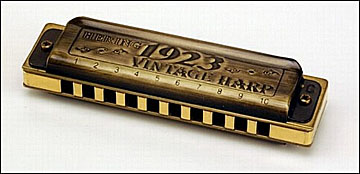
A basic Hohner Marine Band 10-hole diatonic harmonica can often be found for around $20-$25. One could collect just Marine Band models, in fact, for this name has been applied to at least 30 different models over more than 100 years, each available in a variety of keys and packaged in an array of boxes. Some collectors specialize in particular models.

Most collectible harmonicas sell for $45 to $200. A small number go for $200 to $400, and there are just a few higher than that. As with all collectibles, their rarity, age and condition are important.

The Holy Grail of harmonica collecting is the Pipeolion by the C. Weiss Company, a 10-hole, 7-inch model with sounding pipes that fan out from the body.  About eight are known to exist.

Beginning harmonica collectors often have difficulty determining the age of a particular model.  In fact, they may be fooled into thinking a harmonica is older than it is because some companies, especially Hohner, stamped  a variety of 19th and 20th-century dates on the cover plates of most of their harmonicas. These don't indicate when the harmonica was made, but rather important dates in company history, such as the founding of the Hohner factories, or in some cases when the company won a prize, such as the Grand Prix Paris of 1917.

But reasonably accurate dating is possible by carefully examining both the external and internal structure of a harmonica. Some manufacturers stamped their instruments with registration numbers that can be tracked. Early harmonicas had reed plates made of lead, with nickel-plated covers of stamped steel or tin. Reeds and covers became brass in the late 1800s or early 1900s. Celluloid cover plates became common on some harmonicas in the early 1900s, and both bright metallic colors and a streamlined look clearly mark harmonicas made in the Art Deco 1920s and 1930s.

The material of the central body, or comb, of a harmonica evolved, as well. Early on, pear wood was the standard, but swelled and become rough with moisture over time. Very old instruments sometimes show the marks of whittling or trimming to alleviate this problem. Mahogany and other hardwoods proved more durable. And synthetic bodies, sometimes translucent, took over on less expensive models beginning in the 1950s.

 To read more articles on antiques, please visit my Web site.  And to stay up to the minute on antiques and collectibles, please join the other 17,000 readers by following my free online magazine, #TheAntiquesAlmanac.

Tuesday, August 29, 2017

The Shimmer of Marble Glass


QUESTION: I was browsing at a flea market recently and discovered a beautiful green glass vase that looked like marble. The dealer didn’t know anything about it and said she had picked it up at a garage sale. I’ve never seen anything like it. It had veins like marble and shimmered in the sunlight. I had to have it. And now that I do, I’d love to know more about it. Can you tell my anything about this marble glass? How old is it and where was it made?

ANSWER: It’s seems that you’ve purchased what’s commonly known as “malachite” glass. The mineral malachite is a green copper carbonate stone which occurs naturally and has concentric layers. It’s especially prevalent in Russia and was a favorite of the czars. The inventors of malachite glass intended it to simulate marble. Many 19th-century glassworks used the term and each created their own variation on this theme. Those items made of this type of glass from the former Czechoslovakia go by another name—Ingrid.

Ingrid is the name of a series of artistic pressed glass items created by Henry Schlevogt and named for his daughter. Henry was the son of Curt Schlevogt, who around 1900 founded a firm in Jablonec, Bohemia, to produce glass beads and buttons. His wife, Charlotte, was the daughter of Heinrich Hoffmann, the owner of a glass company that made and exported sculptures, beads and hollowware.

But Henry knew that the "beads and buttons" business was a difficult one because of the tough competition from so many companies in the area and from other countries. He wrote to his daughter, Ingrid, that knowledge he gained in other countries had led him to create items that were so beautiful that the price wouldn’t matter.

At the Spring Trade Fair in Leipzig in 1934, Schlevogt introduced a line of ornamental crystal sculptures, and the same year presented the line at the Chicago World's Fair. The Ingrid brand was born. And while it was Curt Schlevogt who designed most of the molds used to make the glass, it was Henry who knew how to promote their new line of glass. Ingrid was so well received at the Fair that the firm began producing it on a large scale.

Schlevogt reached out to designers working with the Wiener Werkstatte, including Franz Hagenauer, Ena Rottenberg, and Vally Wieselthier, and also to designers who worked for other major glass firms, such as Bruno Mauder, Eleon von Rommel, and Alexander Pfohl. The result was a complete line of ornamental sculptures, perfumes with figural daubers and/or impressed stoppers, liquor sets, toilet sets, devotional items, figurines, table ware, and vases.

Henry Schlevogt utilized the technology at the Riedel glassworks in Polubny, Czechoslovakia, to make this artistic, marbled, pressed glass. But just because his firm pressed the glass into molds, didn’t mean that it was of inferior quality. The glass, itself, was pure. Workers ground out the mold marks and frosted or polished the surfaces. They even engraved some of the details.

The most common items are those made of jade green and lapis blue marbled glass. The company’s 1939 catalog shows more than 200 crystal and another 80 jade/lapis items.

Schlevogt's crystal perfumes aren’t as easily identified. Some appear in the firm's catalogs, but the vast majority have been included in the broad category of Czechoslovakian glass in most listings. The designs for perfumes included bottles in various Art Deco shapes, and stoppers with relief-pressed nudes, couples, flowers, and butterflies.

By 1936, Schlevogt had business representatives in several European cities. When the Czechoslovak pavilion won a Grand Prize at the 1937 Paris World's Fair, Schlevogt's ornamental sculptures by Ena Rottenberg and Josef Bernhard were part of the reason. By 1940, the Schlevogt firm owned more than 1,300 glass molds, coin molds, and hand presses. It had its own cutting, sandblasting, and acid-etching workshops, but continued to have the glass shapes pressed at the Riedel firm.

The Czechoslovak government nationalized the glass industry after World War II and sentenced Henry Schlevogt to prison in Siberia. After his release in 1948, the Communist government in Czechoslovakia t banished him. He first went to Austria, then accepted an offer to manage the glassworks in Romilly-sur-Andelle, France. He sold this firm in 1972 and died in Paris in 1984.

Collectors need to be cautious, however, since the Ingrid molds have been used continuously. In addition, unauthorized versions of Ingrid items have been made from reverse-engineered molds.

To read more articles on antiques, please visit my Web site.  And to stay up to the minute on antiques and collectibles, please join the other 17,000 readers by following my free online magazine, #TheAntiquesAlmanac