Thursday, May 14, 2020

The Symbol Out in Front


QUESTION: Way back when, my grandfather owned a 1925 Packard. My father says he loved that car, so much so that he removed the hood ornament from it and kept it as a souvenir when the car no longer worked, and he took it to the junkyard. He gave it to my father, who, in turn, gave it to me. It now sits proudly on my desk. It’s a real beauty, but is it worth anything or am I just being sentimental?

ANSWER: Your hood ornament, a Packard cormorant, is something very special. If you haven’t noticed, cars don’t come with them anymore. At the time your grandfather owned his car, hood ornaments were all the rage. Every car had one—some were extremely elaborate, more like works of art.

Collectors refer to these hood ornaments as automobile mascots. They began as radiator caps at the turn of the 20th century. Automakers added decorative touches to differentiate their vehicles from others during an era when there were 3,000 automobile manufacturers in the U.S. There are now only a handful.

Back when drivers had to negotiate muddy roads and weren’t sure if they’d get back home, St. Christopher, the patron saint of travelers, supposedly brought them good luck. He also protected them from robbers, who prayed on unsuspecting motorists. If you owned a car back then, you had some money.

Birds, chosen by auto makers to convey quick flight, became a common ornament theme. Packard chose a cormorant. Ford chose a quail for its Model A’s and Duesenberg, a stylized bird.

Many collectors consider the stork, used by European automaker Hispano-Suiza, to be the most distinctive and collectible. The stork commemorates French World War I ace Joseph Vuillemin, who had a stork painted on his airplane.

Some auto makers chose to use graceful ladies. Moon Motor Co., a now defunct St. Louis manufacturer, had the Greek goddess Diana on its cars to appeal to women. The glass lady hood ornaments crafted by Lalique before World War II are worth $1,000 to $10,000 depending on subject matter, condition and rarity.

Bugatti Royale selected an elephant balancing on a ball to demonstrate agility. World War I ace pilot Eddie Rickenbacher used an airplane mascot before his auto business failed in the 1920s. Chevrolets also sported airplanes in 1932. Designers for the Lincoln chose a greyhound mascot to dispel rumors that the auto was slow.

Some mascots invented in that time still exist, including Mercedes-Benz's three-point star and the Mack Truck bulldog. The height of hood ornament use was the 1920s and early '30s. By the mid-'30s, they began to fade as the Streamline Moderne movement, which emphasized aerodynamics and eschewed features that slowed down vehicles, caught on. But Mercedes held on to its mascot anyway. The company cared more about prestige than it did aerodynamics.

Other ornaments, such as Cadillac’s Lady, Rolls-Royce’s Flying Lady, Packard’s Cormorant, Desoto’s Explorer and Imperial wings, lasted through the 1950s, though they were much smaller than their  predecessors.

Collecting hood ornaments began in the 1940s when the owners of great old cars like the 1920s Rolls and Packards began scrapping them. Some of the first collectors visited junkyards, armed with screwdrivers and pliers, to hunt for mascots among the wrecks, for which they paid a dollar or so. Today, it’s almost impossible to find them in junkyards—junkyard owners know their value. Today, a typical Chevrolet mascot from the 1950s costs $100.

The AACA Museum in Hershey, Pennsylvania, has a tremendous collection of hood ornaments. Read more about it in #TheAntiquesAlmanac.

To read more articles on antiques, please visit the Antiques Articles section of my Web site.  And to stay up to the minute on antiques and collectibles, please join the over 30,000 readers by following my free online magazine, #TheAntiquesAlmanac. Learn more about  La Belle Epoque in the 2020 Spring Edition, online now. And to read daily posts about unique objects from the past and their histories, like the #Antiques and More Collection on Facebook.


Friday, May 8, 2020

Insurance and Antiques


QUESTION: I’ve been collecting antiques and such for a number of years. Do I need extra insurance or will my homeowner’s policy cover what I have?

ANSWER: As a collector, you’ll want to take care to see that your treasures are adequately insured. And even if you have coverage, you may find that coverage you purchased several years ago leaves you financially vulnerable today.

Most collectors use one of three types of insurance—that found in a standard homeowner's policy, special endorsements to that policy, or a "floater" policy for valuables such as art and antiques.

The policy that covers your home includes insurance for your personal property as well as the structure it's housed in, usually at 50 percent of the amount of coverage for the dwelling. This means that if you have insured your house for $150,000, your belongings are protected for up to $75,000.

Is this amount sufficient for your collection as well as all your other belongings? That all depends on what your collection contains. If you have a small collection of "collectibles" or less expensive items, the coverage in your homeowner's policy is probably enough. But keep in mind that standard policies usually fix limits on certain types of items such as currency, documents, silver, and jewelry. You should read your policy carefully to see if these limitations affect your collection.

The coverage in homeowner's policies is "unscheduled," that is, it groups all of your goods together rather than listing and valuing them separately. Should a theft or fire occur, it’s your responsibility to prove ownership and the value of the items in your collection. The insurance company will then calculate your losses on the "actual cash value" of those items, figuring in depreciation. If you collect anything other than certifiable antiques, complications can arise over the settlement.

Your insurance company may deem "old and worthless" items you consider “vintage.” So you should keep receipts and other records, especially for less expensive "collectibles" and offbeat items—be sure to print out receipts for anything you purchase at online auction sites. Though claims adjusters are usually on target, any documentation will help —the more the better.

Even if you decide to work within the limits of your standard homeowner policy, you may find that increased coverage is necessary. While that $75,000 may sound like a lot of insurance, you’d be surprised how quickly the normal, everyday contents of a house add up, leaving only partial coverage of your losses.

To remedy this problem, most policies offer the option of a special "endorsement" which allows for a higher percentage of personal property coverage for an additional fee. If you have a collection of any size or value, you’ll probably want to take inventory of your home's entire contents to see whether you should purchase such an endorsement.

Finally, you can also purchase a separate policy to cover valuables such as art, antiques, silver, and the like. And in this case, silver means Sterling, not plate. These policies, known generally as "floaters," cover "scheduled," or listed, items. Each item is listed separately with its own value, usually by means of a written professional appraisal. Those cheap or free online appraisals just won’t do. The benefits of floaters are that each items is covered for its full replacement value because ownership and value are  pre-established, In addition, most floaters will protect the collection against loss as well as theft, a benefit not available through most homeowner's policies.


The cost of such a floater will of course depend on where you live and what you’re insuring. Very portable items of recognizable value command the highest rates. For instance, the amount for jewelry is always higher than for artwork. Prices may also be lower if you store your collection—or part of it—in a safe or safety deposit box, or if your home has a security alarm system. If your collection is worth more than $50,000, your insurance company will probably insist that you install such a system.

To read more articles on antiques, please visit the Antiques Articles section of my Web site.  And to stay up to the minute on antiques and collectibles, please join the over 30,000 readers by following my free online magazine, #TheAntiquesAlmanac. Learn more about  La Belle Epoque in the 2020 Spring Edition, online now. And to read daily posts about unique objects from the past and their histories, like the #Antiques and More Collection on Facebook.


Wednesday, April 29, 2020

The Magic of Oriental Carpets


QUESTION: My great grandmother left me a beautiful Oriental carpet runner. My grandmother said it is quite old, but I’m not sure by how much.  What can you tell me about antique Oriental carpets? I have no idea about its origins, pattern, and such.

ANSWER: What most people classify as Oriental carpets are actually Persian (now Iranian) or Turkish carpets. Originally made to cover the sand in the tents of nomads and to kneel on when saying daily prayers, these beautiful floor coverings have a long history.

Oriental carpets have been highly prized in the West since their first appearance in Venice in the 13th century. By the 18th century they were common in wealthier households. But relative demand was fairly small, so the production of carpets declined. During the 19th century, trade routes improved, contact with the Orient increased, and the Western obsession with the exotic grew. So Persian weavers produced great quantities of carpets for export.

Carpet-weaving is an integral part of Iranian culture and art and dates back to ancient Persia. Weavers from other countries copied the designs of Persian carpets, but Persia produced 75 percent of the world's woven carpets.

Generally, Persian carpets can be divided into three groups—Farsh/Qa-li, any carpet greater than 6×4 feet, Qa-licheh, sized 6×4 feet and smaller), and nomadic carpets known as Gelim including Zilu, meaning "rough carpet," mostly for use in tents.

Wool is the most common material for carpets but cotton is frequently used for the foundation of city and workshop carpets. There are a wide variety in types of wool used for weaving Oriental carpets, including . Kork wool, Manchester wool, and in some cases even camel hair wool.

Persian rugs have both a layout and a design which in general include one or more motifs, so it’s not unusual to find more than one motif in a single rug. The original designs act as the main pattern and the derivatives as the sub patterns. Rug experts have identified 19 pattern groups---historic monuments and Islamic buildings, Shah Abbassi patterns, spiral patterns, all-over patterns, derivative patterns, interconnected patterns, paisley patterns, tree patterns, Turkoman patterns, hunting ground patterns, panel patterns, European flower patterns, vase patterns, intertwined fish patterns, Mehrab patterns, striped patterns, geometric patterns, tribal patterns, and composites. The most common motifs include Boteh, Gul, Herati, Mina-Khani, Rosette, Shah Abbasi, Azari Kharchang, and Islimi Floral.

Persian rugs are typically laid out using one of four patterns—all-over, central medallion, compartment and one-sided. So a rug’s design can be described in terms of the manner in which it organizes the field of the rug. One basic design may serve the entire field, or the surface may be covered by a pattern of repeating figures. In areas using long-established local designs. the weaver often works from memory, with the patterns passed on within the family.

Weavers often tailored the dimensions of their carpets to suit Western needs. They produced a disproportionate number of runners—long narrow rugs originally designed to cover the sides of rooms or tents since these had special appeal to Westerners. Even so, the standards remained the same. The major carpet-weaving centers—Persia, Turkey and the Caucasus—continued to use traditional motifs and techniques, maintaining the carpets’ regional integrity and originality.

While carpets made before 1800 are extremely expensive, the antique carpet market offers some excellent buys for the beginning collector. High quality runners generally cost between $1,500 and $15,000, depending on overall design, pliability, date, and type and number of knots.

Edgar Allan Poe once said, “A judge at common law may be an ordinary man; a good judge of carpets must be a genius.” And as hard as they are to judge, they’re certainly easy to enjoy.

To read more articles on antiques, please visit the Antiques Articles section of my Web site.  And to stay up to the minute on antiques and collectibles, please join the over 30,000 readers by following my free online magazine, #TheAntiquesAlmanac. Learn more about  the Industrial Age n the 2020 Winter Edition, "The Wonders of the Industrial Age," online now. And to read daily posts about unique objects from the past and their histories, like the #Antiques and More Collection on Facebook.


Wednesday, April 22, 2020

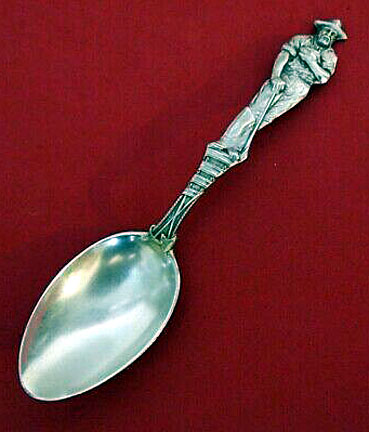
Spoon Mementos


QUESTION: My mother loved to collect souvenir spoons. She had over 100 of them. She recently died and now I have these spoons. One of them is particularly strange. It’s a sterling silver spoon with the trademark of a witch riding a broomstick on the back. Was this one produced to celebrate Halloween? And when did people start collecting souvenir spoons?

ANSWER: Sterling silver souvenir spoons are great mementos of an earlier era. As George B. James Jr. wrote in his catalog, Souvenir Spoons, published in 1891, "Many a legend, which has long been forgotten in the town of its origin, many a beautiful story which has long since been lost, have been happily brought to mind, and tradition honored by its incorporation in the souvenir spoon."

Antiques historians believe the first souvenir spoons appeared in Europe and were modeled after the silver Apostle spoons, produced in the late 16th century as religious souvenirs. In those early times, when a person wanted a portable security it had to be either silver, gold, or jewels. Spoons were practical and portable, but, unfortunately, when melted down served as ready currency.

Some of the most skilled 19th century and early 20th-century silversmiths made souvenir spoons, commemorating everything from world fairs to cities to historical figures, Biblical characters, and even the witches of Salem, Massachusetts.

In the late 19th century, the Gorham Manufacturing Company produced a group of Apostle spoons in the United States that now sell for $125 to $175 each. The trademark found on these sterling silver pieces manufactured from 1848 to 1865 shows a lion facing left, an anchor, and a "G."

Often souvenir spoons were the first gifts given to babies by their godparents at christenings. The idea began in the Middle Ages—a child no sooner learned to feed himself or herself, use a spoon, than he or she began to acquire a knowledge of Scripture and ecclesiastical history.

In 1887, as souvenir spoons became the fad in European cities, Daniel Low, of Salem, Massachusetts, made a trip to Europe where he purchased spoons from skilled craftsmen. From these, he conceived the idea of a spoon embodying the traditions and legends of Salem. His son, Seth F low, designed the first "witch" spoon. Its handle had the figure of a witch and the word "Salem.”

The first witch spoon spawned the souvenir spoon craze of the late 19th-century in the United States. It was the first to be made in this country from a special die, of a design suggestive of some particular place, and it has since become the most celebrated of the souvenir spoons.

Victorian women proudly displayed their souvenir spoons when serving tea, after-dinner coffee, and other beverages. They often used them with their good silver and china, especially at holiday celebrations.  Souvenir spoons also showed off all the places they had been.


Students in the early 20th century were often given souvenir spoons featuring their alma mater. Many of these graduation spoons had a male or female figures in graduation garb on their handles.  Others had handles decorated with pens, books, and globes.

The souvenir spoon craze moved west with the settlers. Most western towns used sterling silver spoons to advertise their assets. One of the biggest producers of these spoons was Joseph Mayer & Bros. in Seattle. The Mayers company had been in business as the Empire Jewelry Company in the East, but, when it moved west, it changed its name to Joseph Mayer & Bros.

G.A. Schuman, who became manager was a designer and toolmaker who had experience with Gorham, Whiting and Tiffany. In addition to souvenir spoons, the Mayer firm also made jewelry and several patterns of flatware. One of Mayer's special designs was a commemorative spoon for Butte, Montana, with a miner forming the handle. Another carried an ostrich engraved in its bowl along with the words. "Los Angeles" and the figure of a woman picking fruit forming the handle.

Both of the above spoons carry the Mayer's trademark of a crossed miner's pick and shovel above a rising sun. This mark originated with two of Joseph Mayer's younger brothers, who went to the Yukon where they opened a jewelry store instead of staking gold claims.

By 1909, Joseph Mayer & Bros. employed 100 craftsmen who manufactured souvenir spoons, along with sterling flatware and jewelry related items. The Mayers stamped their trademark on everything they made. In 1938 Joseph Mayer& Bros. became the El.Towle Manufacturing Co.

Mayer produced a lot of silver souvenir spoons because the process they used was mechanized, so it didn't cost much to produce each item. However, many pieces are skillfully engraved. Because so many were made and are still available today, they’re a popular collectible valued from under $20 to several hundred dollars.

Early souvenir spoons had the word “sterling” along with a trademark identifying its maker at the base of the spoon handle.

To read more articles on antiques, please visit the Antiques Articles section of my Web site.  And to stay up to the minute on antiques and collectibles, please join the over 30,000 readers by following my free online magazine, #TheAntiquesAlmanac. Learn more about  the Industrial Age n the 2020 Winter Edition, "The Wonders of the Industrial Age," online now. And to read daily posts about unique objects from the past and their histories, like the #Antiques and More Collection on Facebook.