Thursday, March 3, 2022

Pottery with a New Orleans Flavor


QUESTION: I’ve always liked Arts and Crafts pottery. I understand that women made and decorated some of the different types of that pottery. One particular type that I’ve admired is Newcomb pottery. What can you tell me about it and the women who created it?

ANSWER: The years from the mid-1890s to just before World War I witnessed a progressive movement that affected not only the arts but the way people viewed how things were made.  During the second half of the 19th century, mass production of many products, including pottery, became common. This gave rise to a movement that looked back to when people made it by hand. At the same time, women began to look beyond the home to fulfill their lives. 

Newcomb Pottery was produced from 1895 to 1940. The company grew out of the pottery program at H. Sophie Newcomb Memorial College, the women's college now associated with Tulane University in New Orleans, Louisiana. The Pottery was a contemporary of other Arts and Crafts potteries, such as Rookwood, North Dakota, Teco, and Grueby.

Pottery decoration was one of the programs offered at the College since other Arts and Crafts potteries, such as the Rookwood Pottery in Cincinnati had begun employing women to decorate their pots This was one field where women could earn money in a respectable manner.

Under the tutelage of Professor William Woodward, advanced Newcomb art students participated in the Tulane Decorative Art League, which combined with the New Orleans Art League Pottery Club to take over the old New Orleans Art Pottery facility in 1890. Students employed their pottery decorating skills here until the Newcomb Pottery was organized in 1895. The Pottery Club encouraged Newcomb students with decorating experience to focus their artistic efforts on wares produced at the school facility. The plan was to establish a pottery program by converting a former chemistry laboratory into a pottery studio so that students could sell their wares and make the program self sufficient.

Two art professors, Ellsworth and William Woodward, who had been members of the faculty since the opening of Newcomb College became the driving forces behind the College’s art school. Ellsworth Woodward developed a curriculum in which women could be trained to earn money in a field other than the already acceptable vocation of teaching.

The first people the Woodwards hired to assist with the new pottery program were the potters. Unlike the artists who created and carved the designs for the Newcomb Pottery, the potters were all men. Even though the College was progressive for its day, the administration believed that only men could work the clay, throw the pots, fire the kiln, and handle the glazing. So they hired men to throw the pots, a task the school considered unladylike, beyond the abilities of the female students, and beneath their dignity  The first potter they hired in 1895 was a Frenchman named Jules Garby 1895. Joseph Meyer, one of Newcomb Pottery's most recognized potters, followed him in 1896, About the same time, the Woodwards hired the eccentric potter George Ohr. His tenure lasted for less than two years, at which time they fired him because they said he was unfit to instruct young ladies. Ohr went on to establish his own pottery in Biloxi, Mississippi in 1897.  

Jonathan Hunt replaced Meyer in 1927 and later Kenneth Smith in 1929. After Hunt left the Pottery in 1933, Francis Ford replaced him. Both Smith and Ford stayed with the Newcomb Pottery program through its termination in 1940.

Eventually, the Pottery designated women who worked regularly in it as craftsmen with a preference given to those who had completed an undergraduate degree and a later graduate studies program with the school’s art department.

The women were responsible for creating and carving designs for each piece of pottery the program produced. During the Pottery’s existence, they created and carved over 70,000 unique pieces.

Early pieces at the Pottery closely reflected the Arts and Crafts style. The pottery often depicted Louisiana's local flora, done in blue, yellow and green high glazes. Newcomb Pottery was at its peak from 1897 to 1917. During that time, the women experimented with various glazes and designs, winning many awards at exhibitions throughout the country and in Europe. 

As the school entered the 1920s, new professors arrived and began to introduce influences from the 1913 International Exhibition of Modern Art. Highly carved pieces done in matt glazes of blue, green and pink marked this period. The Pottery introduced one of its most famous designs, the "Moon & Moss" style, during this time.

Newcomb Pottery also recruited pottery experts to help improve its product. Among them was Mary Given Sheerer from the Cincinnati area, originally hired to train the students in the slip-decorating techniques popularized at that time by the Rookwood Pottery.

Though training genteel young women was the Pottery’s main goal, the potters and students attempted a number of styles, as they sought to best use the raw materials available in the vicinity of New Orleans. The had originally planned to replicate the contemporary style of the Rookwood Pottery but that failed because slip-painting was unreliable in the hot and humid New Orleans climate. By 1900, Sheerer had to adapt her style, first to biscuit-painted designs and later to incised decorations, both under a high-gloss transparent glaze.

The potters also experimented with the types of clays they used to form the pots. The first clays they used fired either red or buff. A few years later, they used only clays from St. Tammany Parish, Louisiana. They mixed these clays with loam gathered from the banks of the Mississippi River to produce white bodies.

With the end of the First World War, the popularity of the Arts and Crafts Movement waned. What had once seemed attractive and desirable because of its handmade qualities now looked rustic, old-fashioned and amateurish.

To read more articles on antiques, please visit the Antiques Articles section of my Web site.  And to stay up to the minute on antiques and collectibles, please join the over 30,000 readers by following my free online magazine, #TheAntiquesAlmanac. Learn more about the "Pottery Through the Ages" in the 2022 Winter Edition, online now. And to read daily posts about unique objects from the past and their histories, like the #Antiques and More Collection on Facebook.


Thursday, February 24, 2022

The Ultimate in Danish Design


QUESTION: When I was a kid, I remember sitting on my grandfather’s lap in a very comfortable chair. It was designed like a big glove and swiveled on a chrome base with four legs. I don’t know what it was called, but I remember him referring to it as Danish modern. Can you tell me anything about this type of chair?

ANSWER: You were very lucky indeed, for you got to experience the ultimate in Danish design, the Egg Chair, designed by Arne Jacobsen in 1957. But before we explore this chair further, it’s important to know how this design style came into existence.

In 1924,. Danish architect Kaare Klint was asked to teach a newly class in furniture design at the Royal Academy's School of Architecture in Copenhagen. Considered the originator of the modern Scandinavian style of furnishing and furniture design which thrived from the 1940s to the 60s, Klint’s influence on even today’s designs is great. 

Using teak, which was plentiful in Denmark, the Danish Modern style began to emerge in the 1920s and soon gained popularity with cabinetmakers in Copenhagen.


After 1945, this unique style achieved worldwide recognition and by the mid-20th century, Danish modern had officially arrived.

The son of Peder Vilhelp Jensen-Klint, the leading Danish architect of the early 20th century, Kaare Klint studied painting and apprenticed to several architects, including his father, before opening an independent furniture design studio in 1917.

He became the first Danish designer to combine function with Danish hand-craftsmanship. His drawings revealed an attention to the needs of the human body, long before the science of ergonomics came into being.

For instance, in order that his sideboards would be the most efficient, he determined the average dimensions of the cutlery and crockery used in a Danish home. Klint then created a case containing the smallest space required for the maximum amount of cutlery needed by a household. Aesthetically, he allowed the unvarnished teak to speak for itself, maximizing its clean beauty by waxing and polishing. And so Danish designers began using natural finishes for their pieces.

Klint is known as the grandfather of modern Danish design. He, more than any other Danish furniture designer, felt that it was important to understand the craftsmanship of the furniture of the past.

He pioneered in anthropometrics, which correlates measurements of the human body to make furniture better suited to man’s physical characteristics, essentially the essence of today’s ergonomics. In 1933, he created a deck lounge chair, which he outfitted with a removable upholstered mat and pillow. 

America's initial fascination with Danish modern furniture was largely the result of Edgar Kaufmann Jr. of the Museum of Modern Art in New York. He returned from Europe in 1948 with photographs of chairs designed by another Danish  architect, Finn Juhl. The interest in Juhl's furniture led to a collection designed by him for the Barker Co.

Presented in 1951, the collection introduced American designers to the structural and decorative combining of woods of various colors and grains. Highlights included a teak armchair.

Fruitful collaboration between designers and cabinetmakers led to more industrialized production. By 1950, a few factories in Denmark began producing furniture using purely industrialized methods. The new generation of designers included Arne Jacobsen, whose creations, while organic in nature, used materials such as light metals, synthetic resins, plywood, and upholstered plastics.

Graduating from the Royal Academy in 1924, Jacobsen soon demonstrated his mastery of both architecture and furniture design. With the completion of his Royal Hotel in Copenhagen with all its fittings and furniture in 1960, his talents became widely recognized.

Jacobsen's most commercial success was the Ant Chair, which was available in a number of materials, including natural oak, teak and rosewood veneers, colored finishes or upholstery. Inspired by American legends Charles and Ray Eames, this unique chair was considered revolutionary in 1952, having only three spindly legs, no arms, and a one-piece plywood seat and back. The design of this chair became the basis for the stackable chairs used in hotels and conference centers today. Jacobsen followed the Ant with Series 7, a chair that had four legs and optional arms. Initially designed in 1955, and still being produced today.

Most of Jacobsen’s designs were the direct result of his belief that architecture and furnishings should be totally integrated. Two of his commissions—the Scandinavian Airlines Terminal and the Royal Hotel in Copenhagen—resulted from the creation of the uniquely shaped chairs, the “Egg” and the “Swan.” Designed in 1957, these modernistic chairs featured hi-density, rigid polyurethane foam, upholstered on single-seat shell construction. Both are extremely comfortable while being ergonomically sound and pleasing to look at.

There was a period of time in the middle of the 20th century when Danish designers were the world's most admired. Some of the most talented earned prizes at major competitions, and their works were quickly acquired by top European interior designers and collectors. Today, American designers see them suited to many different kinds of interiors.

To read more articles on antiques, please visit the Antiques Articles section of my Web site.  And to stay up to the minute on antiques and collectibles, please join the over 30,000 readers by following my free online magazine, #TheAntiquesAlmanac. Learn more about the "Antiques of Christmas" in the 2021 Holiday Edition, online now. And to read daily posts about unique objects from the past and their histories, like the #Antiques and More Collection on Facebook.


Sunday, February 13, 2022

A Bookmark for My Love


QUESTION: I love to read, so I have quite a few bookmarks. Most are newer. But at several recent antique shows, I noticed quite a few older bookmarks, many of them featured hearts in some way. Were they given as Valentine’s gifts? I think I’d like to start a collection of some of these older bookmarks. How collectible are they?

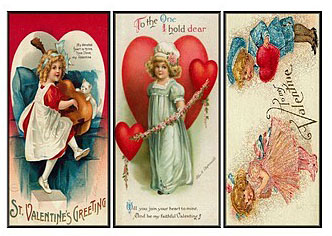
ANSWER: Bookmarks have been around in some form or another for hundreds of years, ever since the first printed book rolled off the press in 1455. What a lot of people don’t know was that bookmarks were popular gifts, especially during Victorian times. And many people gave them as small Valentine gifts.

Over the years, Valentine gifts have taken many forms—cards, chocolates, even bookmarks. But whatever form they have taken, these expressions of love often displayed a heart of some sort.

People often gave bookmarks as gifts and as souvenirs or to commemorate a number of events. The heart shape in bookmarks often served to convey expressions of emotions, religious sentiments, or as a way to advertise products of the day.

Also called bookmarkers, these were important instruments for people to use to keep their place while reading. Surprisingly, a great many bookmarks are in the shape of a heart or contain some kind of heart motif.

At first, they were probably nothing more than a scrap of parchment. But as time went on people used a variety of objects as bookmarks. Eventually, printers created actual bookmarks with the primary purpose of marking a place in a book. Someone presented Queen Elizabeth I of England with a silk fringed bookmarker by Christopher Barker in 1584. 

Bookmarks became more common by the post Industrial Revolution. By the mid-19th century there was a convergence of improved methods in the book binding process and an overall increase in literacy. With improved book printing techniques, books became less expensive to produce, and more available to a lot of people. But no one usually read an entire book in one sitting, so bookmarks became a necessary way to mark the place where the reader stopped. 

Silk bookmarks were the most common from around the 1850s and were primarily intended for use in Bibles and prayer books. During the 1860s in Coventry, England, Thomas Stevens was experimenting with his looms and developed a jacquard technique for manufacturing colored silk pictures. He demonstrated these at the 1876 Centennial Exposition in Philadelphia, and the World's Fair Columbia Exposition in Chicago in 1893. Silk bookmarks, generically called "Stevengraphs," are typically 2 by 6 inches long. These machine embroidered silks became so popular that Stevens began producing them with American themes. Other companies also produced these  desirable and highly prized silk bookmarks. They were especially popular with the women in Victorian book clubs. 

Between 1850 and 1900, home-crafted bookmarks of needlework on perforated cards became quite common. Printing techniques dramatically changed from 1860 through 1900 and ushered in the “Era of Lithography." Names such as Currier & Ives and Prang were to the best known associated with lithography and chromolithography. 

Silver bookmarks became quite popular from about 1380. People still give them as gifts today. In addition to silver, bookmarks have also been made in brass, copper, nickel steel and Britannia white metals. With the turn of the century came bookmarks made of aluminum, celluloid and lighter weight paper. The heart motif can be found on bookmarks made of all these materials.

Because the shape of the heart has long been a symbol of love, affection, deeply felt sentiments, caring, concern and earnestness, its easy to see why makers of bookmarks often turned to the heart as a theme.

The intertwined cross, anchor and heart were often meant to represent faith, hope and charity. Was this bookmark a symbolic religious expression of late Victorian or turn of the century sentiments? Or was this possibly the bookmark of a tea captain? Or was it designed to be given by a sailor to his sweetheart or wife as a gift, a gift that would remind the recipient of the giver whenever a book was read? 

While hearts represent love, or positive feelings such as warmth and charity, they also were very useful marketing tools. A celluloid heart bookmark with a surround of blue and green forget-me-nots on the outside border advertised "Cunningham Pianos." 

Embossed aluminum bookmarkers fashioned in the shape of hearts were quite popular during the 20th century, especially for souvenirs. A 1901 heart bookmark with embossing read "Pan American Exposition, 1901, Souvenir" around the raised raging bull symbol. Another example features an embossed aluminum bookmark that bears + the Bunker Hill Monument.

To read more articles on antiques, please visit the Antiques Articles section of my Web site.  And to stay up to the minute on antiques and collectibles, please join the over 30,000 readers by following my free online magazine, #TheAntiquesAlmanac. Learn more about the "Antiques of Christmas" in the 2021 Holiday Edition, online now. And to read daily posts about unique objects from the past and their histories, like the #Antiques and More Collection on Facebook.


Friday, January 28, 2022

Out, Out Brief Candle


QUESTION: One of my aunts recently passed away. She had a collection of antique candle snuffers that was truly unique. Now I’ve inherited them. I know absolutely nothing about them. Some look very strange. What can you tell me about candle snuffers? How far back do they go—obviously before the invention of electricity. 

ANSWER: Most people call the bell-shaped cone at the end of a long handle used to put out candles a snuffer. But the device known as a snuffer is actually an “extinguisher” or candle “douter.”

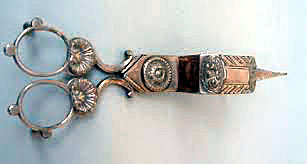
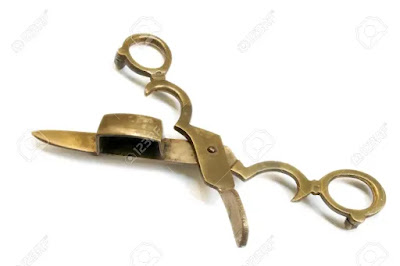
As candlesticks became more sophisticated in the mid-18th century, people required a method to safely put out candles without blowing them. While the candle snuffer's component parts—scissors, a stand, dustpan—might be familiar to some people,  combined, they do look strange. However, before electricity, candles and candle snuffers were an integral part of everyday life. Candle wicks used to be made of cotton which would start smoking and burst into flames as they grew longer, therefore necessitating regular trimming. The scissor part of the candle snuffer would sever the burnt wick, which would safely fall into the dustpan to be extinguished and discarded. This would also catch any dripping hot wax.

Christopher Pinchbeck the Younger developed and patented the true candle snuffer in England in 1776. His device looked like a pair of stunted scissors with a raised round bowl on top of them. The user would to snip the wick, catching it in the bowl and extinguishing the candle safely with no soot or wax on the walls from blowing, or hot wicks catching anything on fire. In the 18th and early 19th centuries, it was considered a sign of candle skill for a person to be able to use the snuffer to trim a wick without extinguishing the flame.

There’s considerable confusion among collectors, antiques dealers and the public concerning the name and function of these little devices known as candle snuffers.

The problem is due to two meanings of the word "snuff." Used as a noun, snuff refers to the burned ash from the spent wick of a candle, but when it's a verb, usually used with the word "out" – then it means to extinguish.

Back in the 18th century, people used snuffers to trim the candlewicks, and to remove the burned snuff, but not to extinguish the candle. At times the flame might have been inadvertently put out in the process, but that wasn’t the intent.

A snuffer was a device made of metal for cutting off, or snuffing, and holding the charred part of a candlewick. Before the invention of the self-consuming wick, around 1830, the hanging burned wick caused the flame to dim, flicker or even go out. Or it may have dropped against the side of the candle, forming a channel or gutter in the precious wax. So it became expedient to reach in with the snuffer to clip the wick and remove the snuff every hour or so. 

The earliest snuffers were plain and simple but over time became more decorative and complicated. The first snuffers were simple scissors types with no container for the snuff. This presented the problem of dropping charred, sometimes still burning wick onto the table, and so the idea of adding a little box to contain the snuff was born.

Craftsmen made all snuffers, douters, and extinguishers of brass, copper, or pewter and  elaborately engraved them. They added delicately twisted handles, basket woven cones, or beautifully etched patterns to make the snuffer a beautiful addition to any home.

Besides improving the efficiency of their snuffers, craftsmen began engraving and chasing them with cupids, garlands, leaves and flowers, and sometimes with the monogram of the owner. They used elaborate finishes, such as gilt, enamel, silver plating and even inlaid fancier ones with faience and porcelain. 

Snuffer trays were flat and usually rectangular, with cut off corners, deep enough to hold the snuffer and the clippings with safety. Sometimes, the tray had small feet to raise them up The invention of the box addition and the automatic spring mentioned above affected the style of the tray. The deep dish of early days was no longer required, for the snuffer box contained the burned snuff. So a more shallow tray with a low rim grew in favor. At the same time, makers fitted trays with three short feet—one beneath each finger hold on the scissors end and one on the pickwick end. These lifted the tool a bit above the tray and made it easier for the user to grasp.

Makers also decorated snuffer trays with handles, scrolls, and masks, and often finished them in Sheffield plate. Heavy borders became popular. By the late 18th century, large “table snuffers,” that sat between a pair of large candlesticks, came into fashion. By that time smaller ones became known as “chamber snuffers.”

It may seem strange today that so much effort went into the design and making of simple snuffers and trays. But since candles provided all lighting during the darker hours, it’s easy to see why so much went into care went into these devices. A pattern bock of around 1800 shows 165 different tray designs, and in 1839 a directory of the city of Birmingham, England, listed 30 manufacturers of steel candle snuffers, the plainest kind.

With the invention of the self-consuming candle wick and improved wax, snuffers and their trays became unnecessary. In fact, many people used the snuffer trays as ashtrays when cigar smoking came into vogue during the Victorian Age.

To read more articles on antiques, please visit the Antiques Articles section of my Web site.  And to stay up to the minute on antiques and collectibles, please join the over 30,000 readers by following my free online magazine, #TheAntiquesAlmanac. Learn more about the "Antiques of Christmas" in the 2021 Holiday Edition, online now. And to read daily posts about unique objects from the past and their histories, like the #Antiques and More Collection on Facebook.