Showing posts with label 18th century. Show all posts

Sunday, January 25, 2026

The Colorful World of Jasperware


QUESTION: Recently, while browsing in an antique shop, I came upon a small display plate with a Classical relief decoration. The plate looked like Wedgwood ware but its background color was sort of a pale salmon pink color with cream-colored decoration. The only Wedgwood pieces I’ve ever seen have been a light blue with white decoration. Since the price was low—the dealer said she didn’t think it was real Wedgwood but a contemporary copy—I bought it. Is this plate real Wedgwood? And if so, why the pink background color?

ANSWER: You got a real bargain. Your plate was, indeed, made by Wedgwood and because it’s pink, is on the rare side. Wedgwood introduced pink Jasperware in the late 19th century and never made it in large quantities. The pale rose color gave a delicate and romantic appearance to small decorative boxes and medallions. Today, pink pieces can sell for $500 to $1,200. 

Noted English potter Josiah Wedgwood invented Jasperware in 1774 after conducting over 5,000 carefully recorded experiments over several years.  Wedgwood made Jasperware of a dense white stoneware which accepted colors throughout its body and not just on the surface.

Usually described as stoneware, it has a smooth texture and unglazed matte "biscuit" finish. Wedgwood experimented with different colors and at first produced it in a pale blue that became known as "Wedgwood blue." Relief decorations in contrasting colors—usually in white but also in other colors—gave his pieces their characteristic  cameo effect. He produced the reliefs in molds and applied them to the ware as sprigs.

After several years of experiments, Wedgwood began to sell Jasperware in the late 1770s, at first making it in small objects, but adding vases from the 1780s onwards. It was extremely popular, and after a few years many other potters devised their own versions. 

The decoration was initially in the fashionable Neoclassical style, which became especially popular in the beginning of the 19th century. But Jasperware could also be made to suit other styles. Wedgwood turned to leading artists outside the usual world of Staffordshire pottery for designs. High-quality portraits, mostly in profile, of leading personalities of the day were a popular type of decoration, matching the fashion for paper-cut silhouettes. The wares were made into a great variety of decorative objects but not as tableware. Three-dimensional figures are normally found only as part of a larger piece, and are typically in white.

In his original formulation, Wedgwood tinted the mixture of clay and other ingredients  throughout by adding dye. Later, workers merely covered the formed but unfired body  with a dyed slip, so that only the body near the surface had the color. These types are known as "solid" and "dipped." The undyed body was white when fired, sometimes with a yellowish tinge. Workers added cobalt to the decorative elements of the pieces that were to remain white.

To add a bit of class ins marketing his ware, Wedgwood named it a after the mineral jasper.

Barium sulphate was a key ingredient. Ten years earlier, Wedgwood introduced a different type of stoneware called black basalt. He had been researching a white stoneware for some time, creating a body called "waxen white jasper" between  1773 and 1774. But this tended to fail in firing and wasn’t as attractive as the final Jasperware.

Besides its most common shade of pale blue, Jasperware came in a variety of other colors, including dark blue, lilac, sage green, black, and yellow. Sage green resulted from adding chromium oxide, blue to cobalt oxide, and lilac to manganese oxide, yellow to a salt of antimony, and black from iron oxide. Other colors sometimes appeared, including white used as the main body color, with applied reliefs in one of the other colors. The yellow is rare. A few pieces, mostly the larger ones like vases, use several colors together, and some pieces mix Jasperware and other types together.

Wedgwood dyed or stained the earliest Jasperware throughout and it has become known to collectors as "solid," but before long most pieces had colored slip applied  only on the surface. These became known as "dipped." Wedgwood first dipped his pieces in 1777 due to the high cost of cobalt oxide. By 1829 Jasperware production  had virtually ceased, but in 1844 production resumed making dipped wares. Solid Jasperware didn’t appear again until 1860.

Generally, Wedgwood made Jasperware into Neoclassical vases with heavily stylized Neoclassical cameos. Many of these cameos depict famous scenes from Greek literature and modern interpretations of Greek literature.

Shortly after discovering how to make Jasperware, Wedgwood went into business and started producing it in large quantities from a factory based in Staffordshire, England. In order to confuse potential competitors about the ingredients he used, he had the minerals for his clay ground in London, and then brought to Staffordshire in powdered form.

To discourage corporate espionage, Wedgwood made sure that no single one of his workers had a complete understanding of the process for making Jasperware, the formula for which he kept secret. By dividing up factory tasks and forcing his workers to become extremely specialized, he prevented them from becoming competitors.

Jasperware was Wedgwood’s most important contribution to ceramics. With its timeless style and class, it has become an enduring luxury material, beloved by collectors the world over for more than 250 years.

To read more articles on antiques, please visit the Antiques Articles section of my Web site.  And to stay up to the minute on antiques and collectibles, please join the over 50,000 readers by following my free online magazine, #TheAntiquesAlmanac. Learn more about "Sacred Artifacts" in the 2025 Holiday Edition, online now. And to read daily posts about unique objects from the past and their histories, like the #Antiques and More Collection on Facebook.

Tuesday, July 16, 2024

Up to Snuff


QUESTION: I’ve been fascinated by antique snuff boxes for some time. Most are a bit above my budget, but I’d like to purchase one or two soon. However, I know little about snuff and the origins of these decorative little containers. When did people start taking snuff? And where and where were the first snuff boxes made?

ANSWER: Snuff was a type of smokeless tobacco made from finely ground or pulverized tobacco leaves. Users snorted or "sniffed" it into their nasal cavity by inhaling it lightly after placing a pinch of it either onto the back of their hand, by pinching some between their thumb and index finger, or holding a specially made "snuffing" device.

Friar Ramón Pane, a missionary who came to the New World with Christopher Columbus in 1493, was the first European to witness the inhaling of snuff by the Taino people of Haiti. Until then, tobacco was unknown to Europeans. But by the 1650s, artisans were making small boxes the snuff dry.

Traditional snuff production consisted of a lengthy, multi-step process, in tobacco snuff mills. The selected tobacco leaves were first cured or fermented, which gave it the  individual characteristics and flavor for each type of snuff blend. Many blends of snuff required months to years of special storage to reach the required maturity. Fine snuff consisted of varieties of blended tobacco leaves without the addition of scents. Varieties of spice, piquant, fruit, floral, and mentholated soon followed, either pure or in blends. 

Each snuff manufacturer usually had a variety of unique recipes and blends, as well as special recipes for individual customers. Common flavors also included coffee, chocolate, Bordeaux wine, honey, vanilla, cherry, orange, apricot, plum, camphor, cinnamon, rose and spearmint.

The 18th century witnessed an increase in the use of snuff, especially among the English and French aristocracy. Because it was a small, fine substance, it needed a vessel to contain it. Both snuff and the little boxes that contained it became important expressions of class. Originally made for daily use, snuff boxes became important symbols of personal representation. Snuff taking had become an important marker of social status.

Although men could ingest other forms of tobacco, both men and women could take snuff. Tobacco would often be used by men while socializing in coffeehouses, thus becoming linked to public masculinity.

Taking snuff could be unpleasant, especially if there were a crowd in a room. In the act of ingesting it, a person had to remain dignified. Society considered it rude for snuff takers to make excessive noise making or reaction. Like tea or coffee consumption at this time, it wasn’t only about the substance being ingested: but the ingestion itself that had to adhere to society’s rule.

The manufacture of snuff boxes became a lucrative industry when taking snuff was fashionable. Snuff boxes ranged from those made of horn to ornate designs featuring precious materials made using state-of-the-art techniques. Since prolonged exposure to air caused snuff to dry out and lose its quality, manufacturers designed snuff boxes to be airtight containers with strong hinges, generally large enough to hold a day's worth of snuff. The wealthy kept larger snuff containers, called mulls, on their dinner tables for use at dinner parties. These could be quite elaborate and often included rams horns decorated with silver or in some cases a depiction of the head of a ram.

In the early 18th century, French jewelers created snuff boxes of gold set with diamonds, amethysts, and sapphires. By 1740, specialized artisans took over the production of these ornate tabatières, which they engraved, chased, and enameled. 

The shapes of these boxes weren’t limited to rectangular boxes. Porcelain containers resembling little trunks were popular, as were ovals, but tabatières shaped like shells were more rare. And while the materials used to construct a box were often enough for its decoration, sometimes artisans hand painted these snuff boxes, depicting everything from miniature landscapes and bucolic scenes to tiny portraits or cameos of their owners.

Miniatures often adorned the lids of snuff boxes. These could be scenes from various mythological, Biblical, or pastoral settings, but portraiture was the most common decoration, especially on those boxes given as gifts. It was usually men who adorned the portraiture present on the jewelry of women.

Silver snuff boxes became associated with Sheffield, England, where silver-plating had been perfected on these small containers in the late 18th century. By the early 19th century, the silver industry had blossomed in Birmingham, England, where snuff box makers such as Samuel Pemberton, Nathaniel Mills, and Edward Smith produced oblong containers with images of castles and abbeys on their tops and sides.

Birmingham was also a center for papier-mâché snuff boxes, which manufacturers hardened using several layers of enamel. A market for these inexpensive boxes developed in the United States, so Birmingham box makers began decorating their wares with portraits of U.S. naval heroes and victory scenes from the War of 1812, often using engravings by such renowned American artists as Gilbert Stuart as their source material.

To read more articles on antiques, please visit the Antiques Articles section of my Web site.  And to stay up to the minute on antiques and collectibles, please join the over 30,000 readers by following my free online magazine, #TheAntiquesAlmanac. Learn more about "The Art Deco World" in the 2024 Spring Edition, online now. And to read daily posts about unique objects from the past and their histories, like the #Antiques and More Collection on Facebook.


Saturday, July 6, 2024

What's All the Fanfare?


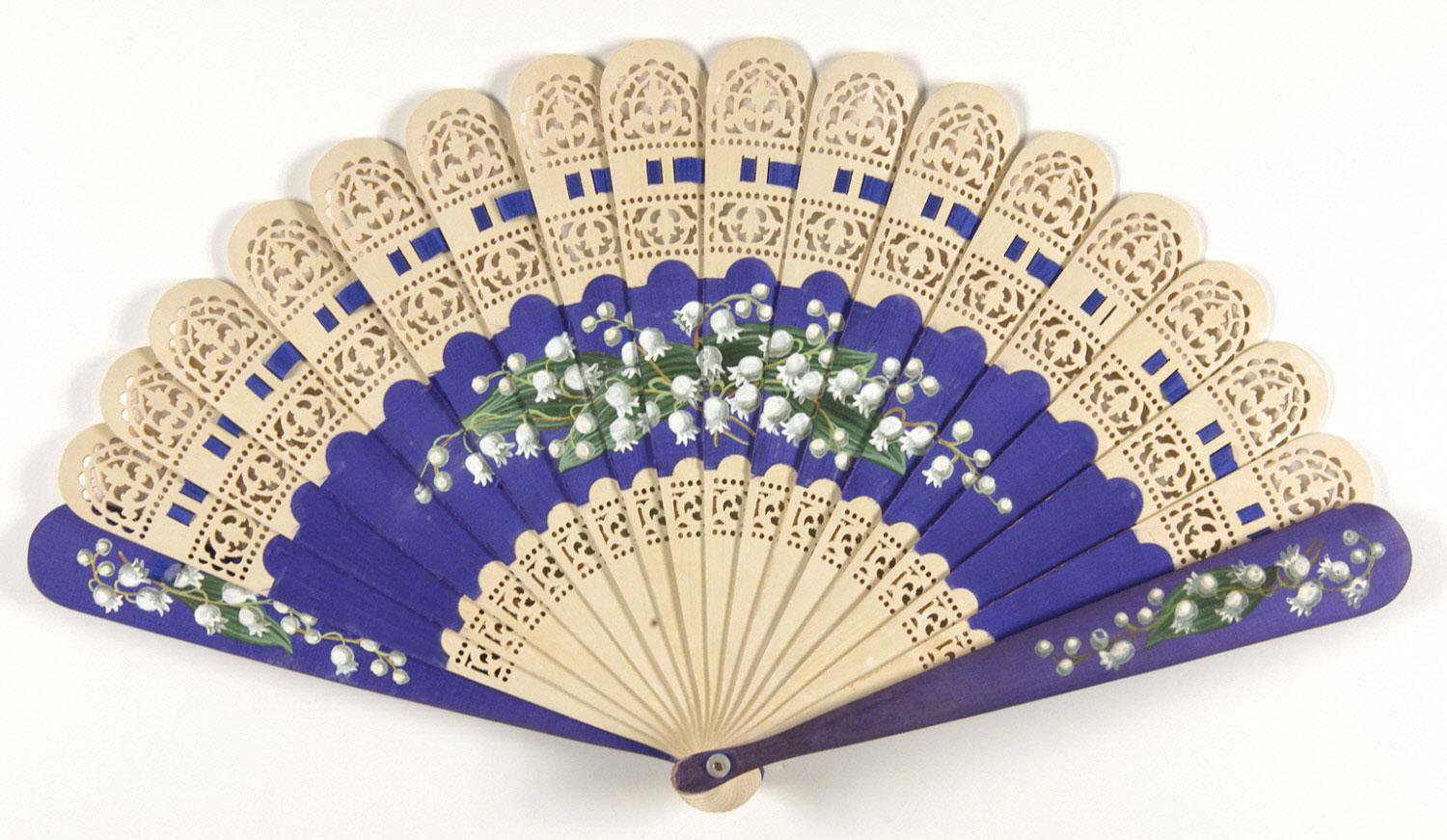
QUESTION: I was digging around in my mother’s attic the other day and discovered a flat box containing two very beautiful fans. I imagine these must have belonged to her mother or grandmother. What can you tell me about them? Do they have any value?

ANSWER: Fans have been around for a long time. As a piece of functional art, they go back as far as ancient Egypt. 

The Egyptians saw them as sacred instruments used in religious ceremonies. They also became a symbol of royal power. But it was the Chinese who evolved the fan into a complex, decorated instrument. The Japanese took the fan one step further and produced a folding version, supposedly based on the folding wings of a bat. When Marco Polo returned to Venice, he brought with him fans made of vellum, paper, swan skin with blades of gold, silver, and inlaid mother-of-pearl.

The original purpose of hand fans was to create a breeze, but they had many other uses. They could be used as protection against rain, as a tray for offering or receiving refreshments, and to hide bad teeth. European women would use fans to hide their faces during mass.

By the 18th century, the folding fan had come into its own in Paris. Delicately hand-painted floral motifs, on a structure of decorative sticks, came into common use. In fact, any wealthy lady worth her salt had to have fans as accessories to her wardrobe.

These wealthy women developed a whole language of salutations and signals around their fans. For instance, carrying a fan in the left hand signified "desirous of acquaintance" while allowing it to rest on the right cheek meant "yes" and on the left "no." Drawing a fan across the forehead meant "We are watched" and drawing a fan across the eyes meant "I am sorry." Opening a fan wide meant "wait for me."

Dropping a fan meant "We could be friends." If a lady fluttered her fan, it meant “I am married.” But if she placed the handle of her fan to her lips, it meant "kiss me."  An open fan held in the right hand in front of the face—the ultimate form of seduction— meant "follow me"


The blades of these delicate instruments could be of carved ivory or tortoise shell inlaid with precious inlaid metals and elaborate jewels. Less expensive fan sticks were usually of sandalwood or fruitwood. These rococo fans were the finest ever made, and many fo the designs took the form of stylized art.

By the latter part of the 18th century, fans had gained popularity as a fashion accessory in the upper circles of American society. While fan makers imported finer sticks, they made their own wooden ones.

The earliest fans made in any large quantity in the United States were paper souvenir fans depicting historical scenes. as well as current events. Lithographers portrayed views of New York's Crystal Palace, 1853, the Philadelphia Centennial in 1876, printed in black on a cream background, and the World's Columbian Exposition in 1893.

By the late 19th century, fans displayed images of nearly every product. Every department store and every manufacturer advertised on fans, including such products as coffee, milk, bread, carpet sweepers, restaurants, cafes, theaters, sewing machines, etc. 

Before the advent of air-conditioning, funeral parlors gave out fans t mourners. These were as much to keep mourners cooler in warm weather as they were to wave the stink of the corpse away. These mourning fans became a social necessity. Manufacturers often fashioned them in black materials to coincide with the black clothing worn during recognized periods of mourning. Of course, it didn't hurt to print the name and address of the mortician on the guards of a cheap wood fan.

Fans are still relatively inexpensive—except the jewel-encrusted ones—so they’re ideal to collect, especially for the novice collector. Many sell for $5-$20 online. Some of the most sought after fans came from the E.S. Hunt Company, later called the Allen Fan Company. In 1868, Hunt patented the process by which he assembled the fan sticks and the fan leaf in one step. This included folding or creasing and gluing the leaf to the fan sticks at the same time under pressure. This was America's first fan to appear and unfortunately folded, like its fans, in1910.  

Serious fan collectors often prize the simpler fans with printed leaves and plain sticks and guards. Many of these simpler folding fans provide a glimpse of particular times in history. Some once served as records of special occasions, such as births and marriages. Often fans celebrated military and naval victories. And some did the same for national holidays. Collectors find such a quantity of fans that many specialize in one particular subject, such as advertising fans. Unlike many other delicate antiques and collectibles, folding fans have survived for decades and often centuries in superb condition. 

To read more articles on antiques, please visit the Antiques Articles section of my Web site.  And to stay up to the minute on antiques and collectibles, please join the over 30,000 readers by following my free online magazine, #TheAntiquesAlmanac. Learn more about "The Art Deco World" in the 2024 Spring Edition, online now. And to read daily posts about unique objects from the past and their histories, like the #Antiques and More Collection on Facebook.


Friday, February 16, 2024

Who's for a Game of Cards?


QUESTION: Recently, while browsing though an antique shop, I came across two tables. Both had fold-over tops. One seemed like it was from the 18th century, the other from the Empire period of the 19th. The dealer unfolded the top of the older table to reveal a green felt cloth inlaid into it. He said that this was a card table. When he unfolded the top of the second table, it had no felt inlay and was plainly finished. He told me the second table was a tea table. I always thought they were both card tables. Can you tell me the difference and when card tables started to be used?

ANSWER: There’s a difference between the two tables, although subtle. Back in the 18th century, furniture was expensive as each piece was handcrafted to suit the customer. People woud have used their card tables as tea tables by just putting a tablescloth over it. But by the 1840s, furniture had begun to be at least partially machine-made, and manufacturers kept the cost down by making card tables plainer. 

Playing cards were probably invented during the Chinese Tang Dynasty around the 9th century as a result of the usage of woodblock printing. Playing cards became a diversion both in public houses and private homes. Early playing cards had neither suits nor numbers. Instead, they had instructions or forfeits for whoever drew them. Usually, playing cards revolved around drinking alcohol, especially in the public houses.

The earliest game involving cards occurred on July 17,1294 when the Ming Department of Punishments caught two gamblers, Yan Sengzhu and Zheng Pig-Dog, playing with paper cards. The Department confiscated the wood blocks used for printing the cards together with nine of the actual cards. By the 11th century, playing cards had spread throughout Asia and eventually made their way to Egypt. Playing cards probably came to Europe from the East, arriving first in either Italy or Spain.

By the early 18th century, specially made tables for playing cards began to appear all over England. The first card tables first appeared in the American Colonies around 1710. Card tables became symbols of wealth and the consequent expansion of leisure time and soon became a social necessity in every fashionable home. Without modern entertainment devices, about the only forms of evening entertainment was playing music, dancing, and of course, playing cards. 

Cabinetmakers constructed most of these imported English card tables of mahogany or walnut. Each had a hinged two-leaf top that, when open and supported on a swing leg, revealed an inner surface lined with leather, felt, or the coarse woolen cloth called baize. Since household lighting was usually inadequate for evening play, most of the tables had four turrets projecting from the corners to accommodate candlesticks. In addition, there were often “guinea pools” or “fishponds”—shallow dishlike depressions to hold money, dice, or counters—and, in Chippendale styles, a single drawer in which to keep the cards. The tables stood on graceful cabriole legs, meant to resemble a woman’s shapely calves, but their backs, unseen against the wall, remained unfinished.

Since so many of these tables were highly decorative and also bore their makers’ marks, they provide valuable evidence of the varieties of carving, inlay, veneer, and other detail used by the cabinetmakers, as well as of regional characteristics. Tables with bowed fronts were popular in Boston and Salem, and five- and six-legged examples appeared in New York.

Some people used card tables for purposes other than for playing cards. Unfortunately, tablecloths only covered over the fishponds, often causing accidents and breakage.

In Puritan New England and Quaker Philadelphia, as well as in the South, people bet huge sums on cockfights and horse races, on bull and bearbaiting. Doctors and lawyers would wager their fees at the card table, and the “devil’s prayer book”—a deck of playing cards—could be found everywhere.

From the beginning of the United States, gambling overpowered every effort to restrain it. By the late 18th century every fashionable home had a card table. Still, most households reserved the card table for recreational use.

In the upper-class 18th-century American home, ladies played cards at afternoon tea parties where guests might win or lose hundreds of dollars. In the evening, families would summon servants to bring the card table into the center of the drawing room after dinner, as card playing was a primary form of evening entertainment. Players became embroiled in spirited games of whist, a simpler foreunner of bridge, pokerlike brag, quadrille, or any of the several other games while spectators observed the action. 

When not in use, card tables in most households remained folded away to become consoles or side tables. Servants set card tables against the wall when not in use, sometimes with the upper half raised as a kind of ornamental backsplash.

After about 1840, card tables began to lose the felt inlaid on their surface. People still played cards but now these tables came into popular use as tea tables. With a smooth top, minus the fishponds and candlestick rests—indoor lighting had been much improved—it was now possible to place a tablecloth over the table without the fear of anything toppling due to the former depressions. In many cases, these table featured graceful rounded corners and were still being made of mahogany or walnut.


To read more articles on antiques, please visit the Antiques Articles section of my Web site.  And to stay up to the minute on antiques and collectibles, please join the over 30,000 readers by following my free online magazine, #TheAntiquesAlmanac. Learn more about "The Age of Photography" in the 2023 Holiday Edition, online now. And to read daily posts about unique objects from the past and their histories, like the #Antiques and More Collection on Facebook.

Friday, November 10, 2023

The Descendant of the Laptop


QUESTION: On one of my first trips to England, I enjoyed antiquing as I traveled the countryside. In a shop in the Cotswolds, I discovered an unusual box. It had a lid that opened a out into what looked like a sloping writing service. The dealer said it was a 19th-century writing box. This seemed odd to me as many people now do whatever correspondence they need to do on their laptop through Emails or by texting on their smartphone. When and where did these boxes originate and how long were they in use?

ANSWER: While most writing boxes date to the 19th century, they go back even further than that. Victorians carried these boxes with them on trips so they could write letters and postcards back home. When not traveling, many also used them in place of a desk. Essentially, they were the laptops of their day.

Writing boxes date back to the beginning of writing. During the Middle Ages, monks kept their writing materials in special boxes called scriptoriums. Eventually, they mounted these boxes on stands and later added  legs, creating the first desks for doing illuminated manuscripts. But the writing box, itself, survived into the early 20th century.

People used traveling desks or writing boxes throughout the 19th century. When opened, they offered a leathered or velvet slope and rested on a table or over compartments for holding stationery. More luxurious versions included a removable pen tray under which spare nibs and holders could be kept, and screw-top inkwells, usually of glass, on each side. Others offered secret drawers or compartments. 

Before usernames and passwords, professional men kept their valuable documents—deeds, ills, and private letters—in their writing boxes. They didn’t keep these at their desks and always kept them locked. The first writing-boxes like these were descendant from “bible-boxes” and came into being in the 1600s. 

During the second half of the 17th century, craftsmen began to make improvements to these the Bible box, creating a rectangular box with a sloping lid. Such boxes provided a ‘desk on the move’ for such people as merchants, members of the clergy and professional men of the turn of the 18th century. 

In the 18th century, drivers stacked squarish trunks and boxes on the backs of stagecoaches and carriages. A box with a slopping lid didn’t fit this arrangement, forcing passengers to carry it on their lap. 

Eventually, a creative cabinetmaker discovered that if he sliced a rectangle in half, diagonally, and moved the cutting-line so that it was slightly off, when he applied this to a box, he found  when the lid was opened and laid down flat, a complete, compact writing-slope could be created for anyone who wanted to use it. When business was done, the slope was simply folded up into a neat little box. This became the basic form of the writing box for the next 200 years.

Once the form of the writing box became standardized, it became quite common. Their practicality and portability allowed them to be carried on journeys, on long sea-voyages, on military campaigns, scientific and geographic expeditions and even for a trip out of town to visit the Duke for the weekend shooting-party. It was during this time that writing boxes became fine pieces of craftsmanship, handmade by cabinetmakers, carpenters and skilled artisans. They ranged from sturdy, utilitarian pieces with brass-edgings to protect the wooden corners from damage to fine top-of-the line models with inlaid decoration, brass handles, leather writing slopes and plenty of secret compartments.

Writing boxes carried everything a person needed to do business. Most people, however, used them for correspondence. Most included seals and sealing-wax, stamps, a couple of envelopes, notepaper, nibs or quills and a pen-shaft. All writing-boxes also had a dedicated slot or alcove where a sealed inkwell would sit. 

An essential part of any writing box was the glass ink bottles. Before fountain pens appeared around 1895, a dip-pen and inkwell was the only way to go. Before you could get ink that was bottled in safe, screw-top, leakproof bottles, a travelling inkwell, which had a lid that locked securely and a rubber or leather seal to prevent leakage, was the only ink supply you were likely to get. And with the dip-pen shaft came the little box of nibs or ‘pens’ as they were called then, that went with it. 

Their practicality and portability allowed them to be carried on journeys, on long sea voyages, on military campaigns, as well as scientific and geographic expeditions. 

Towards the middle of the 19th century, manufacturers produced wooden writing boxes in enormous quantities to meet a growing demand. They came in all sizes and varieties of wood, including mahogany, burr walnut, rosewood and the more expensive ones in Coromandel wood. Less expensive ones, usually made of thin pine or fruitwood, were a step above an elaborate school pencil box and often decorated with cheaper decals instead of inlay.. 

Makers produced each to various specifications, depending on the intended type and amount of use. An army officer posted to the northwest frontier, for example, would want one robustly built, heavily brass bound, with brass mounted corners and edges to withstand rough treatment. A Victorian lady, on the other hand, might have one made in Tunbridge ware (a type of English marquetry decoration from the spa town of Tunbridge Wells, England) or even papier mache. The more expensive ones had serpentine lids, sometimes inlaid with intricate designs in brass or a mother of pearl or a shield for the owner's initials.

Simpler tourist writing cases in Moroccan leather and lined with satin came equipped with different sizes of stationery, pens, pencils, and a paperknife, but not an inkwell.

The utility of an easily portable box to provide storage for writing materials and a surface on which to write eventually led to the continuing usage of a smaller and more compact box that became very popular in the late 18th century. Known as lap desks or writing slopes, these writing boxes were quite portable, so they could be held on a lap or used at a table. They came with lids, hinged at the front, that slanted upwards towards the back, opening to form a writing surface with only one compartment underneath for storage. 

Before the days of central heating, members of the family could gather by the fire and each work at his own small desk. A lap desk provided each individual with a private place in which to keep letters, paper and writing materials. In those days, ink, quills, paper, sand, wax wafers, and seals were all necessary equipment to use in writing a letter. 

The writing box enjoyed its greatest popularity in days when ladies and gentlemen kept detailed diaries and wrote many letters. Imagine a romantic novelist or poet using just such a box while working in the warmth of a cozy fire. Today, cell phones, laptops, and tablets have made writing boxes and even stationery obsolete. However, as decorative boxes, they're more sought after than ever.

To read more articles on antiques, please visit the Antiques Articles section of my Web site.  And to stay up to the minute on antiques and collectibles, please join the over 30,000 readers by following my free online magazine, #TheAntiquesAlmanac. Learn more about "The Age of Photography" in the 2023 Fall Edition, online now. And to read daily posts about unique objects from the past and their histories, like the #Antiques and More Collection on Facebook.