Tuesday, March 17, 2015

The First Home Improvement Companion


QUESTION: At a community book sale recently, I was going through a box of old magazines and discovered a copy of The Craftsman, a magazine from the early 1900s. It looked interesting, so I put it with the rest of the items I intended to purchase and bought it. As I was going through the books and such I bought a few days later, I noticed that the publisher was Gustav Stickley. Is this the same person who made Mission furniture? Also, what can you tell me about The Craftsman?

ANSWER: It is indeed the one and the same person. And The Craftsman magazine was Stickley’s pride and joy and the first of its kind to discuss home improvement and design.

Gustav Stickley was one of the most important figures in the Arts and Crafts Movement in the United States. He was a furniture maker who became a leader in the philosophy of the Arts and Crafts Movement as well as in the production of objects suitable for use that followed its principles. And although he wasn’t a craftsman himself, he successfully inspired craftsmen to carry out his concepts.
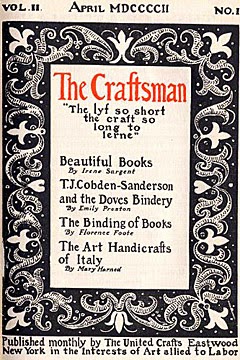
Also, he knew the value of publicity in selling his products and his ideas. He used his magazine, entitled The Craftsman, which he edited and published during the 15 years he was active in the Movement, as his main means of promotion.  At its peak, The Craftsman reached 60,000 subscribers and featured articles and essays on Stickley's many interests and concerns.

Gustav Stickley often referred to himself as "the craftsman" and used the term "craftsman" in many ways. The furniture he sold was Craftsman—not "mission"—furniture, his version of the Arts and Crafts movement was the Craftsman Movement, and his monthly magazine was The Craftsman.

He published the first issue of his magazine in October 1901 in  Eastwood, New.York, where he had located his furniture factory. Later he moved The Craftsman to Syracuse and finally to New York City. The premier issue emphasized the work and ideas of William Morris through an article entitled “William Morris, Some Thoughts Upon His Life.”

Irene Sargent, professor of art history at the University of Syracuse, served as Stickley's principal editor. She wrote many of the articles in the magazine’s early years. A very persuasive person, Stickley was able to obtain contributions from such notables as Louis Sullivan, Jacob Riis, Leopold Stokowski, John Burroughs, and Jane Addams. They covered a wide variety of subject matter, from architecture to art and nature, as well as the concepts of social reform prevalent at the time.
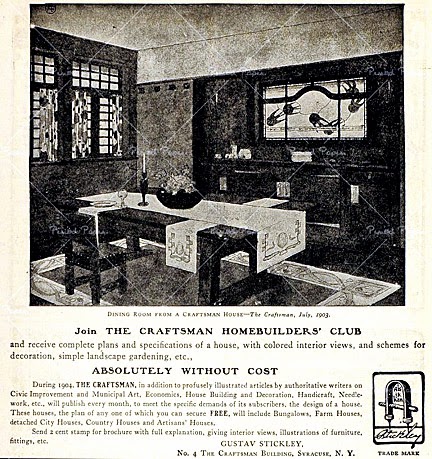
Though he was an idealist, Gustav Stickley had to eat. The Craftsman offered him lots of advertising  space for his growing furniture business. Thirteen pictures of furniture made by Stickley's company, United Crafts, included a round table, an armchair, and a settle, followed an article entitled “An Argument for Simplicity in Household Furnishings” in the first issue. The Craftsman also showed readers how to use the furniture in its many illustrations of room settings. Over the years, Stickley added metalwork, lighting fixtures, textiles and other items to his product line, and also to The Craftsman.

He often commented on the Craftsman ideal. Stickley believed an ideal kind of life encompassed beauty, economy, reason, comfort, and progress. It didn’t satisfy him to merely achieve this ideal in furniture but he felt that consumers must also have the right kind of houses in which to place the furniture. He no sooner began  designing Craftsman houses than he realized that people wanted Craftsman fabrics and accessories of all kinds. In other words, he believed in the concept of total interior design.

While early issues had somewhat smaller covers, ones beginning in 1913 had larger ones measuring 8 by 11 inches. Stickley printed all of them on brown or tan stock and usually featured a wood block decoration in two or more colors, initialed by the artist. Each issue consisted of 100-140 white and glossy pages, and later ones had as many as 175 pages.
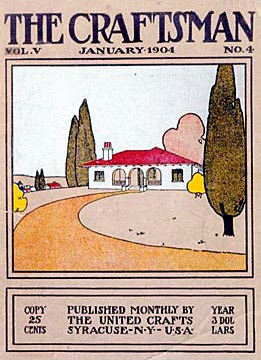
Plans for Craftsman houses, some small and simple, others more elaborate, attributed to Stickley as the architect, although he had no architectural training. People built many of these houses using Stickley’s plans.  The Craftsman also featured short fiction and poetry, as well as the work of famous photographers.

Besides articles about Stickley’s products, The Craftsman often included ones about other makers of Arts and Crafts objects. For example, a 1903 article, “An Art Industry of the Bayous: The Pottery of Newcomb College” by Irene Sargent, documents the early history of Newcomb pottery. Photographs of the pottery school and examples of early high glaze pieces accompanied it. There were also essays devoted to philosophical, political and social commentary, usually promoting the simple life

The magazine also offered all kinds of practical and how-to advice, from gardening to leather tooling to embroidery to purchasing household appliances.

It also included advertisements by manufacturers whose products are now greatly valued by collectors, for example, Rookwood pottery, Heisey glassware, Handel lamps, and Homer Laughlin china.

Unfortunately, Stickley overextended himself and in 1915 had to file for bankruptcy. But The Craftsman was the first periodical to emphasize the importance of harmony in a home’s interior, harmony which was to be created through attention paid to walls, floors, windows, textiles, small objects and furniture.

Tuesday, March 10, 2015

Ashes to China, Bones to Beauty


QUESTION: I have a beautiful vase that’s been in my family for years. It seems to be made of delicate porcelain and is decorated with a fish-net type of design that’s raised off its surface. The vase has a green circle with a crown on top and Lotus Ware printed around the outside. Inside are the initials K.T.K. Co. with a crescent and star. Can you tell me more about this piece?

ANSWER: What you have is a piece of Lotus Ware, a short-lived but highly prized type of bone china made by Knowles, Taylor & Knowles of East Liverpool, Ohio. Produced for only a few years in the 1890s, many collectors consider it to be the finest bone china ever made in the United States. The term "Lotus" comes from the translucent pearliness of the glaze, which Isaac Knowles had once observed resembled the glowing sheen of a lotus blossom.

Lotus Ware was a dream of Isaac Knowles. His firm, founded in the 1850s and lasting until the 1930s, consisted of Isaac Knowles, Col. John Taylor, his son-in-law, and his son, Homer Knowles. Isaac Knowles wanted to produce fine bone china that would rival the best imported from England. He had been a longtime producer of Rockingham pottery, yellow Queensware, and ceramic canning jars. So in 1870 he decided it was time for a change and brought his son and son-in-law into the firm. Within 10 years, Knowles, Taylor, & Knowles was not only the largest pottery in East Liverpool, but did all its decorating in-house. .

What is bone china? Literally, it’s fine china ware made from bone ash, which results from burning animal bones that are crushed into a fine white powder. English porcelain makers discovered this combination of ingredients about 1750. Strong hard porcelain chips fairly easily and unless specially treated, is usually tinged with blue or gray. Bone china, on the other hand, is strong, doesn’t chip easily and has an ivory-white appearance, perfect for fine china. The bone ash greatly increases the translucence and whiteness of the porcelain. And though it costs less to make it than porcelain, makers charge a premium for it.

Fortunately, East Liverpool had a stockyard that could supply the needed bones to make the ash. This probably had a lot to do with the decision of Knowles, Taylor, and Knowles to make bone china. And even though the company did well, Isaac Knowles had a vision to create something rare and beautiful—art in porcelain.

Trucks hauled in large quantities of bones from the slaughterhouses and dumped into them into large vats to boil away any meat. Workers dried the remains in kilns, which burned the bones to a powdery ash. They then mixed the powdery ash and the porcelain formula together to form the porcelain composition.

After first casting bases, bowls and other items in the casting shop, workers took the bisque ware to the kilns to be fired for the first time.

After the firing took place, workers transferred the pieces to the decorating shop to be decorated partially or totally by hand. There skilled artists gilded the ware or applied hand-painted designs. Once decorated, workers transported the ware to the kiln room to be fired again to make the design permanent. After cooling, they finally transferred the pieces to the warehouse for shipment.

Knowles employed a type of decorating unique to Lotus Ware which placed flowers, leaves, stems and filigree—open works of elaborate designs—on the pieces of china. The person responsible for this was Heinrich Schmidt, a German artist who had previously worked at the Meissen factory in German. He was a bit of an eccentric and saw himself as an artist, keeping the recipe to make the clay slip he used in his head. He also insisted on working in a room without windows in order to foil pottery industry spies.

Schmidt originated his own floral decorations and open work designs. When he was ready to put his clay flowers on a Lotus bowl, he would first center the bowl on a whirler and then trace out his particular pattern on the bowl with a undulating movement, much like one would trace an imaginary lead pencil around the bowl. His instruments were a rubber bag and copper tube similar to that used in cake decorating. He produced the stems, leaves and flowers of his patterns with remarkable skill, using a small piece of plaster of Paris, a little bit thicker than a lead pencil and shaped like a petal, to give a more realistic impression to his flowers. This was always done after the petals had reached the proper hardness. He sometimes indented the stems of his floral designs, and attached leaves to them, using a sharp tool to give a roughened and more natural effect.

Schmidt first worked out his patterns on a small plaster mold. He would do a quick penciling of his design on the mold and then etch it out slowly with his cornucopia bag. These minute indentations served to support the moist clay while the clay was drying. When the drying process was complete, the open work would be removed from the mold by a slight jolt on the plaster form fro the hand.

He would next take the open work designs into his hand and apply a little fresh slip to its outer edges. Then he would attach the design to the vase or bowl he was working on. If too much pressure was applied, the pattern would be crushed and rendered useless.

Another method Schmidt used, called `jeweling," featured a jewel and swag type decorative chain placed on the item of Lotus Ware making it appear as if the jewel and chain had been hung on the piece. The "fishnet" design was also commonly used on many pieces of Lotus Ware along with the molded patterns of shells and lily pads.

The bodies of Lotus Ware pieces are translucent and fragile with a gloss or matt finish in white or in a light and deep olive green color Most of the Lotus Ware decorating reflects the Art Nouveau influence of the era, with its flowing styles and applied decorations.

Discovering who decorated a piece of Lotus Ware has always been a challenge, even for the most knowledgeable collector. Unless a piece has been signed and the artist is known to have worked at the firm at that time of the decorating and signing, it’s mostly speculation as to who did the decorating. Since the company paid artists by the piece and not by the hour, it’s probably certain that they didn’t mark the pieces they decorated.

Only two marks are known to exist on Lotus Ware. The first shows a circle with a crown on top and the words “Lotus Ware” printed around the outside. The initials K.T.K. Co. with a crescent and star are inside the circle. The second is similar but with the words Knowles, Taylor & Knowles spelled out.

Today, only about 5,000 pieces of Lotus Ware survive.


Wednesday, March 4, 2015

First and Foremost


QUESTION: My grandfather left me a first edition of Robert Louis Stevenson's Treasure Island, illustrated by N.C. Wyeth. I’m just an average reader and not a book collector. What makes a first edition special and is it worth anything?

ANSWER: First editions of books are special because they’re the first printing. If they’re signed by the author, they’re worth even more. But not all old books are first editions and not all first editions are old books.

Books have had a tremendous influence on shaping our civilization and culture for over a thousand years. People love to hold and own an original or older copy of a classic and feel a part of its influence by preserving it. And apart from the content, many books are antique objects as beautiful as furniture or pottery or any other collectible. Such is the case with your grandfather’s book.

The quest for exploration and adventure Is what attracts collectors to old books— reading first-hand accounts of those that were there, plus the craft and art of older books is dramatically lacking from those of today. Antiquarian books, as rare books are called, remind people of how well the past has been preserved. They kept books for generations because they contained the kind of information or story that inspired their view of life. As they got older and settle into a life of reflection, the books that influenced them or their ancestors became objects they’d like to own.

Today, fewer people are collecting rare books. Instead, they’re focusing on modern ones, mainly first editions of literature—those printed after 1929. Modern book collectors believe their collections will gain in value, like any good investment, plus they enjoy having the first editions.

The exposure of collectors to the Internet and television shows like Antiques Roadshow has had an impact on the market, and that impact hasn’t always been positive. After watching the rising prices of the first edition market, people believe that antiquarian books are all about money. They’re not—antiquarian books are important objects of the past, like arrowheads, and should be collected in at effort to understand what and how people read in another time.

Important American writers, such as Ernest Hemingway, Walt Whitman, and Edgar Allen Poe have a strong collector base. Unfortunately, most of these authors have been heavily reprinted, and the beginning collector often assumes that old editions are first editions, when in almost every case they aren’t. Being old doesn’t necessarily make a book valuable.

Today’s book collectors lean heavily towards modern American first editions, such as The Great Gatsby, The Sun Also Rises, A Farewell to Arms, The Grapes of Wrath, To Kill a Mockingbird, and Catcher in the Rye—books they read in high school or college, which helped shaped how they think and who they are. Fine copies of these books in their original dust jackets fetch astronomical prices in today’s market. For instance, a first edition of The Great Gatsby went for $130,000 at auction, due largely to the personal connection that people feel for these classics. Books by Charles Dickens, Mark Twain, Zane Grey, and Jack London are popular, also. A first edition of To Kill a Mockingbird, which sold for around $1,000 in the 1990s, today commands between $10,000 and $15,000, especially after the announcement by the author of an upcoming second novel, the first in 40 years..

The same goes for beautifully illustrated books by Maxfield Parrish, Edmund Dulac, and N.C. Wyeth. 

A first edition of Charles Darwin's The Origin of the Species has doubled to about $50,000 in recent years. John Steinbeck's novels have been going up steeply, at least for The Grapes of Wrath, which has tripled to $6,000 in the past few years.

So why do first editions sell so briskly?. That’s easy to understand, since they’re well-identified and have only a few factors that affect their value, such as dust jacket condition and signatures of the author.

A book in a nicely-preserved jacket is worth many times that of one without a jacket. For example, a first edition of Gone With the Wind with a dust jacket is worth approximately five times more than a first edition without the jacket.

But how about the availability of old and antiquarian books? Are they still accessible? The availability of old and antique books has never been greater. The Internet overflows with old books, and for modern books there are multiple copies of collectible books. Unusual old books in fine condition suddenly become collectible, despite being overlooked by past generations. And while people continue to find old books in attics and at estate sales, the best discoveries usually can be found in antiquarian bookstores.

But while accessibility to rare books is increasing, their availability is decreasing. A book’s exposure to the elements and casualty—fire, smoke and water damage, rodent and pest damage, cannibalism and discard—adversely affect its availability. For instance, the Internet has improved access to rare books, but also to cannibals—those who extract the prints, maps and signatures from books to sell separately as ephemera.
Today, it’s virtually impossible to find an existing copy of Elliott's 1884 History of the Arizona Territory because the value of the individual illustrations far exceeds the value of the complete book. As a result, very few complete copies remain.

Monday, February 23, 2015

Spin, Spin, Spin


QUESTION: Several years ago, I purchased a small spinning wheel at a local antique show. The dealer said it had been made small for use by a child. While that seems like a good way to teach a little girl how to spin, I’ve never seen one so small. It stands less than two feet tall. Also the wheel doesn’t look like the usual kind and sits in a vertical position under the spinning mechanism. What can you tell me about my spinning wheel? Was it for a child’s use or maybe made as a sales sample?

ANSWER: Your spinning wheel was neither made for a child’s use or as a sales sample. It’s called a parlor spinning wheel and is one of four types of wheels made in the 18th and early 19th centuries for use by women in the home.

Spinning has been a vital part of everyday life all over the world for thousands of years. The Western spinning wheel has been around since about the 14th century, thus there are as many style of wheels as there are people who make them. But there are only two basic ways to spin, and all styles of wheels are variations on one of the two.

The first way to spin is called "quill" or"spindle" spinning. The mechanism is a simple system of pulleys attached to the wheel. The pulleys cause a long, sharp, metal spike, or "quill," to turn. Fibers are spun off the tip of the quill and then manually wound back onto it.

The second, more modern, way to spin is with a "spinning assembly" which consists of a "flyer" and "bobbin." The flyer is a U-shaped piece of wood with hooks running along both sides and a hole, called the orifice, at the bottom. The spinning assembly allows the spun fiber to wind onto the bobbin automatically.

There are four styles of spinning wheels. The first is the wood wheel, which has no treadle or foot pedal to turn the wheel. The user must work with it while standing, walking backward to twist the fibers and then forward again to wind the spun yarn onto the quill or spindle. For this reason, people call the wool wheel the walking wheel or the high wheel or great wheel because it stands 4 to 6 feet tall.

The second style of spinning wheel is the flax wheel, also called the Saxony wheel. This type is what most people think of when they picture a spinning wheel. It has a low slanted bench, a treadle to keep the wheel going, and a spinning`assembly. A Saxony  wheel also has some sort of distaff to hold the flax while the user spins it. The distaff could be a straight stick in a hole at the front of the bench, or it could be on its own frame so, you can swing it to the side. Very often the distaff has been lost over time, and the only clue that there was a distaff at one time is a hole in the bench.

The third type of spinning wheel is the castle wheel, which has all the same components of the Saxony—a small wheel, treadle and spinning assembly—but instead of being mounted on a slanted bench, the wheel and assembly sit in a vertical frame. Technically, this type can only be a castle wheel if the spinning assembly is mounted below the wheel, but most people now call any upright or vertical frame style a castle wheel. True castle wheels are relatively rare.

The last type of spinning wheel is the parlor wheel, an upright or vertical version of the Saxony. Though it may look like a castle wheel, only two vertical upright posts support the wheel instead of a rectangular frame. These wheels are also the smallest.

Besides the story that these dainty wheels were originally made for use by children, some antique dealers spin a yarn which says that immigrants brought this type over to America with them because they could only bring small items on the ships. And while both of these explanations for the parlor wheel's size seem plausible, neither is true.

The parlor wheel’s small size appealed to the Eastern and Central Europeans. There have been wheels dated well before immigration began which were just as compact as those made during and after the rush to America.

Truly antique versions of the parlor spinning wheel sell for nearly $500. But there are a lot of reproductions out there, and it’s often difficult to distinguish the authentic from the reproduction.


Tuesday, February 17, 2015

Carrying on the Tradition


QUESTION: I recently purchased a small wooden sculpture of a crane. It looks to be carved from an exotic wood, but I’m not sure what kind. It has a sleek, streamlined appearance, much like sculptures from the Art Deco Period of the 1920s and 1930s. Can you tell me anything about my sculpture—when and where it was made and perhaps who made it?

ANSWER: It looks to me as if you have a piece of Balinese wood carving. Your crane has the style and shows the fine workmanship of pieces from that part of Indonesia. Dating it is more of a challenge because much of the contemporary wood carving of Bali was heavily influenced by the style of Art Deco. And even more recent pieces have that look.

Wood carving, dating back 3,000 years, is the most popular medium for artistic expression in Indonesia, and the diversity of Indonesia's wood carvings is remarkable.

In the times of Bali's old feudal kingdoms, woodcarving served as temple decoration. Wood was also utilized in such everyday household features as carved beams, columns, doors for houses, and implements like musical instruments, tool handles, and bottle-stoppers. Carvers painted these carvings in bright colors, lacquer, or gold leaf and seldom left the wood raw.

There are two main types of Balinese woodcarving. The first is traditional carving in bas-relief tableaux and plaques, used mainly for decorating temple doors, walls and columns, plus small statues of deities and mythical heroes, designed for use in public buildings. The second type is contemporary woodcarving, featuring highly stylized human or animal figures, often grotesque, almost psychotic—expressing the Balinese fear of the supernatural and a strong, sensual feeling for nature.

One of Bali’s most noted wood carvers was Ida Bagus Nyana, who worked in the village of Mas. His son, Ida Bagus Tilem, carries on the tradition today.

Ida Bagus Njana created abstract sculptures of human beings and surrealistic knotty "natural" sculptures out of gnarly tree trunks. He used small incisions on the surface to indicate contours while the wavy grain of the wood contributing to the motion of the figure. He was also the original creator of the fat statues of toads, elephants, and sleeping women now on sale all over Bali.

Nyana allowed his son, Tilem, to develop his skills, unhindered, while teaching the boy to be patient. Gradually, Tilem developed his talent, carving tiny birds, animals, and traditional figures, despite battered hands from his first few attempts with his father’s razor-sharp chisels. He was able to sell his carvings to tourists and pay for his schooling.


Tilem decided to leave school and set up a studio at his home in Mas in 1958, where he sold his own work to help his family. He furnished wood and tools to local boys who couldn't afford them. Eventually, he had over 100 apprentices and 100 carvers working with him. He was chosen to represent Indonesia at the New York Worlds Fair in 1964 and has had numerous overseas exhibitions.

During the 1930s and 1940s Balinese wood carving underwent a transformation when the main art center shifted to Ubud and its surrounding villages. The 1930s brought an influx of tourists, and a dramatic change in the perspective of Balinese wood sculptors. Shops, street corners, hotel lobbies, marketplaces, the airport, and harbors suddenly blossomed with objets d'art   produced to sell. In contrast to the traditional polychrome, mythological religious carvings, more realistic statues of peasants toiling, nude girls bathing and deer grazing appeared, themes that found a very ready market among the tourists. All in natural polished woods.


Most Balinese wood carvers favor teak wood, though it has become increasingly expensive. Teak is one of the best woods because it is easily carved and is less susceptible to warping, splitting, insects and rot. Carvers will occasionally use mahogany and ebony, both of which are also very expensive. Besides the more exotic woods, carvers use jackfruit, a cheap, common wood, though it tends to warp and split, as well as tamarind, hibiscus, frangipani, and kayu jepun, and sawo, a beautiful dark red wood.

The texture of the grain determines the nature of the piece to be carved. Dark ebony, particularly pieces with striped grain, are best suited for vertical shapes or faces. Rarer are pieces made of unpolished ebony (sanded and brushed only) where you can make out the grain in the wood. The blackest ebony might be used to depict a subject of great dignity. Satinwood, a light striped, beige-colored wood native to Bali, may inspire pieces of a softer theme. The grain often follows a skin pattern or veins in the arms of the statue.

The sounds of gentle hammering, sanding, and spontaneous chatter of the woodcarvers fill the lanes in villages like Mas. They sit cross-legged on the floor surrounded by piles of freshly carved wood chips and rough, uncut blocks as chickens peck their way around the tools. The sweet aroma of clove cigarettes and coffee hangs over the warm, humid air.

Carvers work with simple tools—a hand-held knife or a chisel struck with a hammer or mallet. The art of the wood carver depends on knowledge of specific woods, skill in fashioning the material, and talent in design.
     
Traditionally, they smoothed their pieces with pumice and gave them a high polish by rubbing them with bamboo. Traditionally, they treated and stained their carvings with oils to achieve a pleasing subtle gloss, but now Balinese artisans find that neutral or black shoe polish produces much the same result with half the effort.
    
In the main woodcarving centers, high-quality carvings sell for as much as US$3,500 apiece. Contemporary carvings in natural woods begin selling for around $25 and go as high as $500 online.

But regardless of how commercial the subject matter, all carvings share certain characteristics and techniques uniquely Balinese. Even the copyists work strictly within the self-imposed rules of an established style.