Showing posts with label bowl. Show all posts

Tuesday, May 5, 2026

The Sparkle of American Brilliant Cut Glass


QUESTION: I have a large cut-glass bowl that belonged to my grandmother. As I’m fast approaching 70, I was hoping to find a home for it. My adult children have no interest in it. Do people collect cut glass? 

ANSWER: People definitely collect pieces of cut glass, especially American Brilliant cut glass. 

American Brilliant cut glass was a symbol of elegance in Victorian America from around 1850 to the beginning of World War I. Middle class to wealthy people liked to give pieces as wedding and anniversary presents. Immigrants helped supply glass houses in the United States with skilled cutters allowing them to develop a product rivaling European cut glass. Prior to that time, most cut glass pieces came from England, France, and Ireland.

Historians trace the first cut glass to ancient Egypt in 1,500 BCE, where artisans decorated vessels of varying sizes by cuts made by what they believed to have been metal drills. Artifacts dating to the 6th century BCE indicate that the Romans, Assyrians and Babylonians all had mastered the art of cut glass decoration. Slowly glass cutting moved to Constantinople, then on to Venice, and by the end of the 16th century, to Prague. Apparently the art didn’t spread to the Britain until the early part of the 18th century.

The New World didn’t see any cut glass until at least 160 years later. Henry William Stiegel, an immigrant from Cologne, Germany, founded the American Flint Glass Manufactory in Mannheim, Pennsylvania, and it was there in about 1771 that he produced the first cut glass in America.

For the next 60 years, the "Early Period" of American cut glass, pieces were indistinguishable from English, Irish and continental patterns because  most of the cutters originally came to America from Europe. About 1830 American ingenuity and originality began to influence the industry, and a national style began to emerge. This came about the time The United States  was preparing to celebrate her 100th birthday. and what historians term the "Brilliant Period" began. From about 1876 until the advent of World War 1, American cut glass craftsmen excelled all others worldwide, and produced examples of the cut glass art that may never again be equaled.

When American glass manufacturers displayed their cut glass at the Centennial Exposition in Philadelphia in 1876, their clear, bright, leaded glass was an immediate sensation. From then on, American cut glass became extremely popular. Most middle-class and wealthy households owned at least a few pieces to grace their elegant holiday tables.

Representatives from eight American glass manufacturers showed off their leaded-crystal goblets, tumblers, decanters, and serving plates at the Exposition. Each of these pieces had been deeply cut by hand on a succession of metal, stone, and wooden wheels. The Brilliant Period lasted from the Centennial celebration until the first decade of the 1900s, when changing tastes and less-expensive pressed glass, which replicated the look of cut glass, pushed the original to the sidelines. In fact, by 1910 manufacturers of the floral, fruit, and geometric patterns in cut glass pressed their pieces first, then cut them, making their pieces less costly to produce.

During the Brilliant Period, over 1,000 cutting shops met the demand. Companies such Dorflinger, Hawkes, Libbey, J. Hoare and Co., T. G. Hawkes, Tuthill, Egginton, and Mt. Washington were highly regarded for the quality of their work, as well as their artistry. 

Some of the most sought-after patterns cut during the American period of cut glass are Wedgemere, Aztec, and Ellsmere by Libbey; Aberdeen by Jewel; Queens, Chrysanthemum, and Nautilus by Hawkes; Assyrian by Sinclaire; Poppy by Tuthill; Wheat by Hoare; and Russian and Comet by several companies. Shapes can also be considered rare, such as tea and coffee pots, table lamps, oil lamps, triple-ring lapidary neck decanters, cake plates, punch bowls, and whiskey bottles.

All glass that’s to be decorated by cutting requires the addition of up to 40 percent lead oxide, a chemical that makes ordinary glass soft enough to cut against moving wheels without shattering. Leaded glass is called "crystal.”

Cutting glass was time consuming. After a worker brought a blank from storage, a designer marked it with outlines of the decoration. The "rougher" began the cutting by holding the blank against a rapidly moving, beveled, metal wheel, kept constantly moistened and cooled by a fine stream of wet sand dripping from an overhanging funnel. He followed the designer's marks, making incisions by pushing the glass down against the wheel. A worker would use various sized wheels to make the many different sized cuts required to complete the design.

Next, the piece went to the "smoother", who went back over all the rough cuts with stone wheels called "craighleiths." The smoother also initially cut some of the small lines on the motifs, as indicated by the design. Finally, the "polisher" finished the piece by polishing each cut with wooden wheels made from willow, cherry or other softwoods. Polishers used rottenstone or pumice with the polishing wheels to give a lustrous appearance to the cut, leaving no imperfections on the gleaming surfaces.

Early in the Brilliant Period, one cutter did all the cutting on a single piece. Since changing wheels to accommodate various sizes and depths of cuts could occupy 60 percent of a cutter's time, manufacturers quickly adapted assembly line methods. By giving each cutter a different sized wheel and by passing a piece from station to station, productivity increased immensely.

Artisans in over 1,000 shops cut hundreds of patterns. Some makers polished glass using wooden wheels while others used acid. Hobstars and fans, strawberry diamonds and flutes, beading and chair caning, are but a few of the motifs that make up American designs. Not all cut glass was of the same quality. While some was excellent, other pieces were just fine, and many were downright inferior. 

Workers cut facets into finished glass pieces by pressing them against a large rotating iron or stone wheel. The nicest pieces of cut glass had a high lead oxide content giving them extra sparkle showing off the exceptional shine of the cutting in this clear glass.

However, as ;the American Brilliant Period progressed, glassmakers turned from hand blowing blanks to blown glass made with molds, and eventually incorporated design elements in the blown mold as well. However, craftsmanship suffered and the overall quality declined.

Manufacturers also changed how they polished pieces, going from hand finishing to a strong acid bath to eliminate sharp edges. This method worked but lacked the same high-quality finish when compared to the earlier handcrafted glass. And to save money and increase profits, decorations became less elaborate, with less swirled cuts and precise points cut into the glass. 

Manufacturers developed and patented stunning new patterns quite unlike earlier European designs. They gave patterns intriguing names, and leading glass houses began advertising campaigns urging collection of whole sets of goblets, tumblers, wine glasses and finger bowls in the new designs. Cutting shops proliferated to meet the demand for fine pieces of cut glass being sought by wealthy American households.

By 1908 less than 100 cut class workshops remained. A number of leading companies continued to maintain their high standards throughout the waning years, attracting the finest designers and most skilled craftsmen, who from 1908 to 1915 produced some of the most elegant patterns of cut glass ever created. 

The outbreak of World War I dealt the final blow. Lead oxide, an essential ingredient in glass made for cutting was needed for the war effort, and by the time the war ended, the few factories that had managed to survive used their resources to produce less costly glass.

To read more articles on antiques, please visit the Antiques Articles section of my Web site.  And to stay up to the minute on antiques and collectibles, please join the over 50,000 readers by following my free online magazine, #TheAntiquesAlmanac. Learn more about "Colonial America" in the 2026 Winter Edition, online now. And to read daily posts about unique objects from the past and their histories, like the #Antiques and More Collection on Facebook.


Thursday, January 5, 2023

Festive Fiesta Ware


QUESTION: My aunt had a large collection of Fiesta dinnerware which she left to me. I added a few pieces that I found at flea markets over the last few years, but now I want to sell it. Is this pottery worth much and where would be the best place to sell it?

ANSWER: Depending on what pieces you have, your collection of Fiesta dinnerware could be worth a small fortune. But before you get dollar signs in your eyes, there are a few things you should know about it.

The style and bright colors of Fiesta dinnerware look very 1950s. But actually it appeared during the Great Depression in the mid-1930s. Englishman, Frederick Hurten Rhead, designed the simple Art Deco shapes while chief engineer Victor Albert Bleininger fabricated the colorful signature glazes. Both worked for the Homer Laughlin China Company of Newell, West Virginia.

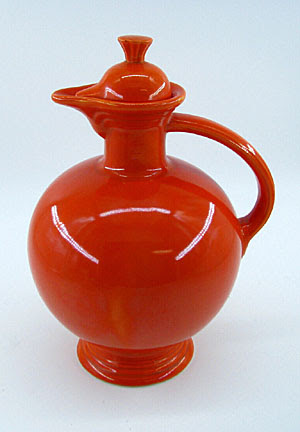
Originally, the company offered 37 different affordable pieces, ranging from candle holders and ashtrays to large serving dishes, each in five bright colors: red-orange, yellow, green, cobalt blue, and ivory. It added turquoise in 1939 for a total of six basic colors.

Homer Laughlin pioneered a whole new concept in dinnerware with Fiesta. When it first introduced the dinnerware at the annual Pottery and Glass Exhibit held in Pittsburgh, Pennsylvania in January 1936, its line was the first widely mass-marketed, solid-color dinnerware in the country. It was also the first dinnerware that consumers could purchase by the piece instead of in complete sets, as was the custom at the time. This allowed customers to mix and match, perhaps choosing a different color for each place setting, or have all their dinner plates one color, their cups and saucers another, and so on. This concept became instantly popular with the public, and soon Fiesta dinnerware became a runaway hit.

At its introduction, Fiesta dinnerware consisted of the usual place settings of dinner plates, salad plates, soup bowls, and cups and saucers, plus occasional pieces such as candle holders in two designs, a bud vase, and an ash tray. A set of seven nested mixing bowls ranged in size from five to twelve inches in diameter. The company also sold basic place settings for four, six and eight persons. But the idea from the start was to create a line of open-stock items from which the consumer could pick and choose based on their personal preference.

The Homer Laughlin Company quickly added several additional items to their line and eliminated several unusual items—a divided 12-inch plate, a turquoise covered onion soup bowl, and the covers for its set of mixing bowls. The Fiesta line eventually consisted of 64 different items, including flower vases in three sizes, water tumblers, carafes, teapots in two sizes, five-part relish trays, and large plates in 13- and 15-inch diameters. 

But with the onset of World War II, the company was forced to reduce the number of items in the Fiesta line as public demand declined and companies cut back non-war related production. By the end of the war, Homer Laughlin had reduced the items in its Fiesta line by one third. 

The design of the original dinnerware pieces remained unchanged from 1936 to 1969. However, the company did change its colored glazes to keep up with home decorating color trends. It introduced four new colors—rose, gray, dark green, and chartreuse, replacing the original blue, green, and ivory. Yellow and turquoise continued in production.

By the end of the 1950s, sales again dropped, so the company reduced its offering of items and changed the glaze colors once again. This time, it introduced a medium green, to distinguish it from other green glazes which the company had produced. This shade of green is in high demand by collectors, and certain pieces in this color command extremely high prices.

Homer Laughlin removed the original red-orange color, the most expensive glaze to produce, before 1944 because it contained uranium oxide which the government needed to construct the atom bombs. Therefore, red pieces also usually command a premium price in today’s collectible market.

By 1969, the company restyled the finials on covers, handles on cups, bowl contours and shapes to give them a more contemporary style. 

Fiesta dinnerware became popular once again as baby boomers began establishing their own homes. Not long after Homer Laughlin discontinued the brightly colored dinnerware line in January 1973,  collectors began buying up what remained at garage sales and second-hand shops. Prices for it hit the roof and by the mid-1980s, prices of Fiesta items reached $100 for scarcer pieces. 

Generally, serving pieces such as casserole dishes, carafes, teapots, and water pitchers almost always have higher values than normal place setting pieces. As mentioned earlier, certain colors are also priced higher, no matter what the piece.

It’s also important to look on the back of each piece for the familiar “Fiesta” backstamp,  followed by 'HLC USA', 'MADE IN USA' or 'H.L. CO. USA.' You may also discover some pieces with the word 'GENUINE' stamped near the Fiesta signature.

To read more articles on antiques, please visit the Antiques Articles section of my Web site.  And to stay up to the minute on antiques and collectibles, please join the over 30,000 readers by following my free online magazine, #TheAntiquesAlmanac. Learn more about old-time winter objects in the 2022/2023 Winter Holiday Edition, with the theme "Winter Memories," online now. And to read daily posts about unique objects from the past and their histories, like the #Antiques and More Collection on Facebook.


Thursday, November 5, 2020

The Origin of American Studio Pottery


QUESTION: I’ve always loved handmade pottery. And looking back over history, it seems to have existed since ancient times. Recently, a friend told me that Charles Binns was the father of American studio pottery. Exactly what does that mean? Isn’t all handmade pottery made in a studio?

ANSWER: While pottery, itself, has existed for eons, what’s referred to as “studio pottery” is a relatively recent phenomenon, dating to the very late 19th century and early 20th. 

Although now nearly forgotten, Charles Fergus Binns, a studio potter and instructor, enjoyed a national reputation during the early years of the 20th century for his classic stoneware pots. Binns' made many of his legendary stoneware vases, bottles, bowls and jars during the height of the Arts and Crafts Movement in the U.S.

Born in England in 1857, Binns left school at age 14 to become an apprentice at the Royal Worcester Porcelain Works, where his father was a co-managing director. Eventually, he occupied an administrative position at the Royal Worcester factory and  became a recognized scholar and lecturer concerning world ceramics. In Paris, in 1878, he exhibited his early experiments with clay bodies and glazes. Binns accompanied the Royal Worcester exhibit of 1,400 pieces to the Chicago World's Fair in 1893 and made the United States his home in 1897. 


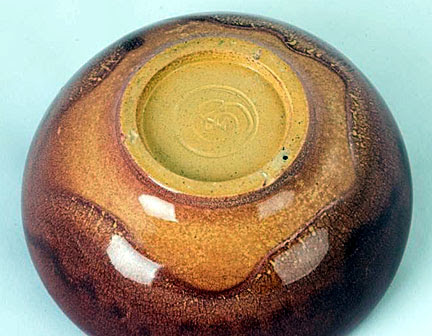
Binns's ceramic technique focused on his pots as utilitarian objects. His work included vases, urns, and bowls. He threw each piece in three forms on a wheel, turning them on a lathe and piecing them together afterwards. One of the concepts Binns taught was “dead ground,” in which the parts of making pottery that couldn’t be precisely controlled, such as firing temperature or glaze calculations, were mitigated by control over glaze placement.

In 1899, Binns helped found the American Ceramics Society. His role in this organization led to the directorship of the newly formed ceramics department of Alfred University, the first United States college to combine programs in ceramic art and science. In the years that followed, Binns shared once-secret clay recipes and glaze formulas with his students, including Arthur Eugene Baggs, William Victor Bragdon, R. Guy Cowan, Maija Grotell and Elizabeth Overbeck, who were largely responsible for fostering the idea of the artist-potter in America.  

Binns is commonly referred to as the "father of American studio ceramics." This title reflects not only his creation of unique stoneware pots in the Arts & Crafts style, but additionally acknowledges his accomplishment of bringing vital information about ceramic clay bodies and glaze recipes to ordinary people, thus laying the foundation of the flourishing studio ceramics movement in the United States that began in the early 1900's.

In 1900, New York Governor Teddy Roosevelt signed a bill establishing the New York State School of Clay-Working and Ceramics—now the New York State College of Ceramics at Alfred University. Appointed as the founding director at that time, Binns held the position for over 30 years until his retirement in 1931, during which time he became known for his classic pots with rich monochrome glazes.

Before Binns' arrival at Alfred University, it was customary for one
person to throw art pottery on the wheel and another person to glaze or decorate surfaces mar reflected his respect for the natural materials he used. He admired Oriental forms and glazes. and sometimes signed his pieces by putting his initials, “CFB" inside a circle closely resembling Chinese marks. His signed pieces ;following Asian tradition, Include his initials along with the year in which he made them.

Binns' work was widely exhibited during his lifetime, including his earliest documented stoneware vase, signed and dated 1905, and his final creation, a fragile bisque vase that he

signed and dated 1934, which he left unglazed and unfired at the time of his death. A memorial exhibition Of Binns’ works drew admiring crowds at the Metropolitan Museum of Art in New York in 1935.

American studio ceramics really began with Charles Fergus Binns, who introduced the principles of chemistry and materials science into the ceramic arts. 

To read more articles on antiques, please visit the Antiques Articles section of my Web site.  And to stay up to the minute on antiques and collectibles, please join the over 30,000 readers by following my free online magazine, #TheAntiquesAlmanac. Learn more about the Retro style in the Fall 2020 Edition, online now. And to read daily posts about unique objects from the past and their histories, like the #Antiques and More Collection on Facebook.


Monday, July 1, 2013

A True Premium Collectible


QUESTION: My mother died recently and left me, among other things, her set of Autumn Leaf china. When I was a kid, I remember her setting our dining room table with this colorful china on holidays like Thanksgiving and Christmas, but especially Thanksgiving because the pattern seemed to complement the occasion. The set is still in pretty good condition since she only used it on special occasions. Do you know if this has any value today? While I like it and it does bring back memories, it seems a bit old-fashioned for today’s use.

ANSWER: Your Autumn Leaf china definitely has value today. In fact, it’s held its value over the last 20 years. However, it all depends which types of pieces you have and on their condition.

The Hall China Co. began producing this decal pattern and offering it exclusively through the Jewel Tea Co. of Barrington, Illinois, in 1936, during the Great Depression. This door-to-door sales firm offered Autumn Leaf pieces as premiums for the purchase of other items, such as teas, coffee, grocery items, and laundry products.

During that time, this china was popular with housewives, who literally had to watch every penny. And the only way for them to obtain pieces were as premiums from Jewel Tea. Since the china was of good quality and had a somewhat elegant and colorful design, many housewives considered Hall’s Autumn Leaf Dinnerware as their good dishes, to be used primarily for company. Most pieces stayed in excellent condition because they washed them and put them away immediately after each use.

Determining the value of this dinnerware can be tricky. Prices vary from coast to coast and in different parts of the country. Since most pieces of this pattern would have been used, even as good dishes, they’re usually not sold in mint condition. This means that your mother’s dishes would only sell for half of the mint price. Also, Hall produced many of the more common pieces from 1936 all the way to 1976, a span of 40 years.

Generally, it seems the more odd a piece of Autumn Leaf is, the more it’s worth. Age doesn’t seem to enter into the equation. So this china is a pure collectible.

For instance, a dozen cups and saucers, labeled as “Breakfast cups and saucers” in Jewel Tea advertisements, brings about $120, or $10 each. An Irish coffee mug, on the other hand, sells for around $40. Four berry bowls also sell for $10 apiece while an oval meat platter brings only about $10.

The big money is in some of the more unusual pieces. Since Autumn Leaf sold as a premium, housewives bought a piece or two at a time—a cup and saucer, a dinner plate, a water pitcher, etc. They bought what they needed in quantities they needed. Jewel Tea never sold this china in complete sets. So the number of the more unique pieces sold—coffee and teapots, mixing bowls, salad bowls, cake plates, and such—was smaller in comparison to ordinary place settings.

One of the hottest items is the cookie jar. Introduced in 1957, the "modern-style" cookie jar has two big handles which Jewel liked to call "easy grip." The original selling price of the cookie jar was only $3.That price has since soared to nearly $200. An earlier cookie jar, introduced for Christmas 1936, sold for $1.50 and Jewel Tea offered it for only three years. Ironically, it sells for about the same price as the other jar.

Another item that’s at the top of most Autumn Leaf collectors’ wish lists is the butter dish. These came in several styles, sized to fit either a quarter pound or a whole pound of butter. The first one to be offered by Jewel Tea was a one-pound model with a long handle on the top. Introduced in 1959, it sold for $3.25. But its style proved to be inconvenient, so the company discontinued it after only one season. As with any item offered by Jewel Tea, those which housewives disapproved of were quickly discontinued. Hall produced improved versions of its butter dish with easier-to-grip bud or "bud ray" knobs. Today, collectors can’t buy a butter dish for less than $150. Those with special “wings” handles sell for over $2,000.

The Autumn Leaf pattern includes many types of accessories, including several clocks. One style, made from a regular Autumn Leaf cake plate, produced from 1956-1959, now sells for $400 to $550.


Monday, January 21, 2013

What’s Up with Watt?


QUESTION: I have some pieces of kind of folksy pottery sitting on a shelf in my kitchen. My mother, who had given them to me, said they belonged to my grandmother. It seems that during the 1950s she picked them up at the grocery store as premiums. She began with coffee mugs and then added a pasta bowl and covered casserole dish. They all have the word “Watt” embossed into the clay on the bottom. Can you tell me anything about these pieces?

ANSWER: Your pottery pieces came from the Watt Pottery of Crooksville, Ohio. They’re highly collectible and today bring relatively high prices.

The Watt family of Perry County, Ohio opened the Watt Pottery in July, 1922 on the site of the old Burley Pottery in Crooksville. Through the remainder of the 1920s and into the early 1930s they made stoneware butter churns, crocks, jugs, and preserve jars, which they marked with an acorn or an eagle  stamped in blue, plus how many gallons the vessel would hold marked in a circle on the bottom.

But the introduction of oven ware pottery, enabling cooks to take a container from their ice boxes and put it directly into their ovens, forced the Watt pottery to discontinue its stoneware line and pursue the more lucrative oven ware.

The lightweight clay body, made of a percentage of feldspar and whiteners which prevented the clay from discoloring after firing in the pottery kilns, also made it resilient enough to withstand the extremes in temperature. The whiteners also gave the Watt’s pottery its brightness, especially when over painted with brightly colored motifs featuring apples, cherries, roosters, and flowers..

In 1949, the Watt Pottery began hand decorating its wares using simple patterns in bright colors on an ochre-colored clay base. To minimize the cost of producing these wares, teams of three decorators used  as few brush strokes as possible. The housewives of the 1950s loved the country charm of these wares. And because they were so inexpensive to produce, Watt wares began appearing as premiums in grocery and department stores.

Altogether, Watt Pottery produced wares decorated in 16 patterns, including four variations of the Apple Pattern, one in the Cherry Pattern, two of the Tulip Pattern, six in various flower patterns, plus Autumn Foliage and Eagle Patterns. The pottery remained in business until a fire in 1965 destroyed the manufacturing plant and halted production.

Most pieces of Watt Pottery ovenware feature large marks, often covering the entire bottom of each piece. These markings usually consist of one or more concentric rings deeply impressed into the bottom of the pottery. Although the company didn’t mark all of its wares, the bottom mark associated with 1940s Watt ware is an impressed: "MADE IN U.S.A."  Pieces may also be marked: "Oven Ware" or simply have the bowl size impressed, usually in a circle.

The pasta bowl your grandmother purchased back in 1952 is now worth nearly $100, and the covered casserole dish comes in at $150. But the big surprise are the coffee cups, now worth a whopping $200 each!