Showing posts with label dinner. Show all posts

Friday, August 28, 2026

A Touch of Elegance


QUESTION: At a recent antique show, I discovered a dealer with a display of unusual antiques. The sign on his booth said “Epergnes and Plateaus.” When I asked him what the many highly polished silver and silverplate and glass pieces were used for, he replied that they were centerpieces from the 19th century. While I couldn’t see a use for either type of ware in today’s casual lifestyle, I was intrigued. He couldn’t tell me very much about their history. What can you tell me about epergnes and plateaus? Are they still being used today?

ANSWER:  Nothing evokes the elegance of the Gilded Age as epergnes and plateaus. While the average person probably has never heard of them, wealthy hosts, who loved to show off to others in their class, would have seen them grace the tables at dinner parties in the late 18th and 19th centuries. The epergne became the highlight of these centerpieces. And to help reflect the candlelight on the table, it often sat on a mirrored glass plateau.

An epergne is a centerpiece which may be used to serve food, as well. At first they were long and low, with a bowl in the center and sweetmeat dishes on either end. Later models often had great height, with a fruit or flower dish in the center surrounded by hanging baskets. These hanging basket dishes could be used to serve nuts or candies. However, a piece like this would most likely have been used for decoration.

Epergnes came in clear glass, cut class in all sorts of colors and decorations, as well as both regular and Sheffield silver plate and, occasionally, sterling silver. 

Hostesses used plateaus, low, flat mirrored glass platforms, on the other hand, to serve light buffets, cookies and cakes, candies and hors d’oeuvres. They usually came with five serving bowls, often used for chips and dip. But the most important utilitarian use for plateaus was to reflect light from candles on the table.

Both plateaus and epergnes were symbols of wealth. Craftsmen used exotic animals to decorate them, fantasizing about what they looked like because they didn’t have prior knowledge.

Centerpieces for fruit and flowers were in great demand in the 19th century. Epergnes and plateaus allowed the designer to use his imagination and ingenuity both in the design and workmanship. Some featured Roman chariots drawn by cupids. Bas reliefs ornamented others. Craftsmen burnished the metal and touched the edges and rims with gold.  Bowls hung from trees and vines or were supported by classic male or female figures.

The typical epergne usually consisted of a tall fruit dish on a metal stand with two lower matching dishes. One by Reed and Barton had a peacock drawing a chariot which held a glass container for flowers. Another featured a rowboat holding children, while Meriden Britannia made a delicate sailboat set on a plateau. A bowl for fruit was set on a pedestal from which sprang a decorative vine-entwined arm holding a cornucopia-shaped glass vase for flowers. 

Craftsmen on both sides of the Atlantic fashioned epergnes, with the fanciest coming from France. Some featured a number of levels, with several shelves. Others had base consisting of a classic figure or exotic animal with dish or vases resting atop its head. Most silver companies made epergnes with sterling as well as gold decoration. 

The English made epergnes as early as the 1860s in Sheffield plate. To complement some of their most elaborate epergnes, manufacturers created plateaus of all shapes and sizes—oval, round, and rectangular—with gadroon or fluted borders in plain or satin finish. They also made them with repousse borders and fancy corners to complement the epergne designs.

The English made epergnes as early as the 1860s in Sheffield plate. To complement some of their most elaborate epergnes, manufacturers created plateaus of all shapes and sizes—oval, round, and rectangular—with gadroon or fluted borders in plain or satin finish. They also made them with repousse borders and fancy corners to complement the epergne designs.

By the mid-1870s, the introduction of silverplate by the Meriden Company stimulated the taste for beautiful pieces at a lower cost. Epergnes and plateaus produced in silverplate became popular on both sides of the Atlantic. However, the popularity of silverplate only lasted until the late 19th century when the falling price of silver made it possible for those who wanted silver epergnes to buy sterling. 

As ornate silver epergnes lost favor with the public for table centerpieces, the simpler glass epergnes came into style. After 1850, glass epergnes became popular, especially those made of frosted glass and opaque milk glass.

The Sandwich Glass Factory and the New England Glass Company, two American firms that both made epergnes. The former’s 1870 catalog offered dainty chalices of fragile glass springing up around a central vase and sometimes cone shaped glass baskets hanging from metal scrolls. Only the smallest flowers and most delicate ferns could be placed in these dainty baskets. While these companies usually made their epergnes of colored glass, in later years, they began to produce ones with clear glass etched bowls, highlighted in gold.

As the Victorian era came to a close, low bowls of ornamental glass, known as berry bowls, began to replace the larger epergnes, which seemed so high and spreading that they seemed more suitable for formal dinners or banquets. It was a matter of convenience, for one thing, which made hostesses decide in favor of these glass berry bowls. They could fill them with fruit or flowers and  leave them on the table throughout the meal. 

Ornamental glass manufacturers like Fenton made berry bowls in many colors and types of glass, with some having two colors of glass fused together so that the lining and exterior surface formed a contrast in color. For example, they lined white opaque glass bowls with green, pink, deep rose; blue, amethyst, brownish-orange, apricot, or yellow glass. They applied a frosted surface to red glass bowls, giving them a satin-like finish. 

Though many ruffled-edge epergne berry bowls can be from 9 to 12 inches in diameter, some companies made them as small as 4 to 5 inches across. Glassmakers made them in various shapes with a variety of edges to go with the overall design of individual epergnes. They gave some a wavy, plaited edge while on others they used large petals which had a twist in the glass near the point of each petal. 

Visitors to the Columbian Exposition of 1893 in Chicago could purchase ruffled-edge berry bowls as souvenirs and gifts to relatives and friends. Women also loved to give these colorful and ornate dishes as wedding gifts. Often, they came mounted in a silver plated frame and made a striking table centerpiece, though not as large and elaborate as the traditional epergne. 

After a decline in the use of epergnes at the turn of the 20th century, the makers of carnival glass revived an interest in them by contributing some colorful variations to the traditional epergne designs. The Dugan Glass Company of Indiana, Pennsylvania, made a fishnet epergne using carnival glass. At the same time, the Sowerby Glass Company of Gateshead, England, made a fountain epergne, with glass holders in a sterling frame. The clear glass lilies of this epergne had twisted bases with fluted tops that were marigold in color. One of the rarest carnival glass epergnes, a four-lily version worth over $1,000 in today’s market, was made by Fenton-Imperial Glass Company. 

While epergnes and plateaus may have generally subsided in use, caters to large events like cocktail parties and banquets often use berry bowl epergnes and mirror glass plateaus to display canapes on elaborate buffet tables. 

To read more articles on antiques, please visit the Antiques Articles section of my Web site.  And to stay up to the minute on antiques and collectibles, please join the over 50,000 readers by following my free online magazine, #TheAntiquesAlmanac. Learn more about "Victorian America" in the 2026 Summer Edition, online now. And to read daily posts about unique objects from the past and their histories, like the #Antiques and More Collection on Facebook.

Wednesday, November 27, 2024

The Perfect Platter


QUESTION : For many American families, Thanksgiving has become a landmark holiday marking the beginning of the holiday season. It’s a time when family members begin planning the event as early as October. At the center of it all lay the traditional dinner, with its array of foods surrounding a plump brown roasted  turkey which sat on a grand platter, which had been handed down for generations. Can you tell me how these platters came to be, who made them, and why they became so popular?

ANSWER: Many families still use a large turkey platter. Though large but not very sophisticated, it often features a 22-inch pattern manufactured by Homer Laughlin. It’s got high sides and can hold a very large turkey, and by now it’s even got a few rim chips, but it’s part of the family.

The first turkey platters appeared in the early 1870s, when East Liverpool, Ohio, was the setting for the founding of several important American potteries due to the existence of raw materials such as clay, coal and natural gas. One of the largest and most successful, was the Homer Laughlin China Company, founded by brothers Homer and Shakespeare Laughlin in 1897. It went on to become one of the world's major producers of institutional china, including Fiesta ware. They based their holiday platters on several of their most popular dinnerware lines and decorated them with colorful printed transfers.


Thus, the same image often appeared on many of their turkey platters—a bird with its tail feathers fanned out fully, set against a rural farmyard background. The platters featured wide rims in Harlequin yellow and turquoise blue.

In the mid-1950s, a similar design appeared on Thanksgiving platters made by Taylor, Smith & Taylor, which the company sold to retailers to use as an advertising premium. 

In its "Historical America" series, Laughlin also produced an elaborate scene from 1621 called "The First Thanksgiving," transfer printed in rose pink and sold exclusively through F.W. Woolworth. The company also produced a similar "Bountiful Harvest" platter showing Pilgrims and Indians gathering and sharing food.


A somewhat scrawnier bird appears on platters and plates made by Southern Potteries Inc., a Tennessee firm formerly known as Clinchfield Potteries. It began in 1917 by producing commercial, semi-vitreous china tableware decorated with stock transfers. 

Its better-known trademark, Blue Ridge, debuted in 1932. By the late 1930s, it had switched from transfers to underglazed hand-painted decoration. Within 15 years, it had become the largest American producer of hand-painted china, with an annual production of 24 million pieces. Some of the firm’s top artists signed a limited number of special designs, and these are among the most coveted pieces for collectors. 


For example, there’s a wild turkey platter painted and signed by artist Mildred L. Broyles, depicting a standing, long-necked bird eyeing a bug, valued at over $2,000. Another, signed by Louise Gwinn called “Turkey Gobbler,” shows a bird in a woods and sells for over $1,750.

While Homer Laughlin and Southern Potteries dominated the market, there were several other companies, from California and elsewhere; that staked their own claims. Among these are platters produced by the Nelson McCoy Pottery Comapny of Roseville, Ohio, featuring a solid brown embossed relief of Tom Turkey, the Delano Studios of Long Island, featuring a soaring bird in flight, and the Hadley of Louisville platter, with its whimsical, schematic turkey in blue on vitrified stoneware.

To read more articles on antiques, please visit the Antiques Articles section of my Web site.  And to stay up to the minute on antiques and collectibles, please join the over 30,000 readers by following my free online magazine, #TheAntiquesAlmanac. Learn more about "Lady Luck" in the 2024 Fall Edition, online now. And to read daily posts about unique objects from the past and their histories, like the #Antiques and More Collection on Facebook.


Tuesday, November 22, 2022

A Thanksgiving Heirloom


QUESTION: For my family, Thanksgiving was the biggest gathering of the year. I remember my mother planning the event as early as October. Back in the 1950s, we'd pile into the car and drive to the local turkey farm to order a very large bird. My mother would have never considered buying a frozen turkey at the local market. I heard her speaking on the phone to my grandmother about how many were corning, what kinds of pies should be baked, or whether we would add some new recipe for cranberry sauce. At the center of it all lay the traditional turkey platter, which had been handed down for generations. Can you tell me how these platters came to be, who made them, and why they became so popular?

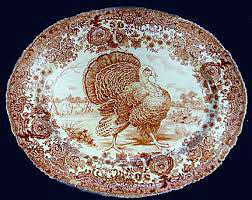
ANSWER: Many families still use a large turkey platter. Though large but not very sophisticated, it often features a 22-inch pattern with yellow roses manufactured by Homer Laughlin. It’s got high sides and can hold a very large turkey, and by now it’s even got a few rim chips, but it’s part of the family, so it means a lot. 

The turkey was the last dish to be brought to the table and the senior member of the family would always carve the bird. Everyone would say grace and eat more than any thought humanly possible. While sitting around the table, family members would tell stories—Grandpa always seemed to tell the same ones to the embarrassment of his wife. In many cases, this holiday feast was just as Norman Rockwell painted it. 

The first turkey platters appeared in the early 1870s, when East Liverpool, Ohio, was the setting for the founding of several important American potteries due to the existence of raw materials such as clay, coal and natural gas. One of the largest and most successful, was the Homer Laughlin China Company, founded by brothers Homer and Shakespeare Laughlin in 1897. It went on to become one of the world's major producers of institutional china, including Fiesta ware. They based their holiday platters on several of their most popular dinnerware lines and decorated them with colorful printed transfers.

Thus, the same image often appeared on many of their turkey platters—a bird with its tail feathers fanned out fully, set against a rural farmyard background. The platters featured wide rims in Harlequin yellow and turquoise blue.

In the mid-1950s, a similar design appeared on Thanksgiving platters made by Taylor, Smith & Taylor, which the company sold to retailers to use as an advertising premium. 

In its "Historical America" series, Laughlin also produced an elaborate scene from 1621 called "The First Thanksgiving," transfer printed in rose pink and sold exclusively through F.W. Woolworth. The company also produced a similar "Bountiful Harvest" platter showing Pilgrims and Indians gathering and sharing food.

A somewhat scrawnier bird appears on platters and plates made by Southern Potteries Inc., a Tennessee firm formerly known as Clinchfield Potteries. It began in 1917 by producing commercial, semi-vitreous china tableware decorated with stock transfers. 

Its better-known trademark, Blue Ridge, debuted in 1932. By the late 1930s, it had switched from transfers to underglazed hand-painted decoration. Within 15 years, it had become the largest American producer of hand-painted china, with an annual production of 24 million pieces. Some of the firm’s top artists signed a limited number of special designs, and these are among the most coveted pieces for collectors. 

For example, there’s a wild turkey platter painted and signed by artist Mildred L. Broyles, depicting a standing, long-necked bird eyeing a bug, valued at over $2,000. Another, signed by Louise Gwinn called “Turkey Gobbler,” shows a bird in a woods and sells for over $1,750.


While Homer Laughlin and Southern Potteries dominated the market, there were several other companies, from California and elsewhere; that staked their own claims. Among these are platters produced by the Nelson McCoy 
Pottery Company of Roseville, Ohio, featuring a solid brown embossed relief of Tom Turkey, the Delano Studios of Long Island, featuring a soaring bird in flight, and the Hadley of Louisville platter, with its whimsical, schematic turkey in blue on vitrified stoneware.

To read more articles on antiques, please visit the Antiques Articles section of my Web site.  And to stay up to the minute on antiques and collectibles, please join the over 30,000 readers by following my free online magazine, #TheAntiquesAlmanac. Learn more about art glass in the 2022 Fall Edition, with the theme "After-Battle Antiques," online now. And to read daily posts about unique objects from the past and their histories, like the #Antiques and More Collection on Facebook.


Thursday, November 28, 2019

Setting the Thanksgiving Table


QUESTION: As the holidays approach, I get out my Oneida silver flatware and polish it up for another joyous season. Beginning with Thanksgiving dinner, I use a setting for 12 that’s been in our family for four generations. Except for the classic beauty of this tableware, I know very little about it. Can you please tell me more about Oneida?

ANSWER: The holidays, especially Thanksgiving, are all about traditions in many families. Your use of your Oneida family heirloom is no exception. But Oneida didn’t always make silver flatware. In fact, at one point early in the company’s existence, it made grizzly bear traps.

Oneida, Ltd. actually began as a utopian religious commune in 1848. At that time, there were several such communities that existed in the northeastern United States. Oneida was one of them.


John Humphrey Noyes and his followers founded the Oneida Community in Oneida, New York. Members of this Protestant, religious sect referred to themselves as Perfectionists because they believed that spiritual perfection could be achieved by them in this world. This was a common concept among 19th-century utopian communities. Much like the Shakers, members contributed all their worldly goods to the community when they joined it. The community held all possessions in common, and it provided for everyone's needs. They called this practice "Bible communism.''

But the Oneida Community is best known for its unconventional family arrangements. Members practiced what Noyes called complex marriage—every man was married to every woman, just as every woman was married to every man. Although neighbors surrounding the community saw this as "free love,” the Perfectionists defended complex marriage as noble and unselfish, since all were expected to be loving to each other. It discouraged individual relationships. During its early years, the community also discouraged child bearing, but by 1869 when the community had become more prosperous, its elders selected couples with desirable qualities and encouraged them to bear children. John Humphrey Noyes himself fathered several, including sons who were later very active in the affairs of the future company. Oneida, Ltd.

At first the Perfectionists tried to support themselves by farming and by preserving and selling fruits and vegetables. But this didn’t provide sufficient income, so they branched out into several industrial activities. An 1890s ad offered a booklet which told how the community came to make such interesting and incongruous things as delicious preserved fruits and traps for catching grizzly bears, fine sewing and embroidery silk, d steel chains, and beautiful flatware. Let’s face it, not many silver companies started out making traps for grizzly bears.

By 1877, when the Wallingford, Connecticut, branch of the community started making tin-plated spoons, the original Oneida Community was beginning to break up. In 1879, Noyes moved to Canada and members abandoned the concept of complex marriage. In 1880, the assets of the community were distributed to its members in the form of stock in the newly formed corporation, Oneida Community, Limited, making it one of the earliest joint-stock companies in the United States.

The new company, under the leadership of P.B. Noyes, one of the sons of the founder, first moved its silverplate production to Niagara Falls, New York, and later to Sherill, New York, within walking distance of the original Oneida Community property. It began production of silver-plated flatware and hollow-ware in 1899 using the "Community Plate" mark.

When the community became a corporation, some members found it difficult to adjust to the new business practices and divided into factions, each competing to control the board of directors. But the younger Noyes remained in control and moved the company into manufacturing higher quality wares in sterling silver, including a flatware line called Avalon in 1901. In 1929, it purchased the William A. Rogers Company began producing a lower-quality line of products using that company’s mark. In 1935, the firm changed its name to Oneida, Ltd.

By 1961, Oneida, Ltd. began producing stainless steel flatware. And by the 1980s, Oneida made at least half of all flatware purchased in the United States. At the end of the 20th century, Oneida fell upon tough economic times, becoming the last remaining U.S.-based manufacturer of flatware, knives, forks, and spoons. The resulting economic troubles resulting from 9/11 forced it to close or sell off most of its factories.
It filled for bankruptcy in 2006, and after finally stabilizing, Monomoy Capital Partners, an equity fund based in New York City, acquired it. Today, it services much of the food service industry with both china and flatware.

To read more articles on antiques, please visit the Antiques Article section of my Web site.  And to stay up to the minute on antiques and collectibles, please join the other 24,000 readers by following my free online magazine, #TheAntiquesAlmanac. Learn more about antique clocks in the Fall 2019 Edition, "It's That Time Again," online now. And to read daily posts about unique objects from the past and their histories, like the #Antiques & More Collection on Facebook.


Monday, November 20, 2017

A Platter Fit for a Turkey


QUESTION: For my family, Thanksgiving was the biggest gathering of the year. I remember my mother planning the event as early as October. Back in the 1950s, we'd pile into the car and drive to the local turkey farm to order a very large bird. My mother would have never considered buying a frozen turkey at the local market. I heard her speaking on the phone to my grandmother about how many were corning, what kinds of pies should be baked, or whether we would add some new recipe for cranberry sauce. At the center of it all lay the traditional turkey platter, which had been handed down for generations. Can you tell me how these platters came to be, who made them, and why they became so popular?

ANSWER: Many families still use a large turkey platter. Though large but not very sophisticated, it often features a 22-inch pattern with yellow roses manufactured by Homer Laughlin. It’s got high sides and can hold a very large turkey, and by now it’s even got a few rim chips, but it’s part of the family, so it means a lot.

The turkey was the last dish to be brought to the table and the senior member of the family would always carve the bird. Everyone would say grace and eat more than any thought humanly possible. While sitting around the table, family members would tell stories—Grandpa always seemed to tell the same ones to the embarassment of his wife. In many cases, this holiday feast was just as Norman Rockwell painted it.

The first turkey platters appeared in the early 1870s, when East Liverpool, Ohio, was the setting for the founding of several important American potteries due to the existence of raw materials such as clay, coal and natural gas. One of the largest and most successful, was the Homer Laughlin China Company, founded by brothers Homer and Shakespeare Laughlin in 1897. It went on to become one of the world's major producers of institutional china, including Fiesta ware. They based their holiday platters on several of their most popular dinnerware lines and decorated them with colorful printed transfers.

Thus, the same image often appeared on many of their turkey platters—a bird with its tail feathers fanned out fully, set against a rural farmyard background. The platters featured wide rims in Harlequin yellow and turquoise blue.

In the mid-1950s, a similar design appeared on Thanksgiving platters made by Taylor, Smith & Taylor, which the company sold to retailers to use as an advertising premium.

In its "Historical America" series, Laughlin also produced an elaborate scene from 1621 called "The First Thanksgiving," transfer printed in rose pink and sold exclusively through F.W. Woolworth. The company also produced a similar "Bountiful Harvest" platter showing Pilgrims and Indians gathering and sharing food.

A somewhat scrawnier bird appears on platters and plates made by Southern Potteries Inc., a Tennessee firm formerly known as Clinchfield Potteries. It began in 1917 by producing commercial, semi-vitreous china tableware decorated with stock transfers.

Its better-known trademark, Blue Ridge, debuted in 1932. By the late 1930s, it had switched from transfers to underglazed hand-painted decoration. Within 15 years, it had become the largest American producer of hand-painted china, with an annual production of 24 million pieces. Some of the firm’s top artists signed a limited number of special designs, and these are among the most coveted pieces for collectors.

For example, there’s a wild turkey platter painted and signed by artist Mildred L. Broyles, depicting a standing, long-necked bird eyeing a bug, valued at over $2,000. Another, signed by Louise Gwinn called “Turkey Gobbler,” shows a bird in a woods and sells for over $1,750.

While Homer Laughlin and Southern Potteries dominated the market, there were several other companies, from California and elsewhere that staked their own claims. Among these are platters produced by the Nelson McCoy Pottery Comapny of Roseville, Ohio, featuring a solid brown embossed relief of Tom Turkey, the Delano Studios of Long Island, featuring a soaring bird in flight, and the Hadley of Louisville platter, with its whimsical, schematic turkey in blue on vitrified stoneware.

 To read more articles on antiques, please visit my Web site.  And to stay up to the minute on antiques and collectibles, please join the other 17,000 readers by following my free online magazine, #TheAntiquesAlmanac.

Monday, July 1, 2013

A True Premium Collectible


QUESTION: My mother died recently and left me, among other things, her set of Autumn Leaf china. When I was a kid, I remember her setting our dining room table with this colorful china on holidays like Thanksgiving and Christmas, but especially Thanksgiving because the pattern seemed to complement the occasion. The set is still in pretty good condition since she only used it on special occasions. Do you know if this has any value today? While I like it and it does bring back memories, it seems a bit old-fashioned for today’s use.

ANSWER: Your Autumn Leaf china definitely has value today. In fact, it’s held its value over the last 20 years. However, it all depends which types of pieces you have and on their condition.

The Hall China Co. began producing this decal pattern and offering it exclusively through the Jewel Tea Co. of Barrington, Illinois, in 1936, during the Great Depression. This door-to-door sales firm offered Autumn Leaf pieces as premiums for the purchase of other items, such as teas, coffee, grocery items, and laundry products.

During that time, this china was popular with housewives, who literally had to watch every penny. And the only way for them to obtain pieces were as premiums from Jewel Tea. Since the china was of good quality and had a somewhat elegant and colorful design, many housewives considered Hall’s Autumn Leaf Dinnerware as their good dishes, to be used primarily for company. Most pieces stayed in excellent condition because they washed them and put them away immediately after each use.

Determining the value of this dinnerware can be tricky. Prices vary from coast to coast and in different parts of the country. Since most pieces of this pattern would have been used, even as good dishes, they’re usually not sold in mint condition. This means that your mother’s dishes would only sell for half of the mint price. Also, Hall produced many of the more common pieces from 1936 all the way to 1976, a span of 40 years.

Generally, it seems the more odd a piece of Autumn Leaf is, the more it’s worth. Age doesn’t seem to enter into the equation. So this china is a pure collectible.

For instance, a dozen cups and saucers, labeled as “Breakfast cups and saucers” in Jewel Tea advertisements, brings about $120, or $10 each. An Irish coffee mug, on the other hand, sells for around $40. Four berry bowls also sell for $10 apiece while an oval meat platter brings only about $10.

The big money is in some of the more unusual pieces. Since Autumn Leaf sold as a premium, housewives bought a piece or two at a time—a cup and saucer, a dinner plate, a water pitcher, etc. They bought what they needed in quantities they needed. Jewel Tea never sold this china in complete sets. So the number of the more unique pieces sold—coffee and teapots, mixing bowls, salad bowls, cake plates, and such—was smaller in comparison to ordinary place settings.

One of the hottest items is the cookie jar. Introduced in 1957, the "modern-style" cookie jar has two big handles which Jewel liked to call "easy grip." The original selling price of the cookie jar was only $3.That price has since soared to nearly $200. An earlier cookie jar, introduced for Christmas 1936, sold for $1.50 and Jewel Tea offered it for only three years. Ironically, it sells for about the same price as the other jar.

Another item that’s at the top of most Autumn Leaf collectors’ wish lists is the butter dish. These came in several styles, sized to fit either a quarter pound or a whole pound of butter. The first one to be offered by Jewel Tea was a one-pound model with a long handle on the top. Introduced in 1959, it sold for $3.25. But its style proved to be inconvenient, so the company discontinued it after only one season. As with any item offered by Jewel Tea, those which housewives disapproved of were quickly discontinued. Hall produced improved versions of its butter dish with easier-to-grip bud or "bud ray" knobs. Today, collectors can’t buy a butter dish for less than $150. Those with special “wings” handles sell for over $2,000.

The Autumn Leaf pattern includes many types of accessories, including several clocks. One style, made from a regular Autumn Leaf cake plate, produced from 1956-1959, now sells for $400 to $550.