QUESTION: About five years ago, I bought an old trunk at a yard sale. It’s been sitting in my den all this time waiting for me to do something with it. I’d like to restore it but I’m not sure where to start. Can you give me some advice?
ANSWER: I’ll go one step better and take you through the process with an old trunk I purchased at a porch sale in Binghamton, New York. It’s probably similar to the one you have.
 Although trunks date back to medieval times, it’s only the ones made in the 19th and early 20th centuries that people buy to restore and reuse. Trunks gained popularity with the coming of the railroads. And while people used them when traveling by stagecoach, they were more likely to use a “carpet” bag, one made of durable carpet material that could be carried by the owner.
People along the coasts of the United States traveled from one point on the coast to another by coastal steamer or, within the interior of the country, by steamboat. Larger trunks could be taken along because these vessels had porters to carry the heavy trunks onboard and off, thus the name “steamer” trunk.
 From the later half of the 19th century to the first couple of decades of the 20th, most trunks had flat tops. These usually had a smooth metal or canvas covering, and later an embossed metal cover. They also had wooden slats or metal banding to strengthen them, as well as to add a decorative touch. More elaborate trunks, especially those made by Frenchman Louis Vuitton, had rounded tops.
 A typical 100 to 130-year-old antique trunk has a stale and musty odor from more than a century of collecting dust, mold, and mildew. Along with the deterioration of the outside canvas, leather and the inside paper lining, the glue, itself, will have decomposed over time. The original tray insert, made from a thin wood fiber or a compressed sawdust type of material, may have a deteriorated paper covering. Dry rot and mold can also be present. The purpose of the restoration process is to stop further deterioration and to remove the collection of dust, mildew, and mold which is causing the musty odor.
 A basic restoration consists of first removing all canvas and paper coverings and leather straps and handles. Next the exposed wood must be washed in a special non-toxic solution to kill and remove dust, mold and mildew, then lightly sanded. Any broken hardware must be removed and replaced, as well as all of the leather. It’s important to make all repairs using the same types of tools, nails, tacks, and craftsmanship used when the trunk was first made. The next step is to restore and seal the wood using special non-toxic restorative oils and varnishes in a slow, repetitive manner to bring out the patina that only 100-year-old wood can achieve. The last step is to bring the hardware, fixtures, and any sheathing back to its original color. This includes removing any paint that may have been applied. The hardware, itself, can be painted a flat black if the original finish cannot be restored.
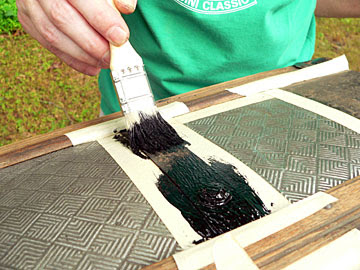 It’s important to use plastic gloves, eye protection, and a construction-grade face mask when removing the dust and old finishes. While there are lots of good non-toxic cleaners on the market today, some toxic ones may have to be used if the finish on the trunk is in bad condition.
After preparing the exterior of the trunk, it’s time to focus on the interior. Never use an old trunk without properly cleaning it both inside and outside. It’s especially important to scrub the inside and remove and old paper lining that can’t be saved. In fact, unless the paper lining in historically important to the trunk, it should be removed entirely, as should the glue holding it in place. Back in the 19th century, trunk makers used horse glue to attach the paper to the inside and canvas to the outside..
 Once the interior has been stripped and cleaned thoroughly, let the trunk air out for several days. The trunk can then be lined with fabric or wallpaper. The interior can be either luxurious or plain. Fabric, especially velvets, will give a more luxurious feel to the interior. But a chintz can also work for a more country look. Wallpaper is easier to apply than fabric, but it’s important to use wallpaper paste to apply it, even if it is pre-pasted. For a washable interior, then vinyl wallpaper is the best solution.
If the trunk straps and hardware are in poor shape, there are sites on the Internet that sell replacements at reasonable prices.
Believe it or not, restoring a trunk actually improves its value because it’s a usable antique. Many people use restored trunks for extra storage and not just for show.
To read more articles on antiques, please visit the Antiques Articles section of my Web site. And to stay up to the minute on antiques and collectibles, please join the over 30,000 readers by following my free online magazine, #TheAntiquesAlmanac. Learn more about "Celebrating an Olde Fashioned Holiday" in the 2020 Holiday Edition, online now. And to read daily posts about unique objects from the past and their histories, like the #Antiques and More Collection on Facebook.