Tuesday, December 19, 2017

It’s Snowing—Babies!


QUESTION: Ever since I was a little girl, I’ve been fascinated by the little white porcelain figurines called “snow babies.” My mother had a number of them and would place them on the mantel above the fireplace nestled in a bed of fresh pine and holly. I can still remember handing them to her since I was too short to reach the mantel. What can you tell me about snow babies? How long have they been around? Are they collectible? If so, I’d like to start my own collection.

ANSWER: Believe it or not, snow babies have been around since the early 1890s. And, yes, they are very collectible. However, over the decades a number of different ones have been produced, not all of which are authentic. So unfortunately, it’s buyer beware.

Snow babies are small figurines, usually of a child, depicting a Christmas or winter sports activity. Like Hummel figurines, they emphasize the nostalgia of childhood and days gone by. But unlike Hummels, their manufacture wasn’t tightly controlled.

Since their introduction in the last decade of the 19th century, snow babies have enchanted collectors all over the world, especially during the holidays. They’re made of unglazed porcelain, also known as bisque, and show a children dressed in one-piece, hooded snowsuits covered in small pieces of hand-whipped crushed porcelain bisque, giving the appearance of fallen snowflakes.

The idea for snow babies evolved from early 19th-century German candy cake toppers, called tannenbaumkanfekt, used to decorate the tops of Christmas cakes and to decorate Christmas trees. Confectioners molded flour, sugar and gum for firmness into little figures, then painted them with vegetable dye. The best loved became known as zuckerpuppes or sugar dolls, which people used, along with igloos and polar bears, to create snow scenes under their Christmas trees. Later, confectioners began making them of marzipan, a mixture of crushed almonds, egg whites and sugar. They were especially popular with confectioners in Lubeck, Germany. One of them, Johann Moll, commissioned Hertwig and Company to re-create these adorable almond paste babies in porcelain bisque. The oldest ones were typically either all white with a painted face or painted in pastel colors.

Hertwig and Company began operation in 1864 in Katzhutte, Thuringia, Germany, making porcelain doll heads and bisque figures. However, the Hertwig snow babies didn’t thrill German children, who naturally preferred the candy version. But their  mothers loved them and used them to adorn their trees and homes during the Christmas season. Then they could pack them up and save them safely for another year.

The first snow babies produced by Hertwig were one to two inches tall, but the company also made some five to seven-inch ones. As production increased, Hertwig began creating snow babies in a variety of winter activities, such as sledding, skiing, and tumbling. Eventually, the company’s artists made the figures’ hands and feet more clearly defined, and even gave their little figures shoes. Although babies predominated, Hertwig produced some older children as well.

Because of Hertwig’s success, many other German companies began to produce snow babies, including Wagner and Appel, Galluba and Hoffman, Bahr and Proeschild, Christian Frederick Klurg, and the Huebach Brothers.

In 1893, Josephine Perry, wife of the famous arctic explorer Robert, shocked the world by accompanying her husband to Greenland on his famous expedition to the North Pole, even though she was expecting a child. On September 8, 1893, Marie Ahnighito Perry, the first non-indigenous baby to be born that far north. The native Intuit came for miles to see the white-skinned baby they called her Ah-pooh-nick-ananny, Inuit for snow baby.

In 1901 Mrs. Perry wrote a book showing a photograph of her daughter wearing a white snow suit and called her a “snow baby.” Suddenly, the German-made figures were in high demand. For many years the Nuremburg firm of Craemer and Co. exclusively exported the figures from Germany. In the U.S., Scholl and Company and Westphalia Imports, both of New York, sold them, as well as confectionery and baking suppliers in the German communities of New York, Philadelphia and Milwaukee. They reached their peak of export to the U.S. between 1906 and 1910 as women’s magazines featured them as Christmas decorations.

In 1910, the R. Shackman Company of New York, an importer of fancy goods, toys and novelties, advertised and distributed them at 20 cents each. In 1914, Sears and Roebuck and Marshall Field, who called them “Alaska Tots,” sold them through their catalogs.

Prior to World War I, snow babies had highly detailed faces, with the paint fired onto the porcelain so that the color would be longer lasting. Some figurines had different pastel colors of ground bisque decoration while others were left all white except for painted faces. But then the Great War began and the export of snow babies came to a sudden halt.

When production resumed after the war, snow babies were smaller, usually ranging from one to three inches tall. Although the paint used came in vibrant primary colors, snow babies now had less facial detail than previous models. The paint was also less durable and prone to flaking. Models in more varied poses appeared, including children singing Christmas carols, riding polar bears, and building snowmen. 

In the 1920s, Japanese manufacturers began to produce snow baby replicas, though they were generally of a lesser quality than those made in Germany.

The early Depression years brought a final group of snow babies from Germany. People once again used them to create Christmas scenes, as well as for package tie-ons and table decorations. There were babies riding airplanes, playing musical instruments, and riding polar bears. However, these later pieces lacked the detail of early snow babies and were less lovable, so their popularity declined during the 1930s and by the outbreak of World War II, snow baby imports stopped. Here in America, interest in snow babies declined from 1950 to the 1980s. In 1987, an American company, Department 56, began producing replicas of the original snow baby designs and had them made in Taiwan. This helped generate a new interest in them as well as in the early pieces.

Obviously, the most collectible snow babies are those produced before World War I. These generally sell for the highest prices. Any of the German ones are also collectible, but as a beginning collector, you need to be aware of cheaper versions made in Asia.

To read more articles on antiques, please visit my Web site.  And to stay up to the minute on antiques and collectibles, please join the other 18,000 readers by following my free online magazine, #TheAntiquesAlmanac.

Monday, December 11, 2017

A 1950s World in Miniature


QUESTION:  My Grandmother had a village of Plasticville that we continue to put up each and every year.  I would like to add to it, but I don't know how to judge the scale of what I have compared to what is available to buy.  Can you tell me more about it and can you give me any guidance?

ANSWER: Except for the flag and Mom’s apple pie, there’s probably nothing more all-American than Plasticville, USA—America of the 1950s anyway. Baby boomers recall their delight as they watched a toy train chug around under the Christmas tree. And in the middle of the track were plastic buildings that helped create the illusion of a little town. It sound like you’re continuing that tradition.

Plasticville is a brand of plastic toy train building sold in the United States, made by formerly Philadelphia, Pennsylvania-based Bachmann Industries since 1947.At that time, the company began making small plastic fences for people to use to surround the displays under their Christmas trees. 

By 1950, Bachman added a variety of small accessories—trees and bushes, a foot bridge, a wishing well, a trellis—to its plastic fences, as well as a brown rustic fence and a picket fence. Before then, the firm sold its fencing in nondescript packaging. But after expanding its line of accessories, it needed to link the components. The key, executives knew, was a name, so they decided on  “Plasticville U.S.A.”

At that time, many Americans looked upon plastic as a symbol of progress. They also yearned for a simpler, rural past, when change was slower. Marketers at Bachmann, sensitive to this wave of nostalgia, added "ville" to the name of their new line in order to tap into the lingering sentimentality.

With the success of its first items, Bachman added a Cape Cod house, yard pump, and birdbath. They stamped each piece with the word “Plasticville” or the letters “BB” on a banner within a circle. Also available was a barn with a silo, roof ventilators and a weathervane. Bachmann then released two versions of a country church. All were easy to build, came apart, and only cost at most a dollar. Bachman loosely based its Plasticville buildings on "S" guage with "O" guage doors and windows so that they could be used with either scale trains.

By Christmas 1950, Bachmann offered a white and red grocery store, plus a gas station molded in similar colors. Especially striking were the window inserts depicting details that enhanced the look of both items. A new fire house completed the current line.


Over the next several years, the firm added all sorts of buildings to its Plasticville lineup. A new trolley-style dinner appeared in 1952, as well as other types of businesses----a supermarket, hardware store, drug store, and a 5 and 10—in 1953. The following year, Bachman added a fast food establishment called the Frosty Bar. All of these buildings reflected the rapid growth of suburbs in the Northeast.

The first church in Plasticville was a small white one with a gray roof, introduced in 1953, which came with paper inserts that simulated stained glass windows. As the suburbs grew, so did the Plasticville line. In 1954, Bachman added a New England ranch and a two-story colonial, both common in new post-war housing developments. Both of these came in a variety of color combinations to encourage buyers to purchase more than one.

Community buildings, also added in1953, included a hospital, complete with appropriate furnishings, a post office, an airport, and an airplane hangar.

Right from the beginning, the toy railroads under the Christmas tree demanded specialty structures. First came a station platform molded in light gray or brown plastic and featuring a brown or green roof and a small sign identifying the locale as Plasticville. A manually operated crossing gate with a white arm and a black or red base came next. The most impressive newcomer was a suburban station, with a brown platform and roof and trim in light gray, brown, or green.

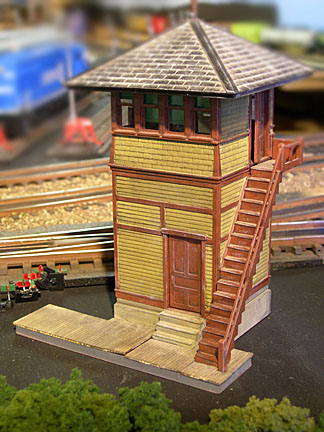
By 1954, the toy trains graduated to model railroad layouts and Bachman expanded its railroad buildings to include a switch tower, plus a black signal bridge. To this, the company added a black trestle bridge, a larger Union Station, a water tank and loading platform.

Specialty buildings like a tan factory with gray or brown roof, a smokestack, and water tower, plus a red and white TV station came in 1957. All together, Bachman produced 104 different items in its Plasticville, U.S.A. line. And while the company had expanded its line of plastic buildings to cover just about every type of structure to be found in a small town, it would take another 20 years before anyone began collecting them.

Variations in common buildings can drive up the value. The common Plasticville one-story ranch house sells for about $5 while a variation using dark blue plastic sells for as much as $200. Larger buildings like the hospital and airport can go for much more.

To learn about Plasticville’s full story, read “Collecting Plasticville, U.S.A.” in #TheAntiquesAlmanac.

To read more articles on antiques, please visit my Web site.  And to stay up to the minute on antiques and collectibles, please join the other 18,000 readers by following my free online magazine, #TheAntiquesAlmanac.




Wednesday, December 6, 2017

Let the Star Wars Force be With You


QUESTION: My son was a big Star Wars fan when he was younger. He had just about every Star Wars action figure that came out—at least of the smaller ones. But now he’s grown and has his own family, and I seem to be left as the caretaker of his collection. I’d really like to know if these figures are worth keeping. Can you tell me something about them and if they’re collectible now or were they just a fad like Beany Babies?


ANSWER: Even though the first Star Wars movie premiered 40 years ago, the action figures that came out as a result of it and other Star Wars films are still highly collectible. Whether or not they’re still in their original packages will tell how much they may be worth.  If they’re still in unopened packages, then you have something. If not, maybe not.

In May 1977 "Star Wars: A New Hope" exploded across the big screen in a symphony of sound and light unlike anything audiences had ever seen. Fans went crazy over the film, some seeing it hundreds of times, and sci-fi films haven’t been the same since. Star Wars was the first movie franchise which created a voracious demand for film-related products. Fans clamored for tangible souvenirs of the new universe they were coming to know and love. Director George Lucas and film industry leaders were all taken by surprise.

While the variety and forms of Star Wars items are almost as numerous as the stars themselves, the most popular objects of Star Wars collectors’ desires are the toys. Furthermore, among the toys, the  most sought after are the 3 3/4-inch action figures.

Kenner Products is responsible for the most of the Star Wars toys that are on the collectibles market today. The firm obtained the original license to manufacture toys, games, puzzles and a few books prior the release of the first film in 1977. In time, the resultant outpouring of products from the Kenner factories far outstripped Lucas’ expectations. In fact, all he expected from his merchandising rights were a few posters and T-shirts with which to lure more children to his film. At a base price of just $2 or less, not only kids but adults quickly bought up the stock of figures. And over the years came back for more in a variety of re-incarnations.

Following Kenner, other toy manufacturers joined in on Stars Wars’ success. Chief among was Galoob, a company determined to "out-small" Kenner with its Star Wars Micro Machines. Play sets and spaceships were this company's main products. Action figures by Galoob were about the size of the smaller accessories that accompanied Kenner's figures. Galoob sold these tiny action men and women as part of  play sets. No other company ever came close to the Star Wars toy output of these two firms.

By definition, action figures are molded of plastic and designed for play. While they’ve varied in size over the years, the original ones were only a little over three inches high.  Kenner made these figures to have five points of articulation—at the neck, shoulders, and hips. They also had their clothing molded as part of the body, while some of the larger figures have removable clothing.

Toy companies package action figures of different sizes differently. The 12-inch and 8-inch figures generally are packaged and sold in boxes. The 3 3/4-inch-tall figures most often appear on store shelves sealed against a decorated cardboard backing within a plastic bubble commonly referred to as a blister. The package for the 3 3/4 inch figure is thus referred to as a blister pack.

Kenner designed its 3 3/4-inch high Star Wars figures for use with play sets, spaceships, and other accessories. But their 12-inch figures of Luke Skywalker, Darth Vader and such were too large to be equipped with play sets. But one thing that action figures have in common is that the come with a array of small accessories that tend to disappear quickly once a child removes the figure from its packaging.

Then Kenner’s line seemed to die out for a while. In 1995, the firm re-introduced its Star Wars figures with a new design and/or a repainting that appealed to both kids and adults. But one thing to be aware of is that the newer figures tend to come and go. From time to time, Kenner would play with the mix of figures on the market at any one time. It would remove some of the older models and replace them with newer ones.


Kenner first released its line of 12-inch figures in the late 1970s, sticking mostly to the film’s main characters. But these 12-inch figures didn’t compete well with Kenner’s 3 3/4-inch ones and the company stopped making them. But its smaller figures live on. 

To read more articles on antiques, please visit my Web site.  And to stay up to the minute on antiques and collectibles, please join the other 17,000 readers by following my free online magazine, #TheAntiquesAlmanac.

Monday, November 27, 2017

Hold That Door


QUESTION: My mother collected doorstops. She had a collection of about 50 which she left to me when she died. I know very little about them, but I’d like to continue collecting them. What can you tell me about them—how did they originate and when, and how collectable are they today?

ANSWER: It’s great that you plan on continuing your mother’s collection. Most people seem to want to get rid of whatever items they inherit while others just warehouse them. But curating and growing a collection is different. Now it’s up to you to figure out just what doorstops you have, selling those that aren’t very good and adding those that will enhance your collection. But first, you need to learn a bit about their history.

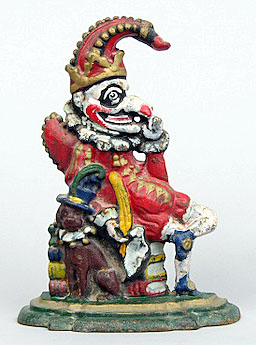
Doorstops date back to the last quarter of the 18th century, around the time of the American Revolution, but in England. They came in a variety of shapes and sizes and held open large doors. The British called them “door porters” and liked the cast in iron or bronze.

By the early 1800s, doorstops began appearing in a variety of materials, including wood, glass, and earthenware. The cast-iron doorstops had flat backs from the hollow molds used to make them, allowing them to stand flat against the surface of the doors.

By the middle of the 19th century and especially following the Civil War, doorstops had evolved into full three-dimensional figures and were becoming increasingly popular in the United States.

American manufacturers followed the basic English tradition of making cast-iron doorstops in the familiar shape of baskets and flowers. They also began to develop a variety of attractive shapes, including houses, ships, stagecoaches, and all kinds of wild and domestic animals. American makers hand painted them in bright colors until all sorts of colorful doorstops were readily available.

By the 1880s, it wasn’t unusual to find iron birds, story book characters, and even a few human-type figures propping doors where ventilation was seasonally so important in so much of the country.

Some believe the Amish developed the use of the human figure as a doorstop to its fullest form starting in the 1880s and continuing into the 1930s. They cast figures of men, women and children, painted them with pleasing facial features, and dressed them in time-honored Amish clothing. These seven to nine inch high doorstops today sell for a minimum of several hundred dollars each.

Casting techniques had improved enough prior to the turn of the 20th century to enable foundries in the U.S. to manufacture nearly every design of doorstop a home owner could want. In fact, some of the firms invited customers to send detailed sketches of doorstops, so that they could create them. But all this variety of design resulted in variations in both the size and weight of doorstops. Heights ranged from four or five inches to two feet.

One of the most popular forms of doorstops was the dog. Manufacturers produced doorstops in the shapes of just about every breed of dog, from Alaskan Malamutes to Russian Wolfhounds to a variety of terriers. Many of these animals were full figure, cast in two parts, screwed together, and painted.

The Albany Foundry Company of Albany, New York, and A.M. Greenblatt Studios of Boston, Massachusetts, were among the major manufacturers of doorstops in the early 20th century. Both did a booming business in the late 1920s, selling cast-iron doorstops  for about a dollar each.

Additional firms included Hubley Manufacturing Company in Lancaster, Pennsylvania, which made toys, Littco Products, National Foundry, and Eastern Specialty Manufacturing Company.

Doorstops were still quite effective and desirable well into the 1930s. Generally, production ceased abruptly at the onset of World War II, since factories converted to production of war materiel.

Today, antique doorstops sell for $50 or so in good condition, but can go as high as $200 for some special ones.

To read more articles on antiques, please visit my Web site.  And to stay up to the minute on antiques and collectibles, please join the other 17,000 readers by following my free online magazine, #TheAntiquesAlmanac.