Thursday, September 2, 2021

Stuck on Beauty


18th-century paper 

QUESTION: While touring some historic houses, I’ve often marveled at the beautiful wallpapers on their interior walls. I’ve always loved wallpaper. In fact, every room in the house I grew up in had wallpaper on the walls. But getting it off was such a chore that many people turned to painted walls instead. I’d love to know how wallpaper originated and some of the history behind its use. Can you help me?

ANSWER: People have adorned their walls for centuries. During the Middle Ages, the wealthy hung woolen tapestries to help keep out the cold. Later, painted cloths came into fashion. And through the evolution of interior decoration—wallpaper. 

Early on, makers of wallpaper used the same wooden printing blocks used on textiles on heavy paper. Most likely its introduction to Europe occurred in the 16th century, following the Dutch trade with China and Japan. Dutch ships returned from the Far East with exotic decorated papers when they then exported to England and France. 

Hanging wallpaper sheet

The first wallpapers to appear in Europe were small, approximately 12 to 18 inches square and very expensive. Merchants used the earliest wallpapers to decorate the insides of cupboards and smaller rooms in their houses. 

Up until the late 18th century, creators of these small squares of wallpaper hand painted them. That made hanging the paper difficult because many times those smaller pieces didn’t join together very well. As a result, there were gaps, and designs and patterns didn’t meld together that well.

Others attached pieces to frames and let them hang freely. The dark, damp halls of chateaus and manor houses were usually drafty, so people placed these hanging papers where they might cut down on drafts that blew through the large open areas and hallways.
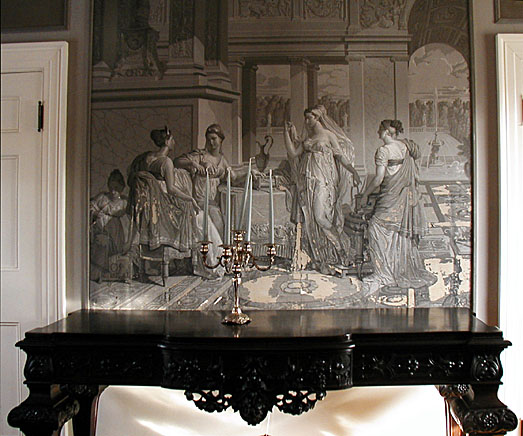
Ancient Roman scene in frame

Many early wallpapers featured stylized floral motifs and simple pictorial scenes copied from contemporary embroideries and other textiles. Makers printed them in monochrome, in black ink on small sheets of paper. It wasn’t until the mid-17th century that wallpaper makers joined the single sheets together to form long rolls, a development that also encouraged the production of larger repeats and the introduction of block-printing. In this process, printers engraved onto the surface of a rectangular wooden block. Then they inked the block with paint and placed it face down on the paper for printing. Polychrome patterns required the use of several blocks----one for every color. They printed each color separately along the length of the roll, which they then hung up to dry before the next color could be applied. “Pitch” pins on the corners of the blocks helped the printer to line up the design. The process was laborious and required considerable skill.

French wallpapers

A number of fine French wallpapers offered different themes than those of the classic English papers. Often, the French papers displayed floral patterns, and many rendered figures from history and literature, whereas the English wallpapers favored landscape and bucolic compositions.

When wallpaper arrived in Colonial America, it was much too expensive for many to afford. Rather than pay the expensive costs for the wallpaper, many continued to paint or stencil their walls. However, some people found the imitation French papers affordable and applied them to their walls in small pieces instead.

Out of proportion design

The floral designs and landscape scenes commonly found were sometimes primitive, with houses and trees out of proportion. The skill of the artist or paperhanger directly affected the appearance of wallpaper. The progression leading to those long rolls of wallpaper allowed people to decorate large expanses of wall space without dividing the areas into those small panels.

By the early 19th century, expensive, imported wallpapers decorated the walls of prominent New England homes. Those papers were of various designs and patterns, and some of them depicted scenes from Greek and Roman mythology. American historical scenes were also popular.

Block printing wallpaper

Up until 1840 all wallpaper makers employed the slow, labor intensive block printing process. So manufacturers wanted to find ways to speed up production. Potters & Ross, a cotton printing firm based in Darwen, Lancashire, England, patented the first wallpaper printing machine in 1839. Adapting the methods used in the printing of calico fabric, the paper passed over the surface of a large cylindrical drum and received an impression of the pattern from a number of rollers arranged around its base. Troughs beneath each one simultaneously inked the rollers with colors. The first machine-printed papers appeared thin and colorless beside the richer and more complex effects of block-printing and most had simple floral and geometric designs with small repeats.

Wallpaper evolved into an art form. One example depicted the Scottish Highlands, complete with sportsmen stalking deer. Another showed a scene of Italian peasants dancing and harvesting grapes. And yet another depicted riders leaping fences.

Historic panorama scene wallpaper
Victorian wallpaper floral

The frieze-filling-dado wallpaper scheme highlights the popularity of wallpaper in Victorian homes. In 1868 as a way of breaking up the monotony of a single pattern on the wall, and by 1880 it was a standard feature in many fashionable interiors. The dado paper covered the lower part of the wall, between the skirting board and chair rail; above this hung the filling, and above this the frieze. And as if three different wallpapers weren’t enough decoration for any room, the scheme was often combined with ceiling papers to complete the densely-patterned effects. Ideally, the frieze should have been light and lively, the filling, a retiring, all-over pattern, and the dado should be darker to withstand dirt and wear and tear. Co-ordinating papers, printed in muted greens, reds, yellows and golds, could be extremely attractive but the frieze-filling-dado-ceiling combination often led to visual overload. Hallways and stairs benefitted best from this wallpaper treatment. But by 1900 ceiling papers had disappeared and, in artistic interiors, wide friezes hung above plain or simple paneled walls.

Antique wallpapers are of interest to several kinds of collectors. Some might be interested in specific themes or designs, such as papers depicting historical scenes, or those displaying floral patterns; wallpapers from England or France or some other country might engage the attention of others; still, some individuals like to collect papers produced by certain manufacturers, such as Cole & Son or William Morris. And some of  those assembling a collection might be interested in a certain time period such as wallpapers manufactured in the 17th or 18th century.

To read more articles on antiques, please visit the Antiques Articles section of my Web site.  And to stay up to the minute on antiques and collectibles, please join the over 30,000 readers by following my free online magazine, #TheAntiquesAlmanac. Learn more about railroad antiques in "All Aboard!" in the 2021 Summer Edition, online now. And to read daily posts about unique objects from the past and their histories, like the #Antiques and More Collection on Facebook.


Wednesday, August 25, 2021

Sorting Out the Often Confusing World of Specialty Antiques Categories


QUESTION:  Every time I go into an antique mall, I become overwhelmed by all the items. Booth after booth of what seems like junk. Yet I know there must be some interesting and perhaps valuable antiques hidden there. How can I make sense of it all?

ANSWER: Previously, we took a look at some of the main categories of antiques. But beyond them lies an array of specialty categories. 

One of these is the toy category. Antique toys take in everything from cast-iron banks and vehicles to board games and rocking horses. The diversification is so great that most collectors specialize in collecting one type of toy or another. Few are generalists. But collecting toys can be expensive. The more specialized antiques are, the most costly they become.

A subcategory of toys is dolls. Dolls, dolls, and more dolls dominate this category with teddy bears a close second. There are other products, but from a value standpoint, dolls and bears dominate. English and German dolls are most sought after while German Steiff bears are desired almost exclusively. This category generates more emotion among collectors than does any other. As a result, collectors and dealers become very competent and have extremely specialized knowledge. A beginner in antiques should tread lightly as this is a very technical category filled with passionate and very knowledgeable people.

Like the doll category, antique collectors of scientific instruments are very knowledgeable. As a subcategory of clocks, collecting barometers and chronometers,  particularly marine chronometers and nautical instruments is also a male dominated group. These seem to invoke the smell of the sea in their favorite piece. Again, English makers predominate. Among instruments, telescopes are popular as are surveying and nautical instruments. Microscopes and medical instruments follow hard on their heels.

Another antiques specialty is jewelry. Precious and semi-precious, as well as costume jewelry are the dominant categories with Victorian era jewelry the most popular. Specialized knowledge is required in the precious jewelry category, but most ordinary folks soon become familiar with the semi-precious stones and the costume jewelry found in all antique malls. Pins, earrings and bracelets are the most popular product lines.

One of the most interesting specialty categories is commemorative antiques. Relying mainly on English Royalty and history, the commemorative antique category consists of anything celebrating an occasion. Royal weddings, a monarch's reign, births and victorious battles are all occasions for producing commemorative products. The Victorian period is the most popular, but more localized events such as battles or achievements are also forever immortalized on plates, jugs and spoons.

Collecting Asian antiques takes a lot of effort and research. This highly technical category is best avoided by beginners, Chinese and Japanese antiques dominate this category. Eighteenth Century Tang, Quing, and Cantonese pieces are quite popular, and Japanese antiques are particularly sought after by Japanese collectors who tend to be very nationalistic. Imari ceramics and Satsuma pottery are much in demand among this group of wonderful antique buffs. And more than in any other speciality, the chances of fakes is far greater. 

The military antiques category takes in arms and armor, swords and daggers, pistols, revolvers, medals, and military equipment. British, German, American and Italian items are all covered in this class. For the beginner it is best to avoid these antiques until you have time to study them. Definitely a man's "thing," military antiques cover everything related to wars and regimental history.

Traditionally, antiques include objects that are 100 years old and older. Items less than a century old are typically classified as collectibles. This category covers everything from blue willow patterned ceramics to the war medals. Often collectibles can be quite new and tied to popular media and the movies.

A subcategory of collectibles is memorabilia. Dominated by Walt Disney products, particularly those to do with classics such as "Snow White."  Elvis leads the list of musical memorabilia. Postcards, Coca-Cola signs and signed autographed copies of correspondence are also in demand. This is a fun category as it's so diverse. But it’s also very fickle and tends to go through trendy periods when prices fluctuate widely.

While the main and specialized antiques and collectibles categories mentioned here are the most popular, there are many others. With antiques and collectibles, there’s something for everyone to collect.

To read more articles on antiques, please visit the Antiques Articles section of my Web site.  And to stay up to the minute on antiques and collectibles, please join the over 30,000 readers by following my free online magazine, #TheAntiquesAlmanac. Learn more about railroad antiques in "All Aboard!" in the 2021 Summer Edition, online now. And to read daily posts about unique objects from the past and their histories, like the #Antiques and More Collection on Facebook.


Thursday, August 19, 2021

Sorting Through the Often Confusing World of Antiques


QUESTION: Every time I go into an antique mall, I become overwhelmed by all the items. Booth after booth of what seems like junk. Yet I know there must be some interesting and perhaps valuable antiques hidden there. How can I make sense of it all?

ANSWER: Perhaps your mind and senses have gone into antiques and collectibles overload. So many items—bits of furniture, pottery, piles of old jewelry, dolls, old Coca-Cola signs, and things that look like the cat dragged them in. So where’s the good stuff? 

It all seems so confusing. And the prices for some items seem ridiculous, especially if you’re a beginning collector. But don’t despair. There’s a method to all that antique madness.

Generally, antiques fall into two categories—those of the real world and those of the  rarefied one that most people can only ooh and aah at. And T,V. programs like The Antiques Roadshow, Pickers, and Pawnstars haven’t helped matters. In fact, all of them have brought the world of antiques to a world-wide audience. No longer are antiques in the realm of the rich—the realm of the “Don’t touch that.”

But antiques and collectibles can be broken down into manageable categories.

When most people think of antiques, they think of furniture. And although furniture makes up a good percentage of antiques out there, smaller items, known as “smalls” in the antiques business—ceramics, glassware, silverware, toys, and commemorative items—all play important roles in the overall history of modern culture.

All in all, there are about 15 major categories and 75 sub-categories. Within these there are other, more specialized areas, such as antique musical instruments and automobiliana, two very specialized categories.

Even though antiques can be categorized generally, dealers and serious collectors use historical periods—Jacobean, Colonial, Victorian, Civil War, Western and Retro—to sort things out. Often, these terms also indicate different styles.

For instance, in the world of furniture, you’ll probably see examples of English, French, and American styles in most antiques shops and malls, as well as at antiques shows or auctions. Most English furniture falls into historical periods such as Jacobean,  pre-Victorian, or Victorian while American furniture tends to fall into different types according to region of manufacture—New York, New England, Pennsylvania, or Southern. 

Porcelain or pottery pieces tend to fall into categories associated with the country in which they were produced—England, Germany, France, United States, China and Japan. The four you’ll see most are English, German, Japanese, and American. You’ll soon become familiar with names such as Royal Doulton, Staffordshire, and Meissen, Blue Willow, Limoge, Belleek and Sevres, especially if you frequent the better antiques shops and shows.

Glassware is the third most popular category. You’ll see all types, including Depression, Venetian, English, and Bohemian glass. Most glassware collectors specialize in a particular produce line–bowls, tumblers, decanters, etc. There’s also a refined category known as art glass in which you’ll find all those pretty vases blown in amberina, peach blow, and ruby.

Silverware is also a very popular antique. Here again, English, German and American silverware predominates. Like glass, product type defines this category. Collectors actively seek teapots, candlesticks, flatware, and bowls. Classification in this category is by make and markings generally stamped on the back of the products. Sterling and Sheffield silver are the two most recognizable types. EP is often seen as a marking and stands for silver Electro Plate. Sheffield silver is a combination of a layer of silver and copper beaten together to give a silver surface with a warm sheen.

Next up comes clocks and watches. This is a very popular general category, particularly among men, who seem to like the mechanical nature of timepieces. English, French and Austrian clocks dominate. In the "Longcase," or pendulum grandfather clocks, the English manufacturers stand out with the value of the clock being as much in the beauty of the cabinetry as in the mechanical workings. A beginner should get familiar with clockmakers names such as Thomas Field, McCabe, and Japy Freres. The same applies to watches. Names like Hamilton, Seiko, and Waltham are popular with collectors.

And finally there are collectibles, which cover everything from blue willow patterned ceramics, which are popular with women, to the war medals popular with men. Just remember what a collectible is. It is an object of limited supply, gathered or accumulated for pleasure or as a hobby. A very trendy category, collectibles nevertheless have basic product lines, such as ceramic plates, perfume bottles, pocket watches, stamps, and even figurines that continue to grow year after year.

These are just some of the main categories of antiques that you can begin to collect. While some tend to be higher priced, you’ll find plenty of small pieces of furniture, ceramics, and glassware to get you started in collecting.

To read more articles on antiques, please visit the Antiques Articles section of my Web site.  And to stay up to the minute on antiques and collectibles, please join the over 30,000 readers by following my free online magazine, #TheAntiquesAlmanac. Learn more about railroad antiques in "All Aboard!" in the 2021 Summer Edition, online now. And to read daily posts about unique objects from the past and their histories, like the #Antiques and More Collection on Facebook.

NEXT WEEK: We’ll take a look at some of the specialty categories of antiques and collectibles. 


Thursday, August 12, 2021

The Artful Draw of Citrus Labels


QUESTION: While browsing at my local thrift shop the other day, I came across three framed citrus prints, the kind that used to be pasted on citrus shipping crates. I scooped them right up. They’ve made a nice addition to my kitchen. I hadn’t thought much about these labels before I saw these framed ones. Are they collectible? If so, are they worth collecting? I sure would love to add to the three I purchased. 

ANSWER: Citrus labels, once quite common, have long since disappeared. Both California and Florida growers used these labels to identify their products from the 1880s to the 1950s. Pasted on the ends of these wooden crates, these 10” X 11” labels or 5 ½” X 11” strips identified the brand. And today, they’ve become a hot and affordable collectible.

Christopher Columbus first introduced citrus seeds to what’s now Florida in 1493. Ponce de Leon sailed with Columbus and was the first European to explore Florida in 1513, bringing with him citrus seeds and planting them near the settlement of St. Augustine. Spaniards and native Indians continued to grow and cultivate the fruit, as citrus thrived in Florida’s warm climate and sandy soil.

But it took another 300 years before citrus became an industry. By then, newly arriving homesteaders began relocating to Florida, planting citrus trees around their homesteads. Pioneer began selling the fruit, then bringing it to a common location to be transported by steamships. Steamers collected barrels of fruit packed in Spanish moss at various ports along Florida’s coasts and waterways.

It was the coming of the railroads that encouraged the creation of those colorful, imaginative labels. Oranges had been grown for a long time in Florida and even longer in California, but it wasn't until the completion of railroad spur lines that it became possible to ship the perishable citrus fruit nationwide. By 1875, growers began using 90-pound wooden crates. Eager to capture the attention of wholesale buyers in Eastern and Midwestern produce terminals, the growers began pasting eye-catching paper labels to the ends of the crates.

California growers were the first to use color lithography to print their packing labels. And it was from them that the Florida growers began to see how the colorful labels could be used to successfully market their produce. From 1904 until the 1940s, the growers designed citrus labels to differentiate among the competition for a particular grower or shipper. Artists and lithographers collaborated to help buyers remember and identify their brand. 

The old-time produce market was a crowded place, so having labels with eye-appealing, interesting artwork was a must. It's the same rich colors and striking designs that used to grab the attention of the citrus buyers which attract today’s collectors.

Label colors sometimes served another purpose. Each packing house used several different labels, and at some citrus groves the label background colors used were of special significance. Buyers could tell at a glance the grade of the fruit. Blue indicated top quality fruit, red indicated second grade fruit, and yellow or gold indicated  third-grade fruit.

Label art changed with the times. Fruit crate art can be divided into three periods—Naturalism, from 1885 to 1920, Advertising, from 1920 to 1935, and Commercial Art, from 1935 to 1955. In Florida, early labels seemed designed to appeal especially to housewives, with pastel-tinted illustrations depicting flowers or babies. Following these came label illustrations showing Indians, planes, trains, hunting scenes, and pretty women, all directed towards the all-male buyers at Northern auctions.

Many early labels during the Naturalism era were known as "vanity labels" because they depicted the growers themselves, their families, or their orange groves.

In 1915, the general public became aware of vitamins and the health benefits of the orange's Vitamin C content appeared in label art. Labels from the Advertising era promoted the use of orange juice for health, with names like "Juicy-o," "Juice King," and "Full o' Juice.”

Through label design, artists depicted a wide range of subjects, including the romance of Florida with sunsets, sailboats, and “good, healthy living” themes. Scenic views of Florida with orange groves, orange trees, treasure chests filled with oranges furthered the image of the fruit. The Golden Sunset brand portrayed palm trees and a warm, glowing sunset. Consumers and buyers were getting the message about the good life in Florida which also gave a boost to tourism.

Label artists also pictured Florida flowers. The Gardenia Brand and the Azalea Brand adorned Jacksonville’s W.H. Clark Fruit label. The Kissimmee Citrus Grower’s Association used the Florida Cowboy brand.

Themes of wildlife were also popular with birds, alligators, and even fish. Brooksville’s Blue Heron Brand portrayed the majestic Florida bird and Frostproof’s Ibis Brand displayed the pink-billed white bird. St. Petersburg’s Milne-O’Berry Packing Company developed a label with the classic tarpon called the Silver King Brand.

Citrus labels even promoted Indian River’s Harvey’s Groves, depicting a fertile and luscious growing region. The Polk O Dot Brand created a label with a golden-haired child from the Polk County Citrus Exchange.

It was in the 1940's that the packing houses in both Florida and California ended the 60-odd year tradition of marking their products with colorful labels on the ends of wooden crates. With the advent of World War II, wood used to build crates became both scarce and expensive

By the time the 1950's rolled around, most growers and packers tossed away or burned their unused labels. Who would have dreamed that those old scraps of paper would someday be collectors' items?

To read more articles on antiques, please visit the Antiques Articles section of my Web site.  And to stay up to the minute on antiques and collectibles, please join the over 30,000 readers by following my free online magazine, #TheAntiquesAlmanac. Learn more about railroad antiques in "All Aboard!" in the 2021 Summer Edition, online now. And to read daily posts about unique objects from the past and their histories, like the #Antiques and More Collection on Facebook.