Monday, April 18, 2016

Mother Nature’s Gift to Glass


QUESTION: My mother loved decorative glassware. She died recently and left me her collection. While some pieces are older, most date from the 1950s and 1960s. I particularly like several vases that look like flowers. Do you know what they are called and tell me a little about their history?

ANSWER: Back in the 1950s and 1960s, many women collected decorative glassware. Most of the pieces came from Fenton Glassware, but several other manufacturers also made a wide assortment of vases, candy and butter dishes, ashtrays, and the like. Many of these feature hobnail decoration. The vases you’re asking about are known as Jack-in-the-Pulpit vases.

To glass lovers the name "Jack-in-the-Pulpit" has become synonymous with glass vases styled to imitate a wild flower. This flower is native to some parts of the United States, but this style of glassware originated in England, where no jack-in-the-pulpit flowers don’t grow. Most likely, this design came from the adaptation of a similar wildflower found in England known as Lords and Ladies.

Like the flower, a glass Jack-in-the-Pulpit vase consists of three parts, a base, a stem and the trumpet. The trumpet is the large flared top which gives the piece its style, much like the trumpet forms the flower on the plant. The stem connects that trumpet to the base, much like the stem connects the flower to its root. Trumpets vary in style, from flared, rounded trumpets, to those with pinched and twisted points in the front and the back. Some trumpets, particularly those by Fenton, have a raised back and dip downward in the front.

Some collectors believe Louis C. Tiffany created the first Jack-in-the-Pulpit vase around 1900. But that isn’t the case. The first known Jack-in-the-Pulpit vase appeared in 1854, a good 40 years before Tiffany’s vases. The style of the early English Jack-in-the-Pulpit vase even more closely resembles the flower. However, English glassmakers at the turn of the century didn’t name their pieces, unlike their American counterparts. Instead, they just gave them a pattern number.

English Jack-in-the-Pulpit vases came from a number of makers, including Thomas Webb & Sons, Richardson's, Webb-Corbett and Stuart, plus many small companies. Some smaller firms subcontracted work out to finishers, so it's possible that one firm decorated the blanks of another. British glassmakers did, however, blow most of their Jack-in-the-Pulpits.

Prices for British Jack-in the-Pulpit vases range from $75 for a piece which can’t be attributed to any particular manufacturer to several thousand dollars for a rare Webb or Stevens & Williams piece. Rare pieces can command $2,000 to $3,000. On average, British pieces go for about $175.

While decoration doesn't seem to have a effect on the price of unattributed British pieces, it does effect the prices of the higher-end ones. Size and the decorations, such as applied glass chainwork, vary. Companies produced vases in opalescent patterns such as spiral optic and   cranberry, and some come in the various colors like Beaded Melon.

Fenton’s Burmese vases are particularly popular with collectors. The company also made decorated Jack-in-the-Pulpits in other types of glass. Fenton decorated white and off-white, called cameo satin, blanks with scenes sell for around $75.

Other noteworthy American producers include Northwood/Dugan, Imperial, Westmoreland, Mount Washington and L.G. Wright. Northwood made jacks in various colors in Carnival glass, a short marigold version being the most common. But Northwood and Dugan also made them in opalescent glass. These generally sell for under $100 apiece.


Monday, April 11, 2016

Tile It


QUESTION: In the last few years, I’ve begun to buy decorative tiles from the early 20th century. I buy what I like and not because a particular company made them. One I purchased recently supposedly came from the Moravian Tile Works in Doylestown, Pennsylvania. Since I live in the Midwest, I haven’t had an opportunity to visit the Tile Works. What can you tell me about this tile?

ANSWER:  Go to any Arts and Crafts auction and you're sure to find art tiles, ranging from $20 to several thousand dollars. But what makes one tile worth more than another? And what makes these late 19th/early 20th century tiles any different from the ones we see today at our local home renovation store?

Combine the rise of the Aesthetic Movement, the desire to get back to basics, and a variety of unique techniques, and tiles can represent some of the most interesting objects made during the heyday of the Arts & Crafts Movement." It’s these "art" tiles that are of real interest to collectors, and these are the tiles that command the highest prices. Commercial production tiles, while they're old, even when made by a well-collected maker, are usually only valued in the $20-$30 range.

Although a large number of American potteries made tiles, six are most popular with collectors and/or the most historically significant---American Encaustic, J.G.Low, Grueby, Rookwood, Batchelder, and the Moravian Pottery and Tile Works.

Henry Chapman Mercer, an archeologist and antiquities collector, founded the Moravian Tile Works in 1898. His intent was to bring back the medieval craft of tile making and established the Moravian Pottery and Tile Works on his family's estate in Doylestown, Pennsylvania. Mercer chose the name Moravian to represent the German immigrants who brought tile making to Pennsylvania in the 18th century.


Although Mercer designed all the tiles, using patterns derived from European an Middle Eastern ones, as well as photographs of ones from Mexico, he trained a crew of men to produce them by pressing wet local clay into handcarved molds. Workers slow fired these molds in a wood burning kiln, painted the bisque ware with glaze, and fired them again.

Mercer gained a reputation as a serious proponent of the Arts & Crafts Movement. Many of America's top tile makers, including Grueby and  Batchelder, copied his tile designs. Mercer also produced several lines of four-inch molded tiles representing tall ships, zodiac signs, and farming. He also used them to build items like inkwells and bookends. For more elaborate installations, Mercer produced cookie-cutter-shaped paving tiles referred to as “brocades.”

Mercer remained active with the company until his death in 1930. The company remained in business until 1964, and in 1969, it opened as a museum.

The reproduction tiles made today come from Mercer's original molds, locally dug clay, and have properties similar to those of Mercer's slips and glazes that follow his final formulations, although some have been modified to reduce the lead and heavy metal content to less toxic levels. The manufacturer of reproduction tiles began in 1974, but there’s no danger of deceit. When the Bucks County, Pennsylvania, Department of Parks and Recreation took over the Tile Works as a working museum, they insisted that all the tiles made at the museum bear the mark of a stylized "MOR," the words "Bucks County," and the year of manufacture.

Today, collectors can expect to pay from $30-100 for common tiles, $35-250 for brocades, $300-3,000 for “built items” made from tiles, and $1,000-5,000 for the more unique medieval-style tiles.

You can find some of the largest collections of Mercer tiles at John D. Rockefeller's New York estate, Grauman's Chinese Theater, and the Casino at Monte Carlo. Your tile represents "Virgo," a sign of the zodiac.

Monday, March 28, 2016

Beauty in a Little Box


QUESTION: My favorite aunt left me a beautiful metal jewelry box that looks like tarnished silver. It’s got daisies on it and on the bottom it’s marked “N.B. Rogers.” I know that Rogers Brothers is famous for its silver flatware, but did they also make jewelry boxes? Also, what can you tell me about the design of this box?

ANSWER: Sorry to burst your bubble, but your jewelry box isn’t made of silver. It’s actually white metal, also known as “Britannia” or art metal and dates from the first decade of the 20th century. And the flower on it is a lotus flower, not a daisy.

The creation of mail order catalogs by Marshall Field, Montgomery Ward, Sears, Roebuck and Company, and Macy's in the late 19th century made it possible for the average middle class woman to purchase lovely fashions and accessories at affordable prices.

One of these accessories was the jewelry box—more popularly called the jewel box—a repository for her most precious jewelry and keepsakes. The growth in popularity of these "art metal" jewel boxes, also called jewel caskets or jewel cases, paralleled the growth of catalog shopping which promoted them as ' dainty gifts for Milady." Jewel boxes came in sizes ranging from the smallest ring box to large handkerchief and glove boxes.

Between 1900 and 1910, Art Nouveau, a French term meaning "new art" coined by Maison de 1'Art Nouveau, a Paris gallery which opened in 1895, was the predominant design style in the United States. A romantic style influenced by the art forms of Japan, it used many motifs borrowed from nature, including flowers, leaves, vines, and birds. It also became known for its curves and asymmetrical elements. Of the Art Nouveau jewel boxes produced in the United States, those with the floral motifs were the most popular.

The two most prevalent flowers used on jewel boxes were roses and poppies. Daisies, four-leaf-clovers, lily of the valley, pond lilies, violets, carnations, and a myriad of other flowers also decorated jewel boxes. This maybe due, in part, to the important role flowers played during the Victorian era.

The jewelry trade promoted the “Flower of the Month” concept during the early 1900s. Fueled by consumers’ desire for more decorative objects, the jewelry industry improved production, distribution and marketing methods. Little by little, the role of flowers as a decorative motif became the central theme. Manufacturers assigned specific flowers to birth months, decorating jewel boxes with roses of love for June, carnations for admiration for February, and holly for foresight for December.

The interiors of these jewel boxes were as beautiful as their exteriors. Linings of fine silk, faille, jacquard, and satin gave them a luxurious appearance. Because silk could be easily dyed, it came in a rainbow of colors, although jewel box linings used the pale hues of pink, green, and blue. Manufacturers trimmed trimmed the linings with a fine twisted-silk cording.

During the early part of the 20th century, many American manufacturers produced art metal wares, with jewel boxes being one of their most popular items. Many of these manufacturers have long passed into history but one, Rogers Brothers, still exists today. There were several "Rogers" brothers in business at the turn of the century, and the name gained national recognition due, in large' part, to the wide distribution of mail order catalogs. The name became so popular that other companies tried to adopt it, results in many lawsuits. Though the original Rogers family became known for its flatware, one brother, N. Burton Rogers; founded his own art metal company and produced many Art Nouveau jewel boxes marked “N.B. Rogers.”.

By 1915, the popularity of art metal jewel boxes had reached its peak: With the coming of World War I, production slowed. The earlier naturalistic, yet interpretive Art Nouveau flowers, leaves, and vines, had become "conventional" floral decoration. By 1925, the production of art metal jewel boxes had ceased altogether.


Monday, March 21, 2016

Asleep in Luxury


QUESTION: My mother-in-law, who is 97, has just moved into a retirement home. Her Aunt Margaret was married to Charles Tuckett, the son of Charles Elias Tuckett, founder of Tuckett Tobacco and one time mayor of Hamilton, Ontario. Charles inherited the original Tuckett Estate and when he passed away Margaret was left owning it. Charles and Margaret had one child but the child died. When Margaret died her family inherited the estate. My mother-in-law inherited a lot of the furniture, but I haven’t found  much help regarding the manufacturer and value. Can you help me?

ANSWER: Your mother-in-law now owns two fine pieces of
furniture. Not only are they of massive scale, but the carving on them looks to be made by hand, something that wasn’t common in the late 19th century when most factories made manufactured most furniture.

These two pieces together make up a ‘bedchamber suite,” a more formal version of bedroom suite. Earlier suites consisted of just two pieces—a bed, commonly referred to as a “bedstead” and a dressing case, what most people call a dresser. Both came in all shapes and sizes and in one of seven different major revival styles. This suite is a fine example of the massive Renaissance Revival style, preferred by wealthy Americans. Later on, a second type of suite appeared, one with a bedstead, washstand, and bureau. These were smaller in scale—ideal for middle class homes and Victorian cottages—and less ornate and expensive than their bigger cousins. The concept of selling furniture “en suite” was novel in the 1880s and 1890s. Today, we this for granted.

Not only did the size show off the wealth of the suite’s owners, it also fit the enormous rooms with 12-foot high ceilings common in Victorian Italianate mansions of the time.

Suites with dressing cases from the Victorian period were more expensive than the bureau type, and more elegant as well. Sometimes their tall mirrors seemed to extend from floor to ceiling and had ornately carved frames that featured small bracket shelves for candle-holders or small lamps. Drawers varied in number and size. What people now describe as a well or step-down generally separated the parallel series of drawers. Cabinetmakers treated all three levels alike, topping them with either wood or marble. Some pieces had full-width drawers at the bottom of the well. Sometimes, the mid-section below the looking glass reached down to the floor, but this wasn’t common. To achieve individuality, customers could order their own mirror frame, and select from 16 different carved drawer pulls.

In the 19th century, the word "toilet" referred to personal grooming, thus a mirror became a  toilet or plate. An oval "plate" is now called a wishbone mirror, since the frame in which it is suspended is shaped roughly like a fowl's wishbone.

During the 1870s, people referred to the two small drawers that sit across from each other on the top of a bureau as decks. Today, they’ve become known as handkerchief boxes. Much less common were the petite boxes with hinged lift lids that sat on top of the dresser.

A projection front refers to the part of a dresser that hangs out over the base. A drawer or two may project or overhang the others. Slipper drawers had no handles and appeared to be the apron on a dresser. Not surprisingly, owners stored their slippers in them. Some dressers even had hidden compartments for jewelry.

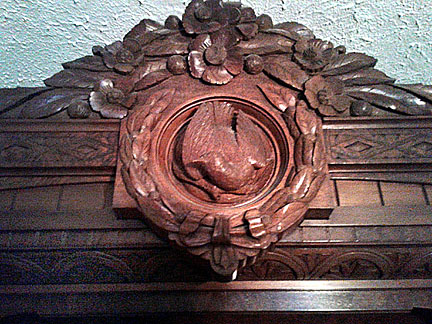
This particular dressing case has all the features of the American Renaissance Revival style and then some. Not only does it have the small drawers, but also smaller cabinets with carved fronts with what look to be magnolia flowers. How magnolia flowers got to be on a piece of furniture made in Canada is a mystery. Burl walnut veneer decorates the fronts of the larger panels. And both the dresser case and the bedstead feature a large carved medallion with a dove of peace.

It’s believed that this bedchamber suite was originally in The Towers, an Italianate mansion built by George Elias in the 1870s, the second manion on his property. Today, renamed The Scottish Rite, it’s the home of a Masonic Lodge. When George Elias had The Towers built, he commissioned a local cabinetmaker, Joseph Hoodless, to not only create the mansion’s fine woodwork, but also some custom pieces of furniture, including this bedchamber suite. At the time, Hoodless had the reputation of being the finest furniture maker of his time. One of his bedchamber suites won gold metal at the Toronto Exhibition.

Because this is so customized a piece, value is hard to determine. Similar bedchamber suites have sold for upwards of $10,000 or more.


To learn more about Victorian Revival furniture, read "The Victorian Era---An Age of Revivals."


Monday, March 14, 2016

The Luck 'O the Irish


QUESTION: I have two chairs that I’ve been told are Irish Chippendale. Both feature lion mask carvings on the knees of the front legs. Are these lion mask carvings rare on Irish furniture?

ANSWER: Before tackling whether your chairs are rare or not because of their lion mask motifs, let’s first define exactly what “Irish” Chippendale furniture is?

Most people think Thomas Chippendale designed and built his famous furniture. He definitely designed it and built some for wealthy clients, but mostly he’s known for his famous Gentleman and Cabinet-Maker’s Director, a catalog of furniture patterns which included detailed drawings of all of his furniture design ideas, plus variations. Cabinetmakers all over the world bought the book and created their own versions of his designs based on the materials available in their locale and on the wishes of their wealthier customers.

Although Irish Chippendale is somewhat of a misnomer, the name which attaches to that peculiar style as well as its general contour comes from Thomas Chippendale It was the work of cabinetmakers in Ireland, and of those who made furniture for the Irish market at a time when Chippendale was influencing the furniture produced by his contemporaries. It was, however, apparently formulated to some extent independently, and even earlier than it was possible for the influence of Chippendale to have spread so far afield.


Chippendale based his designs on those of Queen Anne pieces, especially the cabriole leg. Since Ireland was under British rule in the 18th century, it’s possible that some of the wealthier Irish families imported pieces made by Chippendale in England. The evolution of the Irish Chippendale style was a gradual one. It didn’t just happen overnight. Eighteenth-century cabinetmakers all looked to each other for ideas, incorporating many of them into their designs. In addition, their clients often asked for particular features and motifs on the furniture they commissioned. The wealthy traveled and most likely experienced Chippendale’s designs where they visited, creating a demand for a Chippendale-related style in Ireland sooner than the popularity of the English cabinetmaker’s work would otherwise have done.

Whatever may have been the origin of the Irish Chippendale style, whether made in Dublin or in Irish provincial towns, such furniture had a sufficiently characteristic style running through it which gave it an individuality all its own. Some decorative arts historians believe that the Irish Chippendale style had a Dutch influence which shows in the somewhat heavy foliated carving of the rail, chiefly shown on the edge of tabletops.

Irish cabinetmakers captured the "spirit " of Chippendale in their designs, but for the most part they wrongly interpreted it. Also, many of the pieces show the features of the earlier Queen Ann and Jacobean styles. This indicates that many of the Irish cabinetmakers were unfamiliar with the Chippendale style as such and just added the features requested by their clients to their existing furniture designs.

The lion mask, a motif used from antiquity as an emblem of strength, courage, and majesty, is one such feature. The lion mask holding a ring in its mouth for a handle derives from ancient Roman furniture and continues to be popular as doorknocker even today. From the early to mid-18th century, the lion mask enjoyed popularity as a favored motif for furniture ornament, used as an arm rest support or to decorate the knee of a cabriole leg. Occasionally, a lion's paw or pelt appears alongside the mask. Thus the lion mask was a common facet of Irish Chippendale design.

Unlike other examples of furniture made in the Chippendale style, those pieces made in Ireland feature lion masks prominently in their design. Because much of Irish Chippendale furniture dates a bit before Thomas Chippendale published his catalog of furniture patterns, your chairs are most likely slightly older than furniture made in the traditional Chippendale style during the last half of the 18th century and not a rarity as you originally asked.

To learn more about Thomas Chippendale and his style of furniture, read "Chippendale---The Royalty of Antique Furniture" and "Chippendale Changed the Way Furniture Looked."