Wednesday, July 10, 2019

Bottles, Bottles Everywhere


QUESTION: Ever since I was a kid, I’ve loved collecting bottles. I started by digging them up in our backyard. None of them were anything special—pill bottles and soda bottles mostly. But now that I’m older, I’m more serious about collecting bottles. I find them everywhere—at yard and garage sales, flea markets, even in the trash. But my collection has grown by fits and starts and isn’t organized at all. What advice would you give about focusing a bottle collection? Which kinds are the most collectible?


ANSWER: Bottle collecting is one of the easiest to get into but also the most confusing. The term “bottle collector” is a misnomer since he or she collects not only medicine, soda, beer, wine and liquor, and food bottles, but also bottle openers, advertising, and even stoneware. So first you must decide just what kind of bottles you’re going to collect.

Bottle collectors find beauty and rarity in old, dirty, empty glass bottles made to hold food or beverages over 100 years ago. They scour flea markets and auctions and go digging in old garbage dumps.

Collectors classify bottles by what they originally contained—medicine, soda, beer, liquor and wine, and food. Within each of these categories, however, there are a number of subcategories that really help to illustrate the true depth of bottle collecting

Those who collect medicine bottles specialize in bottles that had contained a particular type of cures or bitters. Others might specialize in medicine bottles that have their original labels or that still have their original content. However, today, it’s illegal to buy and sell old medicine bottles with their contents still intact.

People collect medicine bottles made in certain towns or those embossed with certain words such as “electric” or “magic.” Some of these collectors also seek out bottles in colors other than clear and aquamarine.

Specialty collectors can look at a bottle and tell when the company who made it was in business, what other addresses the company used, what other products the company  made, which glass company probably made the bottle, and even what other colors that particular bottle can be found in. These collectors spend hours researching, looking through original records, business directories and other source documents, in a quest for information about companies that have been out of business for over a century.

Although many collectors specialize in a particular type of bottle, others specialize in a different way. For example, some people collect bottles that were made in their hometown or home state, regardless of whether the bottle originally held spirits, milk or medicine. Others collect bottles that have their name or interesting pictures, such as lions or eagles, embossed on them. There are collectors who select only bottles manufactured by certain glass houses. Others collect solely on the color of a bottle, so that a cobalt blue fruit jar shares display space with a cobalt blue soda bottle.


Of course, not all bottle collectors are specialists. Instead, they choose to collect a few key examples from many different collecting specialties.

Collecting bottles can be a two-edged sword. On the one hand, it's difficult to go to a yard sale, flea market, auction, ii or antique show without seeing dozens of bottles for sale. The volume of bottles available on the market certainly makes it easy to amass a large collection in fairly short order, and at fairly low prices.

Many novice bottle collectors find themselves in a quandary soon after beginning to collect, as their display space begins to disappear before their collecting budget is exhausted. This abundance of supply also causes problems for advanced collectors as well. Due to the volume of bottles manufactured during the past two centuries, no single bottle price guide pictures, describes, and prices all of the ones that a collector might find in just one day at a large flea market. Thus, finding the value of a bottle can be difficult.

NOTE: For more information on collecting antique medicine bottles, read Collecting Pieces of the Medicine Show" in The Antiques Almanac.

To read more articles on antiques, please visit the Antiques Article section of my Web site.  And to stay up to the minute on antiques and collectibles, please join the other 18,000 readers by following my free online magazine, #TheAntiquesAlmanac. Learn more about western antiques in the special 2019 Spring Edition, "Down to the Sea in Ships," online now. And to read daily posts about unique objects from the past and their histories, like the #Antiques & More Collection on Facebook.  

Wednesday, July 3, 2019

Let’s Have a Cold One


QUESTION: Ever since college, I’ve been a great lover of an ice cold beer. And today, with all the microbrews out there, I’ve become quite the beer afficionado. Along with enjoying a variety of beers—I even have a special refrigerator in my garage to keep my collection of microbrews cold—I’d also like to start collecting brewery memorabilia in earnest. I have a few items—coasters, bottle openers, and a variety of cans from various breweries. Can you help me get some direction to my collecting? There are so many items that I’m not sure where to start.

ANSWER: It’s appropriate that you’ve contacted me this week since the Fourth of July is probably the leading holiday at which people celebrate with cookouts and coolers of icy cold beer.

Beer has been a part of American culture since the first Virginia colonists began brewing ale from corn in 1587. Adrian Block & Hans Christiansen's brewhouse at the southern tip of New Amsterdam, now Manhattan, was the first brewery established in the New World. Ever since then breweries have opened all over America.


Michael Combrune published The Theory and Practice of Brewing in 1762. This was the first attempt to establish rules and principles for the art of brewing. In 1808, members of the Congregational Church in Moreau, New York, formed a temperance society. From that point forward, a major struggle between beer drinkers and those who disapproved began, culminating in Prohibition. Until the rise of these societies all over the country, the only competition breweries had was from whiskey manufacturers.

During Prohibition, breweries produced "near beer," a nonalcoholic beer, which people  greeted with a lukewarm reception at best. The breweries also made "health tonics," ice cream and many other products to keep themselves afloat during this time.

In 1935, the G. Kreuger Brewing Company of Newark, New Jersey, became the first brewery to sell beer in steel cans. That year, only about 25 percent of all beer sold was packaged in bottles and cans. Breweries sold the rest in kegs.

The breweries have always had competition, from other alcoholic producers as well as other breweries.  To beat the competition, they used strong print and media advertising campaigns, elaborate visuals, and colorful giveaways. They used everything from foam scrapers, brightly colored cans, distinctive bottle labels, neon signs, tip trays, cups, hats, shirts, serving trays and countless other items in an attempt to make the consumer remember one brand over another.


Today, the market for vintage brewery collectibles is hot. But there are so many different items that beginning collectors have a very good chance of finding ones to fit their tighter budgets.

First, a beginning collector should buy what he or she likes and can afford. Prices for these collectibles are all over the map, so focusing a collection is important from the start. To begin, a novice collector might build on what he or she already has or perhaps start in a new direction of interest. That can include beer bottles or cans, unique advertising signs, and even beer coasters from around the world. Often, these can be had for the cost of a cold beer.

Beginners should select a collecting theme early or risk accumulating too much material to handle. It's easy to start small, with something inexpensive like coasters, as long as the beginner always buys items in the best condition. Beginning collectors of brewery collectibles usually start with signs, trays and cans produced after Prohibition. Advance collectors collect the pre-Prohibition era material and usually zero in on the geographic area in which they live or grew up.


So what determines pricing for brewery collectibles? As with other antiques and collectibles, it’s condition, condition, condition," since most brewery collectibles have been used. Pristine examples can command high prices, and they can be difficult to find. While rarity is important, for collectibles where multiple examples exist, condition rules.


One of the priciest examples is the Clipper beer can, which sold on eBay for more than $19,000. Lithographic factory signs have sold for $7,500 to $15,000, die cuts for $1,000 to $2,500, tin lithographic serving trays for $250 to $1.000 and tip trays for $250. While these are the priciest items, there are lots of others selling for much less.. Signs with reverse painting on glass and calendars are especially prized by collectors.

The variety of brewery collectibles is astounding, so much so that they offer lots of possibilities for collectors at all levels. The bottles and cans produced today may someday be worth more than the contents they hold as will signs, lights, mirrors, tap handles, and labels.

To read more articles on antiques, please visit the Antiques Article section of my Web site.  And to stay up to the minute on antiques and collectibles, please join the other 18,000 readers by following my free online magazine, #TheAntiquesAlmanac. Learn more about western antiques in the special 2019 Spring Edition, "Down to the Sea in Ships," online now. And to read daily posts about unique objects from the past and their histories, like the #Antiques & More Collection on Facebook.   

Wednesday, June 19, 2019

Behind the Eight Ball


QUESTION: When I was a teen, I used to spend my afternoons after school at the local Boys Club playing basketball and pool. In fact, I got pretty good at pool over the years. Now that I’m older, I’ve gotten back into pool. Only today, they call it billiards. I also like to collect things. Is there such a thing as billiards memorabilia?

ANSWER: Actually, there is, but the market for billiard-related items is pretty steep. But let’s take a look back at how this game began.

Billiards began as a lawn game similar to the croquet played sometime during the 15th century in France.

During the reign of Queen Elizabeth I of England, the game had moved indoors to a wooden table with green cloth to simulate grass and a simple border around the edges. The term "billiard" came from the French for either the word "billart," one of the wooden sticks, or "bille," a ball. Since the early 19th century, it has been known as the "Noble Game of Billiards," but in fact all sorts of people played the game from its beginning. In 1600, Shakespeare mentioned it in his play "Antony and Cleopatra."

When players brought the game indoors, players shoved the balls rather than struck them with wooden sticks called maces. The cue stick didn’t appear until the late 17th century. When the ball lay near a rail, the mace didn’t work because of its large head. Players then would turn the mace around and use the end of its handle to strike the ball. The handle was called a "queue" meaning "tail" from which came the word "cue." For a long time only men were allowed to use the cue. Women had to use only the mace because people felt they were more likely to rip the cloth with the sharper cue.

At some point, a player used chalk to increase friction between the billiard ball and the cue stick. Performance improved dramatically, There are four distinct shapes in various colors---square, round, triangular and wafer. The square variety is by far the most common. The  earliest chalk was white, but the majority today is green or aqua to match the felt on the tables.


Early cues typically varied in length between 54 and 57 inches for pool, and between 60 inches and longer for billiards. The finer cues were normally four times more expensive than the common "house cue," reaching as high as $13 for a tournament-trophy quality model. Around the turn of the 18th century, the leather cue tip appeared. This allowed a player to apply side-spin, topspin, or even backspin to the ball. All billiard/pool cues used to be one single shaft until the two-piece cue arrived in 1829.

Billiard/pool tables originally had flat walls for rails. Their only function was to keep the balls from falling off the table. Players originally called them "banks" because they resembled the banks of a river. They soon discovered that the balls could bounce off the rails and began deliberately aiming at them, and thus the "bank shot" was born. This is where the billiard ball is hit toward the rail with the intention for it to rebound as part of the shot.

Wood made up the bed of a billiard table until around 1835, when slate became popular due to its durability for play and the fact that it wouldn't warp over time.  As for the size of billiard tables, a two-to-one ratio of length to width became standard in the 18th century. Before then, there were no fixed table dimensions. By 1850, the billiard table had essentially evolved into its current form.


The game of billiards has had many variants. Players referred to a table without pockets as a "billiard table," while those with pockets were called "pocket billiard" tables. The term "carom table" was used in the early days of the sport to denote a billiard table without pockets. To carom meant to strike two balls at the same time with the white cue ball.

The sizes of billiard balls ranged from one inch for children's tables, to 2½ inches in pocket billiard balls, to as large as 2 3/4 inches in the carom variety. The most common material used was clay. And although manufacturers tried many other concoctions, they eventually settled on some type of composition resembling clay. Celluloid balls first appeared   in the late 1800s and proved to be the best substitute for ivory available at the time. While the makers of clay balls claimed that the celluloid balls occasionally exploded upon contact, this wasn’t true. What they did do was shatter during cold weather when left overnight in poorly heated pool rooms.

Though clay, ivory, and numbered balls were available for over 150 years, and the basic appearance of early billiard cues stood unchanged for much longer than that. Of the more than 150 independent billiard table manufacturers from the early to late 19th century, only a handful were in business for more than a few years. Many combined forces to improve sales and often bought out competitors.

And though the term "pool room" now means a place where people play pool, it had a very different meaning in the 19th century. Back then a pool room was a betting parlor for horse racing. Owners installed pool tables so patrons could pass time between races.

By the 19th century,  ballrooms of the wealthy featured highly carved and/or inlaid, exotic billiard tables. But, it wasn't just the well-to-do who played. For more than a century, even small towns had a pool hall. Businessmen and politicians transacted many deals around pool tables. Gambling also occurred, which is where the term “pool hall” originated. The most common place in town for placing bets or taking chances on a “pool” was the billiard parlor, and these smoky establishments soon became known as “pool halls."


Unfortunately, "pool halls" began to get a bad name and this reputation slowly dimmed the lights on the honorable game of billiards. Hundreds of them began to falter and close across the country in the 1930s and 1940s. Many politicians were advocating the closure of billiard rooms in an attempt to "clean up their communities" as part of their campaign platforms, all the while playing billiards in the homes of their upper-class constituents.


While the memorabilia from this field is amazingly diverse, finding early items isn't easy. It takes persistence, great patience and sometimes deep pockets to put together a collection.

To read more articles on antiques, please visit the Antiques Article section of my Web site.  And to stay up to the minute on antiques and collectibles, please join the other 18,000 readers by following my free online magazine, #TheAntiquesAlmanac. Learn more about western antiques in the special 2019 Spring Edition, "Down to the Sea in Ships," online now. And to read daily posts about unique objects from the past and their histories, like the #Antiques & More Collection on Facebook.  


Wednesday, June 12, 2019

Sleep My Baby


QUESTION: Recently, I purchased an old book on Victorian life at a book sale. As I was leafing through it, I noticed a photo of a bizarre looking little doll. The caption said it was a mourning doll. I never saw anything like this before. What can you tell me about this little doll and what was its purpose?

ANSWER:  During the Victorian Era,  people typically used elaborate physical representations and rituals to mark the death of a loved one. Because people often died at home, family members, usually women, prepared the body of the deceased for buria. The dead body would then be displayed for a time in the parlor. Because of the close proximity of death to the home, and because of high mortality rates for children and infants, children knew about death and dead bodies from a very early age.

In Victorian times, parents and other family members openly discussed death with children. And children's stories often included death scenes and references to death, especially with an emphasis on the joys of heaven and the inevitable reunion with loved ones there.

During the 19th century, especially after the Civil War, death played a major role in everyday life.

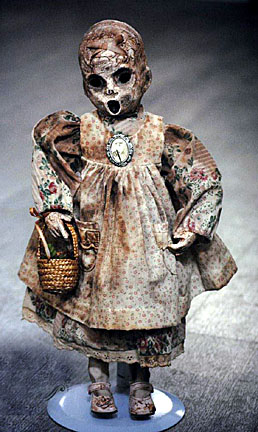
By the late 19th century, it became customary to commission a "mourning doll" to lay at the grave of a deceased child. These dolls became a way for families to deal with the death of a child. Along with mourning attire and jewelry, death masks, and post-mortem photography, the mourning doll was just another, if somewhat overlooked, element in the Victorian grieving process.

Considering that many infants died of disfiguring and draining illnesses such as smallpox, scarlet fever, tuberculosis and diphtheria, the mourning doll offered an idealized reality of their loss. While their child may have departed gaunt and bloody, the wax effigy would look as though it had simply closed its eyes and gone to sleep.

Graveside dolls became a way for parents to cope with the death of a child. When a child died, it was traditional for families who could afford it to have a life-sized wax effigy of the child made for the funeral. The doll would often be dressed in the deceased infant or child's own clothing, and most of the deceased child's own hair would be used to make the doll even more realistic. These wax dolls usually show the deceased lying in a coffin-like setting with their eyes closed, to mimic a peaceful sleep.

The backsides of the heads were made flat so that the doll would lay nicely when laid out to rest. Most parents put the mourning doll on display at the wake and would then leave it at the grave site. Some people often kept these effigy dolls after the funeral, placing those of infants in a crib, periodically changing their clothes, and otherwise treating them like a real baby.

To simulate the feel of a real child, the makers stuffed them with sand and heavy cloth to give them a more realistic feel when being held. Sometimes, parents had the doll,  itself, framed. Effigies of older children consisted of just the head and shoulders. All of them had flat backs, so that they could be placed in a picture frame.

Many Victorian girls had some sort of doll. They used them, much as little girls do today, to play house and thus practice social interactions. By the late 19th century, people recognized that childhood was a time for play, but that play also came with instruction. Little girls play-acted tea parties and courtships, and learned the expectations and rules of femininity. Of course, family members encouraged them to dote on baby dolls like they were their own, preparing girls to become good wives and mothers. But there was another role that dolls prepared girls for—funerals.

Wax effigies weren’t the only death-related dolls associated with Victorian children. Parents often gave their daughters “Death Kits,” which included a doll and miniature coffin. In play, the child would then practice dressing the doll, laying it out for visitation by placing it in the coffin, and planning a funeral. She might also be expected to practice attending to the grief of the doll’s mourners. When young Victorian women became adults, they would have most likely been asked to care for dead family members.


A kit would include a doll with black mourning clothes and a doll-sized coffin. Just as in real life, the little girl would prepare the doll for a wake and funeral, displaying it for mourners near the body of the dead child. Sometimes the effigy would be a full bodied doll, its body weighted with sand so as to feel more realistic, and with a flat back so as to lie down nicely in something like a tiny coffin. Dolls of older children might just be a head and shoulders, with the back of the head and torso flattened so it could be framed.

After the funeral the doll would either be left at the child’s grave or kept in the home, perhaps displayed in a glass coffin. Often cared for much like a real child, the mourning doll might be placed in a bed or crib and have its clothes regularly changed. Occasionally, parents would have a full-sized effigy made of their dead child to place in their bedroom.

Although many of these dolls didn’t survive the years, those that did were usually lovingly kept by the parents, often displayed in the bed of the deceased and cared for and re-dressed as though they were the deceased. Those that remain today were preserved in large glass boxes and, typically, depict a child between birth and three years.

Wax mourning dolls lost their popularity as tastes changed and the First World War began in the early 20th century. This is another one of those bizarre Victorian customs that has faded into history.

To read more articles on antiques, please visit the Antiques Article section of my Web site.  And to stay up to the minute on antiques and collectibles, please join the other 18,000 readers by following my free online magazine, #TheAntiquesAlmanac. Learn more about western antiques in the special 2019 Spring Edition, "Down to the Sea in Ships," online now. And to read daily posts about unique objects from the past and their histories, like the #Antiques & More Collection on Facebook.  

Tuesday, May 28, 2019

School Days, School Days, Happy Golden Rule Days


QUESTION: Not long ago, I began collecting little school awards cards. I also collect postcards and found several of these at a postcard show. Each seems to have been personalized for a particular student and covered a variety of topics. What can you tell me about these cards? Are they worth collecting? And how old might they be?

ANSWER: It’s that time of year when schools let out for summer vacation. It’s also the time when students receive awards for a variety of achievements. Today, only a select few receive awards, but in the latter 19th and early 20th centuries, many students received them in the form of Reward of Merit cards.

As early as 1780, Robert Raikes , editor of the Gloucester Journal, opened his first Sunday school in Massachusetts. He began a reward of merit system to maintain discipline, appropriate behavior and good and punctual attendance.

Eighteenth-century hand drawn, colored and hand painted Reward of Merit cards from this early period are considered American folk art by many collectors. Earlier cards had religious subject matter, with poetry, sermons and verses from the Bible. Beginning in the early to mid-19th century, Rewards of Merit became less religious and pious in nature, gearing themselves more toward children's topics, games, child scenes, and patriotic flags and eagles, especially those printed at the time of the American Civil War.


The very earliest examples were simple hand-written notes of praise. Early printed cards were printed on thin pieces of paper with black ink. Most had had a fancy border and the words “Reward of Merit” printed on them. Some printers added illustrations copied from children's chapbooks or newspapers. Pictures often depicted patriotic and seasonal symbols, trains, ships, people and animals.

The top of the card usually read "Reward of Merit," with the well behaved students name written below, followed by the signature of the teacher who issued the reward. Teachers presented these Reward of Merit cards not only for academic achievement but also for punctuality, attendance, proper and good right conduct, and overall signs of improvement in early 19th century one-room schools. Victorian mothers often pasted these cards into scrapbooks to show a their child's achievement and performance at school.

In the 1850s, teachers began to add color to their merit cards by hand-tinting them. Some printers used the chromolithographic process popular in the greeting card industry. Side inscriptions might have included a full-length poem or a saying.

Rewards of Merit cards came in packs of 10 assorted cards, with four designs to the package. Prices varied depending on sizes and workmanship. Most were imported. The most expensive, 40 or 50 cents for 10, were the die-cut examples. Embossed groupings started at 8 cents a package and ran up to 30 cents.

Those teachers who didn’t want to select their own cards could use an optional selection service. The young ladies who did this had good taste and sent the best and prettiest they could for the money sent.


What were these rewards given for? Many came printed with their topic—Neatness in Writing, Correctness in Recitation, Diligence and Good Behavior, Correct.'Deportment, Never Absent-Never Irate. Others had lines for the teacher to fill in. It’s obvious when reading them that teachers often used Rewards of Merit as tokens of affection with inscriptions such as “A Fine Boy or Girl.”

Teachers never looked upon Reward of Merit cards as educational aids. They were gifts in return for something worth recognizing. Although some could be inscribed with such words as "best" in math or English or Latin, they were never part of the grading system. They were the way teachers could say, “You did a good job,” and “Thank you.”

Sunday School teachers also gave reward cards that usually featured scripture. Some were the same size as the Reward of Merit Cards, but many were stickers as small as postage stamps. Their messages reflect their theme—Live Like Jesus, Blessed Be God, Be Thou Faithful, My Hope is in Thee, Maintain Good Works, The Lord is With Thee.

Publishers began printing standardized mass produced rewards for the American public later in the 19th century. The teacher might simply fill in the name of the student, write a signature, and be done. The George P. Brown and Company School Supplies Catalog of the 1890s devoted the first three pages of Day-School Reward Cards.

To read more articles on antiques, please visit the Antiques Article section of my Web site.  And to stay up to the minute on antiques and collectibles, please join the other 18,000 readers by following my free online magazine, #TheAntiquesAlmanac. Learn more about western antiques in the special 2019 Spring Edition, "Down to the Sea in Ships," online now. And to read daily posts about unique objects from the past and their histories, like the #Antiques & More Collection on Facebook.