Thursday, July 8, 2021

So You Think You Need an Appraisal


QUESTION:  I have inherited a bronze statue called “The Bronco Buster” by Frederic Remington, along with several other bronzes from my uncle. I know nothing about them but admired them on visits to his house. I’d like to find out what they’re worth and the best way seems to be getting them appraised but I have no idea where to start. Can you help me?

ANSWER: Bronzes are interesting pieces of sculptural art. Unlike paintings and other forms of sculpture, bronzes have been cast from a clay original. Does that make them less valuable? Certainly not. In fact, depending on the number cast from the original mold, they can be quite valuable. When it comes to art, most antique dealers don’t know where to start to valuate a bronze sculpture. For this, you’ll need an expert’s opinion. 

Contrary to popular opinion, not just anyone can valuate an antique or collectible. Asking someone how much an object is worth is like asking if it will rain tomorrow. The only way to know what an antique, especially a potentially valuable one such as this clock, is worth is by having it “appraised” by a professional appraiser. And only a professional appraisal is legally binding when it comes to insurance claims or inheritances.

Exactly what is an appraisal? An appraisal is the paid opinion of an expert on the value of an object based on known facts. In the case of antiques and collectibles, known facts include records from more than one sale at more than one auction, the latest published price guides, and personal experience gained from buying and selling similar items many years.

While a verbal appraisal may offer an indication of how much an item is worth, a professional written one is the only one legally recognized by insurance companies and the courts. It must be based on fact and able to stand challenges in court. However, written appraisals, even for one item, can take hours to prepare and are expensive, but are absolutely necessary to prove an item’s worth.


A written appraisal is the result of hours of research by the appraiser. First, he or she must determine the age of the object based on its appearance, materials, and craftsmanship. Decorative techniques and motifs may also play a part. Then the appraiser needs to search for a provenance if the object doesn’t yet have a written one.

A provenance is a history of ownership dating from when the object was first made and by whom and continuing through various owners to the present day. This may not be easy. Often the appraiser has to contact experts in the particular category of antiques to fins out more about the object. Lastly, the appraiser searches auction databases, not available to the public and only to subscribers for hefty fees, to find out the sales history for objects like the one being appraised. While the last sale price usually determines the market value of the object, an appraiser will often average out the most recent sale prices to determine the object’s value. All this information, written up in legal form, plus photographs of the object, constitutes the appraisal of the object. Most appraisers usually assemble the contents of the appraisal in a folder or bound form before presenting it to the current owner of the object.

Take General Sherman’s hat, for example. Did this hat actually belong to General Sherman? How many other owners did it have after him? And how did the hat get passed down to it’s present owner? While there may have been other hats like it, most likely it was one of a kind, made especially for Sherman. This is where an appraisal is best.

Formal appraisals fall into two categories—replacement and fair market value. Insurance companies require the former, while estate valuations require the latter.

Replacement value is generally defined as the price at which an object would be available on the retail market. In other words, what an antique dealer would charge for a particular item.

When you try to insure a collection, the insurance company wants to know how much it will cost to replace it. The same applies for a single piece of furniture. The insurance company won’t accept a verbal appraisal as the basis of settling a claim. Instead, they require a written appraisal with proof of replacement cost.

Fair market value, on the other hand, is best described as "the price that property would sell for on the open market between a willing buyer and willing seller, with neither being required to act, and both parties having reasonable knowledge of the reasonable knowledge of the relevant facts.

But whatever the appraised value, an object will bring only a percentage of its replacement value when offered for sale—generally between 40 and 60 percent below replacement cost. Items that sell extremely slow will sell for only about 30 percent of replacement value, while those that sell fast may bring 80 to 90 percent of replacement value. 

With so many auction sites online these days, it’s easy to pull one up and do a search for a particular antique or collectible to see what it may be selling for. Most people use eBay. Unfortunately, the amounts listed on eBay may not reflect an object’s true value. If the object is listed on an auction site, then, as with live auctions, the price could go way above the object’s current value due to competition between bidders. If someone really wants an antique or collectible, they may stop at no amount of money to obtain it.

Objects of antiquity are another matter altogether. Copies abound. This little ancient Egyptian sculpture of a boat and its occupants is a good example. To the untrained eye, it may look authentic, but only an expert can tell for sure. In fact, many copies of small tomb sculptures have been made and sold as souvenirs to tourists.  

Too many homeowners use this as an easy way to price items in a yard or garage sale. Flea marketers do the same. This is why so many items that are actually worth much less are selling for higher prices today at these venues. 

Prices of objects at antique shows usually sell for the amount of their value or a little less. However, some sell for what the dealer perceives to be the value of the object. High-end dealers selling objects for four to six figures do their research and know their market. Those selling at middle-market shows, sometimes do research about an item, but, more often than not, just guess at an item’s value and price it for what they think the market will bear.

To read more articles on antiques, please visit the Antiques Articles section of my Web site.  And to stay up to the minute on antiques and collectibles, please join the over 30,000 readers by following my free online magazine, #TheAntiquesAlmanac. Learn more about "The Ancients" in the 2021 Spring Edition, online now. And to read daily posts about unique objects from the past and their histories, like the #Antiques and More Collection on Facebook.


Friday, July 2, 2021

It's All About the Patterns


QUESTION: When I was a little girl, I used to sleep over at my grandmother’s house. While there, I used to stand in front of her china cabinet looking at all the beautiful china. Each piece had some sort of scene, usually a landscape with people. Most of the dishes were blue but some were pink and one or two were lavender. After my grandmother passed, I got her china collection. I just love it but don’t know much as these beautiful pieces. The name Spode is either stamped or impressed on the bottom of most of the pieces. Can you tell me who made them and where they got the ideas for the scenes on them?

ANSWER: What your grandmother collected and you now have is Spode china. All those with scenes and borders are what’s known as transferware, a technique for transferring prints to pottery.

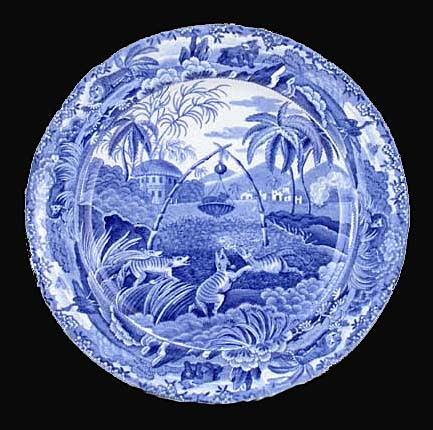
During the early years of the 18th century, Spode achieved success because of  his mastery of transfer printing.  An Irish engraver named Brooks invented the process. It involved first, engraving a copper plate, then inking it and applying to it to thin tissue paper. The impression on the paper could then be transferred to wares of any shape.

Spode produced a variety of pottery wares, often imitating those of Wedgwood, including creamwares, basalts, stonewares, redwares, Jasperwares, and of course blue-printed pearlwares and early experimental porcelains.

In 1784, Spode began printing under the final glaze in blue on earthenware. He copied the early patterns from Chinese porcelain imported wares. By that time, London customers who had originally purchased Chinese porcelain dishes needed replacements. The engraver Thomas Lucas brought with him to Spode’s pottery the knowledge of designs from his previous employer, Thomas Turner at Caughley. 

Most of the early blue transfer-printed patterns were Chinese in style.  As Spode's production advanced and its customers' tastes evolved, the variety of patterns grew. Interest in Chinoiserie patterns later gave way to patterns that depicted rural scenes, exotic places, literary themes, as well as floral and botanical examples.

The earliest pattern produced by Spode around1790, was “Willow,” now known as “Blue Willow,” printed examples of the Willow pattern, commissioned by Josiah Spode and made around 1790, and its copperplate, engraved for Spode by Thomas Minton. 

In June 1805, there appeared the first of 20 monthly issues of a publication called Oriental Held Sports, Wild Spurts of the East, published by Edward Orme of Bond Street, London.  Each issue included a printed story and two large aquatint prints engraved from drawings by Samuel Howitt, a distinguished animal painter. Spode adapted the prints to his dinnerware depicting various hunting scenes with animals and birds. Some views show mounted hunters carrying spears with native bearers on foot. The ’Indian Sporting’ series alone had 21 different hunting scenes.

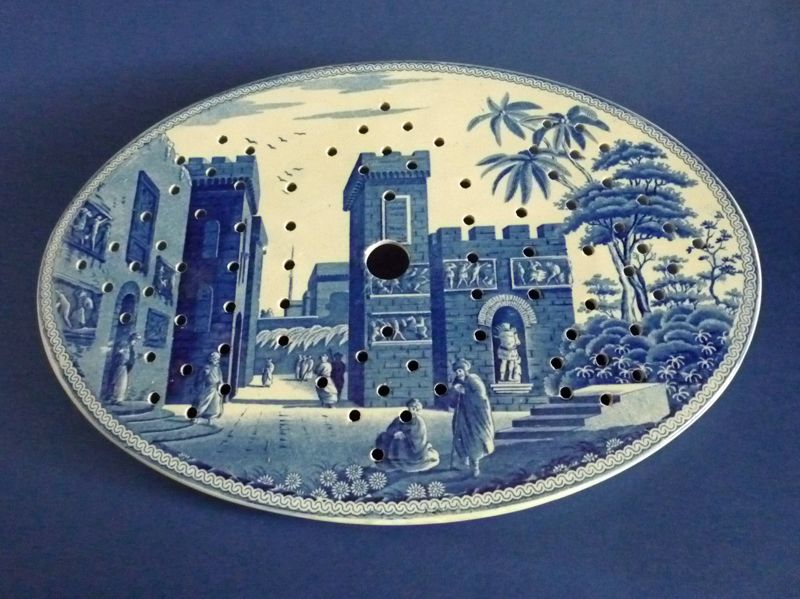
Another popular series formed a travelogue of views in the Eastern Mediterranean. Spode based these on engravings in Mayer's Views in Asia Minor, Mainly in Caramania, published in 1803. "The Castle of Boudron;" The City of Corinth" and “Antique Fragments at Lissimo” were all part of this series. 

From around 1800, most of the patterns painted by Spode's artists were recorded in Pattern books.  These books contained watercolor paintings of tens of thousands of patterns made from about 1800 up to the end of production. Many are beautiful works of art in their own right, but they also acted as a historic document of changing design styles over two centuries. Georgian simplicity, Regency opulence, Victorian Naturalism, sentimentality, Pre-Raphaelite styles, Japanese Revival, Arts and Crafts, Art Deco, and 1950s Modernism.

Spode introduced his more famous pattern, “Blue Italian,” around 1816. It became immediately popular and remained a best seller. Over the years, the company produced it on a wide variety of earthenware shapes. One Spode catalog from the 1920s and 1930s records over 700 different shapes available. 

Unlike many of the other classical scene patterns on Spode wares of the early 19th century, the origin of the view for the Italian pattern isn’t certain. Some experts believe Italian artist G.P. Pannini, well known for his painting style, inspired pictures of ruins and quiet pastoral Italian scenery fpor Spode pieces. The Spode engravers derived many of their pictorial subjects from scenes which had appeared as prints. Publications of prints of scenes associated with the Grand Tour became the inspiration for many patterns. Merigot's Views Of Rome and Its Vicinity, published in 1798, was the source for several Spode patterns, including Tower and Castle, but experts agree that none of these views inspired the Italian pattern.

Furthermore, there is no one location in Italy that seems to correspond to all the features included in the original “Blue Italian” scene. It seems to be a composition made up of several elements. The ruin on the left, although architecturally incorrect, might have been based on the Great Bath at Tivoli, near Rome. The row of houses along the left bank of the river is similar to those of the Latium area near Umbria, north of Rome. The castle in the distance is of a type which occurs only in Northern Italy in the regions of Piedmont and Lombardy.

Could it be that a traveling artist from Northern Europe made sketches of the scenes he encountered as he made his way through Italy? Upon returning home, did he combine his sketches into an attractive scene which, later, Spode used and chose to call the Italian Pattern? Unfortunately, there is no proof of this. The inspiration for the Italian scene may have even come from a print of a painting and then another painting taken from the print by a different artist.

In the early 19th century, most of the pieces Spode produced in the “Blue Italian” pattern were on dinnerware items used by the rich---asparagus servers, huge meat dishes, enormous soup tureens with ladles, cruet sets, foot baths, and more. Wealthy households set their dinner tables with Spode’s Italian. And there were many variations of the pattern. 

“Blue Italian” was an immediate success from its introduction. Though it’s impossible to say what created this strong appeal, it’s perhaps due to the unique combination of a classical scene with a Chinese border which had been directly copied from pieces of Chinese export porcelain, dating from around 1785.

By 1822, Spode had developed other colors, in addition to blue, that could withstand high-temperature firing.  The production of these additional printed colors enabled Spode to expand his line of wares.  While not nearly as popular as Spode's various blues, these new colors included green, brown, manganese purple, Payne's grey, and black.  

Soon afterwards,  in 1824, two-color underglaze printing began.  Spode also employed other methods to add color.  One method was to transfer print outline patterns and then paint in or between the lines of the pattern in other colors. Other methods included enameling with additional colors and gilded decoration over the glaze to further expand the variety of offerings.  Near the end of the early Spode period, the pottery also began producing wares in pink.

Spode introduced about 150 patterns a year.  By 1833 Spode, they numbered nearly 4,000. Most Spode wares bear a pattern number, as well as the name Spode printed, painted, or impressed on the bottom or reverse side.

Some Spode collectors collect just the “Blue Italian” pattern while others specialize in collecting only the oldest pieces dating from 1816 to 1833. Since Spode china continues to be made, newer pieces are often passed off as older ones. It’s important to check the provenance if possible. 

To read more articles on antiques, please visit the Antiques Articles section of my Web site.  And to stay up to the minute on antiques and collectibles, please join the over 30,000 readers by following my free online magazine, #TheAntiquesAlmanac. Learn more about "The Ancients" in the 2021 Spring Edition, online now. And to read daily posts about unique objects from the past and their histories, like the #Antiques and More Collection on Facebook.

Thursday, June 24, 2021

Potting Up Some Beauty


QUESTION: I love plants and for the last few years I’ve been buying a variety of colorful vintage ceramic flower pots at local flea markets and garage sales. Few of them have any makers’ marks. I’d like to have some idea who made some of the pots I have. Can you help me?

ANSWER: Unfortunately, many of the potteries that produced these pots didn’t mark them. But I should be able to give you some clues to their makers through descriptions of their patterns. Some things never go out of style. And so it is with vintage ceramic flower pots. 

Gardening furniture and accessories have become one of the hottest vintage collectibles. For the last several decades, decorating magazines have shown them in rooms adorned with vintage garden ware. Produced in many styles and colors, there’s a flowerpot available to harmonize with almost any decor.

Many American potteries, such as McCoy, Shawnee, Roseville, and Camark produced flowerpots from the 1930s to the 1950s. And people are still using many of them today to display their houseplants. Some even collect them.

The Nelson McCoy Pottery Company, which operated in Roseville, Ohio, from 1920 to 1967, made over 10 different patterns of flowerpots with attached saucers. Some of the most common patterns, available in three sizes and glazes including aqua, green, dark green, white, yellow, rust, plum and pink, were Basketweave, Beaded Tower Patch, Greek Key, and Stonewall. These are quite common and can still be found at garage sales, although prices have risen to $5 to $45 in the past few years. 


Roseville Pottery operated several potteries in Roseville and Zanesville, Ohio, from 1892 to 1954. Early on, they made utilitarian ware, but by 1902, the company had begun to produce art pottery, such as Rozane, Fuji, and Della Robbia. Talented designers such as Frederick H. Rhead and Frank Ferrell contributed to the success of these   lines. Roseville later produced molded flowerpots in a variety of glazes and patterns, including Apple Blossom, Bittersweet, Bleeding Heart, Bushberry, Clematis, Columbine, Corinthian, Cosmos, Donatello, Ferella, Foxglove, Freesia, Iris, Ivory II, Ixia, Jonquil, La Rose, Magnolia, Moss, Pine Cone, Poppy, Primrose, Rosecraft, Snowberry, Water Lily, White Rose and Zephyr Lily. These had separate, not attached, saucers and were usually available in several glaze colors. Most were 5 inches tall, although the Donatello and Rosecraft patterns came in three sizes—4, 5 and 6 inches. Roseville flowerpots cost more than others and are usually hard to find than those of other manufacturers. Most sell for $75 to $200.

Shawnee Pottery Company of Zanesville, Ohio, produced not only kitchenware but inexpensive flower pots from 1937to 196 for Samuel Henry Kress,  F.W. Woolworth, and Sears Roebuck. Patterns included burlap surface, diamond quilted, square, three-footed with embossed flower, scalloped rim, and five-petal flower around rim. Their flowerpots sell for under $15.  

The Vernon Kilns Pottery of Los Angeles, operating between 1931 and 1958, produced flower pots with separate saucers in several of their handpainted dinnerware patterns, such as Brown-Eyed Susan, Homespun, Organdie, and Gingham in three sizes—3, 4 and 5 inches. Though highly sought after by collectors, all are hard to find, especially the saucers, and prices range from $40 to $60.

Founded in 1926, Camden Art Tile and Pottery Company was the third and last producer of art pottery in Arkansas. By the end of its first year, its name had changed to Camark to include both the city of Camden and the state of Arkansas. The firm produced flowerpots that were similar to, if not exact copies of, those of other manufacturers. The bottom line for Camark was to keep abreast of market trends and either meet them or anticipate new ones as was the case with flowerpots. By the mid-1930s, Camark had introduced a line of flowerpots with attached saucers. Camark realized the potential for flowerpot sales and predicted that growing plants will be sold in very large quantities and flower pots will become a necessity—a prediction which definitely came true. To cut costs, Camark changed the types of clays it used for its flowerpots. Previously, the company relied on Arkansas clays but began to use clays from outside the state.

With flowerpots, it’s really not whether they’re worth anything as collectibles— although some are—but whether they appeal to you.

To read more articles on antiques, please visit the Antiques Articles section of my Web site.  And to stay up to the minute on antiques and collectibles, please join the over 30,000 readers by following my free online magazine, #TheAntiquesAlmanac. Learn more about "The Ancients" in the 2021 Spring Edition, online now. And to read daily posts about unique objects from the past and their histories, like the #Antiques and More Collection on Facebook.