Showing posts with label Staffordshire. Show all posts

Sunday, January 25, 2026

The Colorful World of Jasperware


QUESTION: Recently, while browsing in an antique shop, I came upon a small display plate with a Classical relief decoration. The plate looked like Wedgwood ware but its background color was sort of a pale salmon pink color with cream-colored decoration. The only Wedgwood pieces I’ve ever seen have been a light blue with white decoration. Since the price was low—the dealer said she didn’t think it was real Wedgwood but a contemporary copy—I bought it. Is this plate real Wedgwood? And if so, why the pink background color?

ANSWER: You got a real bargain. Your plate was, indeed, made by Wedgwood and because it’s pink, is on the rare side. Wedgwood introduced pink Jasperware in the late 19th century and never made it in large quantities. The pale rose color gave a delicate and romantic appearance to small decorative boxes and medallions. Today, pink pieces can sell for $500 to $1,200. 

Noted English potter Josiah Wedgwood invented Jasperware in 1774 after conducting over 5,000 carefully recorded experiments over several years.  Wedgwood made Jasperware of a dense white stoneware which accepted colors throughout its body and not just on the surface.

Usually described as stoneware, it has a smooth texture and unglazed matte "biscuit" finish. Wedgwood experimented with different colors and at first produced it in a pale blue that became known as "Wedgwood blue." Relief decorations in contrasting colors—usually in white but also in other colors—gave his pieces their characteristic  cameo effect. He produced the reliefs in molds and applied them to the ware as sprigs.

After several years of experiments, Wedgwood began to sell Jasperware in the late 1770s, at first making it in small objects, but adding vases from the 1780s onwards. It was extremely popular, and after a few years many other potters devised their own versions. 

The decoration was initially in the fashionable Neoclassical style, which became especially popular in the beginning of the 19th century. But Jasperware could also be made to suit other styles. Wedgwood turned to leading artists outside the usual world of Staffordshire pottery for designs. High-quality portraits, mostly in profile, of leading personalities of the day were a popular type of decoration, matching the fashion for paper-cut silhouettes. The wares were made into a great variety of decorative objects but not as tableware. Three-dimensional figures are normally found only as part of a larger piece, and are typically in white.

In his original formulation, Wedgwood tinted the mixture of clay and other ingredients  throughout by adding dye. Later, workers merely covered the formed but unfired body  with a dyed slip, so that only the body near the surface had the color. These types are known as "solid" and "dipped." The undyed body was white when fired, sometimes with a yellowish tinge. Workers added cobalt to the decorative elements of the pieces that were to remain white.

To add a bit of class ins marketing his ware, Wedgwood named it a after the mineral jasper.

Barium sulphate was a key ingredient. Ten years earlier, Wedgwood introduced a different type of stoneware called black basalt. He had been researching a white stoneware for some time, creating a body called "waxen white jasper" between  1773 and 1774. But this tended to fail in firing and wasn’t as attractive as the final Jasperware.

Besides its most common shade of pale blue, Jasperware came in a variety of other colors, including dark blue, lilac, sage green, black, and yellow. Sage green resulted from adding chromium oxide, blue to cobalt oxide, and lilac to manganese oxide, yellow to a salt of antimony, and black from iron oxide. Other colors sometimes appeared, including white used as the main body color, with applied reliefs in one of the other colors. The yellow is rare. A few pieces, mostly the larger ones like vases, use several colors together, and some pieces mix Jasperware and other types together.

Wedgwood dyed or stained the earliest Jasperware throughout and it has become known to collectors as "solid," but before long most pieces had colored slip applied  only on the surface. These became known as "dipped." Wedgwood first dipped his pieces in 1777 due to the high cost of cobalt oxide. By 1829 Jasperware production  had virtually ceased, but in 1844 production resumed making dipped wares. Solid Jasperware didn’t appear again until 1860.

Generally, Wedgwood made Jasperware into Neoclassical vases with heavily stylized Neoclassical cameos. Many of these cameos depict famous scenes from Greek literature and modern interpretations of Greek literature.

Shortly after discovering how to make Jasperware, Wedgwood went into business and started producing it in large quantities from a factory based in Staffordshire, England. In order to confuse potential competitors about the ingredients he used, he had the minerals for his clay ground in London, and then brought to Staffordshire in powdered form.

To discourage corporate espionage, Wedgwood made sure that no single one of his workers had a complete understanding of the process for making Jasperware, the formula for which he kept secret. By dividing up factory tasks and forcing his workers to become extremely specialized, he prevented them from becoming competitors.

Jasperware was Wedgwood’s most important contribution to ceramics. With its timeless style and class, it has become an enduring luxury material, beloved by collectors the world over for more than 250 years.

To read more articles on antiques, please visit the Antiques Articles section of my Web site.  And to stay up to the minute on antiques and collectibles, please join the over 50,000 readers by following my free online magazine, #TheAntiquesAlmanac. Learn more about "Sacred Artifacts" in the 2025 Holiday Edition, online now. And to read daily posts about unique objects from the past and their histories, like the #Antiques and More Collection on Facebook.

Monday, February 6, 2023

Anyone for Tea and Cake?


QUESTION: Ever since I was a little girl having tea parties for myself and my dollies, I’ve loved little cups and saucers. One of my grandmothers gave me a little tea set for my sixth birthday. I loved that set. Soon my tea parties expanded as I invited my girlfriends to bring their dollies over to visit. As I got older, my interests changed until one day while helping my mother clean our attic, I found my original miniature tea set. Since then, I’ve been collecting miniature cups and saucers. I would love to enhance my collection. Can you advise me on how to do that?

ANSWER: What a charming memory. Collecting miniature cups and saucers and even whole tea sets has been a popular pastime for many people. The chief advantage is that because they’re small, they take up less space, making them ideal for those living in condos and apartments.

Children’s tea sets, first produced for the children of the wealthy, seem to have been created before potters discovered the formula for porcelain in Europe. Metalsmiths crafted the earliest ones of pewter or copper, and in some cases gold or silver. Children’s toy tea sets first appeared in 16th-century Germany, a country known for producing toys in wood and metal.

Porcelain children’s tea sets didn’t appear until the 18th century, but just like the silver and gold ones, only the wealthy could afford them. These sets were generally of very high quality, and people kept them for special occasions. Children’s tea sets didn’t become popular household items until the early to mid 19th century, during the Industrial Revolution. The Universal Exhibition of 1855 in London seems to have been the starting point of their expansion. 

In Colonial America, tea was a family event, with everyone enjoying a break during the day. No doubt make-believe tea time and pretend tea drinking were a part of some children’s playtime activities. Perhaps many little girls played at serving tea and dreamed of having a tea parties of their own. The pieces in these sets usually imitated those in regular sets, differing only in size. Though children’s cups and saucers look like traditional tea cups, only a bit smaller than demitasse cups. The handles were small, and not easy for adult hands to hold.  

Collectors love miniature cups and saucers for their variety, in shape, style, and decoration. They can be classified in two distinct styles—dollhouse-size miniatures and toy-size. 

Dollhouse-size miniatures are the smallest—usually scaled an inch to the foot. During the late 18th century, English and continental makers produced dinnerware sets for fashionable ladies to furnish  miniature rooms in large dollhouses. By the 19th century many more companies produced these sets, making them for both children's and adults' dollhouses.

During the Victorian era, wealthy families furnished a nursery for their children. While adults took tea in the parlor, the children had theirs in the nursery. This practice required child-size tea sets. Teacups held three or four ounces, just the right size for three-year- and up. Manufacturers decorated these pieces with animal themes, nursery rhymes, airy .tales, children's activities and the art of famous illustrators

First made n the early 19th century, Staffordshire ABC ware included more than 700 patterns. The alphabet appears on each piece. In the case of a small one, such as a tea cup, which was too small for the entire alphabet to fit, English manufacturers made the letters smaller or used fewer of them. Today, children's size miniatures are the most abundant and reasonably priced. American production of children's ware reached a peak during World War II before the less costly Japanese ware became available.

Mary of Teck, wife of George V of Great Britain, who reigned from 1910 to 1936, was an avid collector of dollhouses and miniatures. Because of her interest, the hobby regained popularity in the 1930s through the 1950s, making early dollhouse-size miniatures rare.

Toy-size miniatures are larger than the dollhouse-size but smaller than child's size. Novice collectors often mistake them for salesman's samples. These toy-size miniatures served several purposes. First, collectors could display them in a cabinet. Second, they taught children of wealthy families manners and social races in the late 18th and 19th centuries. Makers frequently decorated these teacups and saucers with historical scenes and mottoes.

Manufacturers produced these toy-size cups and saucers in the same forms, shapes and styles as the full-sized ones of the period. The potters of Nuremberg, Germany became famous for their miniature tea sets, decorated in vivid colors. Early tea bowls and saucers made by Meissen occasionally come up for sale. The Dutch produced small pottery items decorated in blue and white in the 17th century and introduced them to England in the 1690s. Soon "baby house waresÂș were part of Staffordshire potteries’ stock.

Companies such as Coalport, Minton, Spode and Worcester produced miniature creamware, stoneware and porcelain cups and saucers in the 19th century. The Dresden studios decorated miniature cups and saucers, often in the popular quatrefoil shape, in the late 19th century.

The most common examples of toy size cups and saucers found in the marketplace today date from the 20th century. In France several companies in the Limoges area produced them around the turn of the 20th century and still make them today. RS Prussia manufactured examples of lovely molded cups with leafy feet and unusual shaped handles around 1900. English potteries, such as Shelley, Crown Staffordshire, Copeland Spode, Wedgwood, Royal Crown Derby, and Coalport miniature tea sets with trays, which were exact replicas of full-size sets. Collectors especially like the Royal Crown Derby pieces, decorated in the Imari patterns. Probably the hottest miniature cup and saucer in the marketplace today are those made by Shelley. The price for a cup and saucer can reach as high as $250 to $300. In the United States, Leneige Company and Gort China made miniature cups and saucers from 1930 to the 1950s.

The creation of early plastics and Bakelite in the late 19th century marked a huge change in children’s tea set design. Manufacturers still made them in porcelain and more durable stoneware, but plastic sets soon began to emerge. By the mid 20th century, plastic sets and sturdy stoneware became the norm. 

To read more articles on antiques, please visit the Antiques Articles section of my Web site.  And to stay up to the minute on antiques and collectibles, please join the over 30,000 readers by following my free online magazine, #TheAntiquesAlmanac. Learn more about old-time winter objects in the 2022/2023 Winter Holiday Edition, with the theme "Winter Memories," online now. And to read daily posts about unique objects from the past and their histories, like the #Antiques and More Collection on Facebook.


Monday, September 5, 2022

Antique Air Fresheners


QUESTION: Recently, my father died. For as long as I can remember, my father gave a small ceramic fantasy-like cottage pride of place. My mother said he wanted me to have it. There’s a large hole in the back. At first I thought it was a candleholder, but my mother told me that an older woman friend of his send it to him from Haiti, where she had gone on a cruise. The odd thing about this gift was that it took a long time to be delivered and arrived after the woman had died. Can you tell me anything about this little cottage—how old is it, what was it used for?

ANSWER: What your father received is called a pastille burner–-a little device that made rooms more fragrant in the past. By its appearance, it probably came from one of the potteries in Staffordshire, England. 

Times past weren’t always fragrant. While air fresheners come in all shapes and sizes today, back then people used various ways to cover up the noxious odors which permeated the environment. Scent vinaigrettes, pomanders and perfumed handkerchiefs were effective enough while out and about in the streets of a city.

Bronze pastille burner Regency

By the 16th century, a special device had been developed to release a pleasant scent into the air in the home. These devices, called pastille burners, had become quite popular in aristocratic homes during the reign of Queen Elizabeth I. By 1811, most upper class homes had at least one pastille burner, and some of the better ones had  more than one.

The word pastille dates back to the 15th century. It takes its name from the Latin word, pastillus, meaning a small roll or little loaf of bread. Initially, pastilles were tiny lozenges compounded of aromatic herbs blended with a sweetener which people used to freshen their breath. In the mid-16th century, pastille makers produced them to be burned in order to release pleasant scents into the air of an upper class home.

Ceramic pastille burner Wedgwood

But these new pastilles weren’t made commercially until well into the reign of Queen Victoria. Before that, servants made pastilles in the still rooms of the homes of the aristocracy and the gentry using a recipe provided by the lady of the house. These scent pastilles consisted of finely ground charcoal, saltpeter, a binder, and a fragrance. People preferred charcoal made of willow wood because it could be finely powdered and burned evenly without an abundance of smoke. They blended this with saltpeter to ensure the charcoal would continue to burn once it was lit. The binder was most often Gum Arabic or Gum Tragacanth, either of which they added to the powdered charcoal and saltpeter mixture in the amount necessary to create a stiff dough. The addition of either of these gums would ensure the pastilles remained firm once they had dried. 

The makers added the fragrance last, in the form of an essential oil, which had been distilled in the still room at some time prior to the making of the scent pastilles. Among the most popular scents were lavender, rose, jasmine, sandalwood and cedar, though there were a few recipes which included more expensive fragrances, such as myrrh, frankincense and orris.

Pastille cones

After blending the fragrance oil into the pastille dough, servants pressed it into a number of small, conical molds. In most cases, these molds would produce scent pastilles which were about a half inch in diameter and about one and a half inches tall, though there were some which were larger. They then left the scent pastilles  in the molds to dry for at least two days, though for larger pastilles, it took three to four days. Once the scent pastilles were fully dry, the small, hardened cones could be removed from the molds. They would then be ready to use. The fully dry scent pastilles were most often stored in air-tight containers to keep them dry and to help retain their fragrance until needed.

Early bronze pastille burner

Early pastille burner makers used bronze or brass and sometimes silver to make them. But by the second half of the 18th century, potteries began producing them in porcelain, which didn’t get as hot as the metal ones. Also, potters could easily mold porcelain, offering a wide variety of shapes to work with. And the growing palette of glaze colors made it possible to produce very colorful and highly decorative pastille burners.

At first, porcelain manufacturers produced burners in the same shapes as those of the early metal burners. Soon wealthier customers asked for pastille burners to complement the garnitures, or fireplace mantel sets, so as to camouflage the purpose of the burners. Others wanted decorative burners for their bedrooms. By the 1760s, many porcelain manufacturers began producing shapes molded to represent things of every day life, such as fruits and vegetables, animals and flowers. They also took inspiration for their burners from various buildings, from rural churches and cottages to ancient castles. Wealthy landowners commissioned porcelain copies of interesting buildings on their properties.

Building shapes offered open windows, enabling the pastille itself to burn steadily. And one with a chimney allowed a way for the white smoke given off by the pastille as it burned. By the end of the 18th century, rustic buildings such as the cottage orné became a popular as a form for pastille burners. Cottages orné were typically rustic cottages set in an attractive and secluded rural setting.

During the first decade of the 19th century, dove cotes, gate-keeper’s lodges, dairy houses and intricate, flower-covered summer houses had become popular forms for pastille burners. Other country building types included toll houses, churches, and castles, often covered with vines and colorful flowers. 

Sliding tray pastille holder

There were several ways the pastille could be placed inside the burner. In some, the user could remove the roof of the building, in others, the entire building could be lifted off its base. And in others the user could pull out a flat tray for the pastille out of one side of the building. Burner manufacturers often concealed these small slides as a bow window, an external chimney breast, or the gable wall side of a building.

Removeable chimney pastille holder

Back in the early 19th century, matches hadn’t been invented yet, so people used a spill, a long, thin sliver of wood or a twisted length of scrap paper, usually stored in small vases made especially for them and kept on the mantle near the pastille burner. The user would light the spill from the fire in the room, or by use of a tinderbox, and then hold it to the tip of the pastille cone until it caught fire. A one and one half inch tall pastille cone would usually burn for about 20 minutes, giving off its scent along with a thin white smoke. The scent could linger in the room for another 20 to 30 minutes once the pastille had burned out.

To read more articles on antiques, please visit the Antiques Articles section of my Web site.  And to stay up to the minute on antiques and collectibles, please join the over 30,000 readers by following my free online magazine, #TheAntiquesAlmanac. Learn more about art glass in the 2022 Summer Edition, with the theme "Splendor in the Glass," online now. And to read daily posts about unique objects from the past and their histories, like the #Antiques and More Collection on Facebook.

Wednesday, July 14, 2021

Going to the Dogs


QUESTION: I bought these little white match holders from an antiques dealer in northern France, just across from Dover, England, so it’s quite possible they’re English. I’d like to find out their origin and date if possible. I have a collection of match holders but have never seen any like these before.

ANSWER: These match holders are quite unique and seem to be made of Parian, a type of biscuit porcelain imitating marble that was made in England and the United States in the 19th century. Designed to imitate carved marble, it had the advantage that it could be prepared in a liquid form and cast in a mold, enabling mass production.

Parian became popular with middle and upper middle class Victorian women who desired to own the marble statuary and china of the upper classes but couldn’t afford them. Parian filled this need at an affordable price. And while people normally associate Parian with grander sculptural forms and statues and items like water pitchers here in the U.S., it seems that as it’s popularity began to wane that some companies began making smaller less expensive items such as match holders. 

Because Parian had a higher proportion of feldspar than porcelain, makers fired it at a lower temperature. The increased amount of feldspar caused the finished body to be more highly vitrified, thus possessing an ivory color and having a marble-like texture that’s smoother than that of biscuit, or unglazed, porcelain. In its Victorian heyday, potteries produced hundreds of thousands of pieces of Parian ware annually. 

Though the Great London Exhibition of 1851 gave Thomas Battam credit for inventing Parian, indicating that he succeeded in producing a very perfect imitation of marble, there seemed to be controversy about who actually invented it.  While Battam may have invented it, several English factories claimed credit for its development. But the Staffordshire firm operated by William Taylor Copeland and Thomas Garrett was the first to produce and sell it in 1842, and went on to become one of its major manufacturers.

Several potteries marketed it under different names. The Copeland firm called it "statuary porcelain" because of its resemblance to the fine white marble of neoclassical sculpture. Wedgwood named it "Carrara," after the Italian quarry patronized by Michelangelo. But it was Minton which coined the word "Parian" to suggest Paros, the Greek isle that furnished much of the stone used in the classical period. Thus, it quickly became the medium's generic name.

Ultimately, potteries produced two varieties of Parian ware—Statuary Parian, used in the making of figures and reproductions of sculpture, and Standard Parian, from which they made hollowware. 

Standard Parian, with a greater proportion of feldspar in the composition but no frit, was hard porcelain. The presence of iron in the feldspar without iron silicate caused early Parian statuary to appear ivory tinted. Both English and American potters either obtained details of the original formula or worked out their own, resulting in enormous production of Parian wares on both sides of the Atlantic. Plus the invention in 1844 of a patented machine that allowed scaled reproductions of larger bronze or marble originals made replicas of figures and busts by noted sculptors widely available.

Though Minton produced several small Parian statues of dogs, it seems far more likely that Copeland-Spode produced these dog match holders since they produced a wider array of Parian ware, including match holders. They probably date from the 1890s. As time went on, Parian ware went from a less expensive substitute for marble in statuary to the material for inexpensive knickknacks.

To read more articles on antiques, please visit the Antiques Articles section of my Web site.  And to stay up to the minute on antiques and collectibles, please join the over 30,000 readers by following my free online magazine, #TheAntiquesAlmanac. Learn more about "The Ancients" in the 2021 Spring Edition, online now. And to read daily posts about unique objects from the past and their histories, like the #Antiques and More Collection on Facebook.


Friday, July 2, 2021

It's All About the Patterns


QUESTION: When I was a little girl, I used to sleep over at my grandmother’s house. While there, I used to stand in front of her china cabinet looking at all the beautiful china. Each piece had some sort of scene, usually a landscape with people. Most of the dishes were blue but some were pink and one or two were lavender. After my grandmother passed, I got her china collection. I just love it but don’t know much as these beautiful pieces. The name Spode is either stamped or impressed on the bottom of most of the pieces. Can you tell me who made them and where they got the ideas for the scenes on them?

ANSWER: What your grandmother collected and you now have is Spode china. All those with scenes and borders are what’s known as transferware, a technique for transferring prints to pottery.

During the early years of the 18th century, Spode achieved success because of  his mastery of transfer printing.  An Irish engraver named Brooks invented the process. It involved first, engraving a copper plate, then inking it and applying to it to thin tissue paper. The impression on the paper could then be transferred to wares of any shape.

Spode produced a variety of pottery wares, often imitating those of Wedgwood, including creamwares, basalts, stonewares, redwares, Jasperwares, and of course blue-printed pearlwares and early experimental porcelains.

In 1784, Spode began printing under the final glaze in blue on earthenware. He copied the early patterns from Chinese porcelain imported wares. By that time, London customers who had originally purchased Chinese porcelain dishes needed replacements. The engraver Thomas Lucas brought with him to Spode’s pottery the knowledge of designs from his previous employer, Thomas Turner at Caughley. 

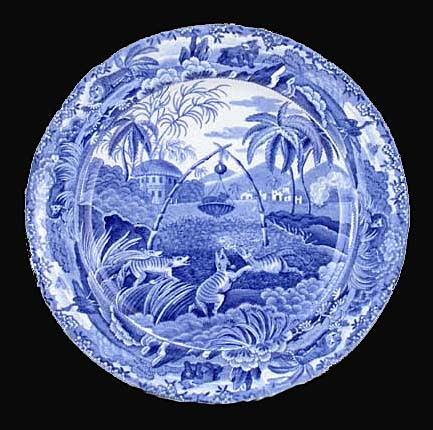
Most of the early blue transfer-printed patterns were Chinese in style.  As Spode's production advanced and its customers' tastes evolved, the variety of patterns grew. Interest in Chinoiserie patterns later gave way to patterns that depicted rural scenes, exotic places, literary themes, as well as floral and botanical examples.

The earliest pattern produced by Spode around1790, was “Willow,” now known as “Blue Willow,” printed examples of the Willow pattern, commissioned by Josiah Spode and made around 1790, and its copperplate, engraved for Spode by Thomas Minton. 

In June 1805, there appeared the first of 20 monthly issues of a publication called Oriental Held Sports, Wild Spurts of the East, published by Edward Orme of Bond Street, London.  Each issue included a printed story and two large aquatint prints engraved from drawings by Samuel Howitt, a distinguished animal painter. Spode adapted the prints to his dinnerware depicting various hunting scenes with animals and birds. Some views show mounted hunters carrying spears with native bearers on foot. The ’Indian Sporting’ series alone had 21 different hunting scenes.

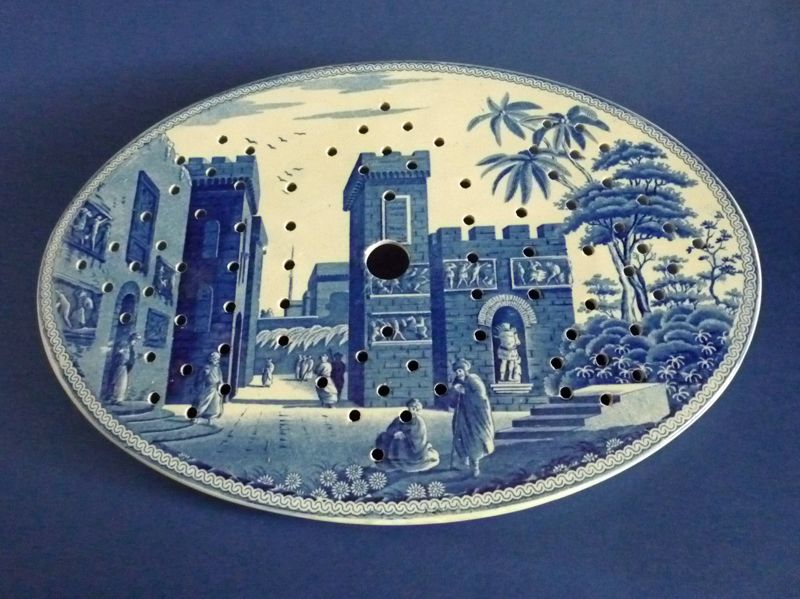
Another popular series formed a travelogue of views in the Eastern Mediterranean. Spode based these on engravings in Mayer's Views in Asia Minor, Mainly in Caramania, published in 1803. "The Castle of Boudron;" The City of Corinth" and “Antique Fragments at Lissimo” were all part of this series. 

From around 1800, most of the patterns painted by Spode's artists were recorded in Pattern books.  These books contained watercolor paintings of tens of thousands of patterns made from about 1800 up to the end of production. Many are beautiful works of art in their own right, but they also acted as a historic document of changing design styles over two centuries. Georgian simplicity, Regency opulence, Victorian Naturalism, sentimentality, Pre-Raphaelite styles, Japanese Revival, Arts and Crafts, Art Deco, and 1950s Modernism.

Spode introduced his more famous pattern, “Blue Italian,” around 1816. It became immediately popular and remained a best seller. Over the years, the company produced it on a wide variety of earthenware shapes. One Spode catalog from the 1920s and 1930s records over 700 different shapes available. 

Unlike many of the other classical scene patterns on Spode wares of the early 19th century, the origin of the view for the Italian pattern isn’t certain. Some experts believe Italian artist G.P. Pannini, well known for his painting style, inspired pictures of ruins and quiet pastoral Italian scenery fpor Spode pieces. The Spode engravers derived many of their pictorial subjects from scenes which had appeared as prints. Publications of prints of scenes associated with the Grand Tour became the inspiration for many patterns. Merigot's Views Of Rome and Its Vicinity, published in 1798, was the source for several Spode patterns, including Tower and Castle, but experts agree that none of these views inspired the Italian pattern.

Furthermore, there is no one location in Italy that seems to correspond to all the features included in the original “Blue Italian” scene. It seems to be a composition made up of several elements. The ruin on the left, although architecturally incorrect, might have been based on the Great Bath at Tivoli, near Rome. The row of houses along the left bank of the river is similar to those of the Latium area near Umbria, north of Rome. The castle in the distance is of a type which occurs only in Northern Italy in the regions of Piedmont and Lombardy.

Could it be that a traveling artist from Northern Europe made sketches of the scenes he encountered as he made his way through Italy? Upon returning home, did he combine his sketches into an attractive scene which, later, Spode used and chose to call the Italian Pattern? Unfortunately, there is no proof of this. The inspiration for the Italian scene may have even come from a print of a painting and then another painting taken from the print by a different artist.

In the early 19th century, most of the pieces Spode produced in the “Blue Italian” pattern were on dinnerware items used by the rich---asparagus servers, huge meat dishes, enormous soup tureens with ladles, cruet sets, foot baths, and more. Wealthy households set their dinner tables with Spode’s Italian. And there were many variations of the pattern. 

“Blue Italian” was an immediate success from its introduction. Though it’s impossible to say what created this strong appeal, it’s perhaps due to the unique combination of a classical scene with a Chinese border which had been directly copied from pieces of Chinese export porcelain, dating from around 1785.

By 1822, Spode had developed other colors, in addition to blue, that could withstand high-temperature firing.  The production of these additional printed colors enabled Spode to expand his line of wares.  While not nearly as popular as Spode's various blues, these new colors included green, brown, manganese purple, Payne's grey, and black.  

Soon afterwards,  in 1824, two-color underglaze printing began.  Spode also employed other methods to add color.  One method was to transfer print outline patterns and then paint in or between the lines of the pattern in other colors. Other methods included enameling with additional colors and gilded decoration over the glaze to further expand the variety of offerings.  Near the end of the early Spode period, the pottery also began producing wares in pink.

Spode introduced about 150 patterns a year.  By 1833 Spode, they numbered nearly 4,000. Most Spode wares bear a pattern number, as well as the name Spode printed, painted, or impressed on the bottom or reverse side.

Some Spode collectors collect just the “Blue Italian” pattern while others specialize in collecting only the oldest pieces dating from 1816 to 1833. Since Spode china continues to be made, newer pieces are often passed off as older ones. It’s important to check the provenance if possible. 

To read more articles on antiques, please visit the Antiques Articles section of my Web site.  And to stay up to the minute on antiques and collectibles, please join the over 30,000 readers by following my free online magazine, #TheAntiquesAlmanac. Learn more about "The Ancients" in the 2021 Spring Edition, online now. And to read daily posts about unique objects from the past and their histories, like the #Antiques and More Collection on Facebook.

Tuesday, March 26, 2019

History on the Dining Table


QUESTION: Ever since I began collecting antiques, I’ve always been fascinated by the beautiful Staffordshire transferware designs on dinnerware. Recently, I saw several stunning pieces at an antique show. These featured American battle scenes and images of historical sites. I thought transferware had only bucolic scenes of the English countryside. Why did English potters produce this type of ware and when was it popular?

ANSWER: That’s a very good question. In fact, most Americans today probably don’t know that English potters were some of our country’s staunch supporters, even risking near treason to do so.

It was bad enough that American soldiers defeated the British in the Revolutionary War, but then on December 14, 1815, the British military conceded defeat to the Americans for a second time. Josiah Wedgwood, a prominent 18th-century English potter, had proclaimed the American Revolutionary War a serious mistake for Britain. He and his fellow potters of the Staffordshire district felt no better about the War of 1812. After all, with the destruction,   blockades, and hatred it generated, warfare was bad for business since the Americans had always been good customers.


To make amends, the Staffordshire potters promptly began decorating their dinner services, tea sets, and assorted crockery with scenes of American military victories guaranteed to make   Americans proud while leaving British generals and admirals glowering in disgust. To add to the victories, the potters exported dinnerware with images of America's war heroes, elder statesmen and favorite politicians. With these, the potters of Staffordshire won back the hearts of their American customers. Historical Staffordshire became the success the potters had hoped for—an economic victory where the British military had failed.

Historical Staffordshire wares were popular, durable, mass-produced in quantity and reasonably priced. They reached a wide audience and offer today’s collectors with fascinating glimpses of America’s past.

Although the Staffordshire potteries produced mugs, pitchers, foot baths, and chamber pots, dinnerware and tea services dominated production of historical Staffordshire ceramics. The potteries first produced it in pearlware and later in a number of durable white wares. Both pearl and white wares were almost as white as porcelains but were rugged enough to survive rough oceanic voyages. Artists decorated the earliest of these with printed transfers in deep cobalt blue that had become popular in the United States. A wider range of colors followed in the 1830s. Running short of military victories and notable personages, the potteries turned to more peaceful subjects, such as individual buildings, towns, idyllic landscapes, and the newest advances in Victorian transportation.

Staffordshire potteries manufactured historical dinnerware from about 1820 to 1860, reaching the height of its popularity between 1820 and 1845.

Printing scandalous portraitures to promote sales was nothing new to the Staffordshire potters. Putting pots before principle was an old habit. Britain’s politicians had long been lampooned and her military heroes hailed on transfer printed pots and mugs to promote sales at home.

During the War of 1812, industrious British engravers supported the cause of American freedom with near-treasonable anti-government images of cringing British lions emblazoned with insulting, anti-English slogans. These could be slipped out through the neutral Netherlands and taken to shore by any number of unrecorded vessels navigating up lesser traveled American waterways.

The designs on historical Staffordshire wares were examples of an early mass- production technique of the growing Industrial Revolution, transfer printing. England's potters developed the technique during the 18th century and perfected it in the 19th century. Industrialization provided British potters with the most rapidly growing stock of earthenware bodies in history. Transfer printing allowed them to quickIy produce large numbers of identically decorated wares from this stock for the first time in potting history. Together the new, white earthenware bodies and the printed patterns would provide a popular, quality ware at a fairly low price, a ware many families of modest means could easily afford.


The quality of the transfer printed pattern, however, was crucial. The artwork determined whether the ware sold well or not. Artists created transfer printed patterns, some of whom had great skill while others didn’t. The largest pottery manufacturers hired their own artist engravers. Smaller companies purchased their patterns from engraving firms. The transfer printing process perfected by Sadler and Green of Liverpool in 1756 allowed a potter to duplicate a pattern by transferring it from an engraved and pigmented copper plate to a ceramic vessel using a specially treated paper.

Artists copied artwork directly from books of the day and from competing engravers' portfolios. They created illustrations for dining services featuring different central prints on each piece, all following a common theme—a "City Series" or a series of "Picturesque Views" for example. Since the central print varied from plate to plate, the artists created a standard border design  to identify the pieces of a single service. Most Staffordshire potters identified specific border designs as their own unique trademarks. In most cases that view was respected. However, smaller companies did copy these designs from time to time.

Women did the meticulous work of correctly placing the inky paper carrying the pattern onto the bisque pottery and for joining the seams of the borders and designs. Most took great care in doing this since they were aware of the Victorian ideal of the "perfect finish." Many of the historical Staffordshire prints how these ladies tried to achieve that ideal. Their printed patterns appear seamless although they placed most of them using several pieces.

However, hastily engraved, copper plates provided transfers that were often larger than the  pottery on which they were to be placed. These oversized patterns, once transferred to their papers, had to be cut and trimmed to fit the smaller vessels. The trimming often led to virtually illegible inscriptions as the women cropped the letters away. While the images frequently remained whole, the words suffered as few of the women trimming the prints could read. They trimmed that which had little meaning to them. Not that it mattered too much because many of their customers couldn’t read either.

And while housewives used historical Stafforshire ware for serving guests and at holidays, eventually the transfer images evolved into peaceful bucolic scenes and souvenir plates.

To read more articles on antiques, please visit the Antiques Article section of my Web site.  And to stay up to the minute on antiques and collectibles, please join the other 18,000 readers by following my free online magazine, #TheAntiquesAlmanac. Learn more about western antiques in the special 2019 Winter Edition, "The Old West," online now. And to read daily posts about unique objects from the past and their histories, like the #Antiques & More Collection on Facebook.