Showing posts with label blue. Show all posts

Sunday, January 25, 2026

The Colorful World of Jasperware


QUESTION: Recently, while browsing in an antique shop, I came upon a small display plate with a Classical relief decoration. The plate looked like Wedgwood ware but its background color was sort of a pale salmon pink color with cream-colored decoration. The only Wedgwood pieces I’ve ever seen have been a light blue with white decoration. Since the price was low—the dealer said she didn’t think it was real Wedgwood but a contemporary copy—I bought it. Is this plate real Wedgwood? And if so, why the pink background color?

ANSWER: You got a real bargain. Your plate was, indeed, made by Wedgwood and because it’s pink, is on the rare side. Wedgwood introduced pink Jasperware in the late 19th century and never made it in large quantities. The pale rose color gave a delicate and romantic appearance to small decorative boxes and medallions. Today, pink pieces can sell for $500 to $1,200. 

Noted English potter Josiah Wedgwood invented Jasperware in 1774 after conducting over 5,000 carefully recorded experiments over several years.  Wedgwood made Jasperware of a dense white stoneware which accepted colors throughout its body and not just on the surface.

Usually described as stoneware, it has a smooth texture and unglazed matte "biscuit" finish. Wedgwood experimented with different colors and at first produced it in a pale blue that became known as "Wedgwood blue." Relief decorations in contrasting colors—usually in white but also in other colors—gave his pieces their characteristic  cameo effect. He produced the reliefs in molds and applied them to the ware as sprigs.

After several years of experiments, Wedgwood began to sell Jasperware in the late 1770s, at first making it in small objects, but adding vases from the 1780s onwards. It was extremely popular, and after a few years many other potters devised their own versions. 

The decoration was initially in the fashionable Neoclassical style, which became especially popular in the beginning of the 19th century. But Jasperware could also be made to suit other styles. Wedgwood turned to leading artists outside the usual world of Staffordshire pottery for designs. High-quality portraits, mostly in profile, of leading personalities of the day were a popular type of decoration, matching the fashion for paper-cut silhouettes. The wares were made into a great variety of decorative objects but not as tableware. Three-dimensional figures are normally found only as part of a larger piece, and are typically in white.

In his original formulation, Wedgwood tinted the mixture of clay and other ingredients  throughout by adding dye. Later, workers merely covered the formed but unfired body  with a dyed slip, so that only the body near the surface had the color. These types are known as "solid" and "dipped." The undyed body was white when fired, sometimes with a yellowish tinge. Workers added cobalt to the decorative elements of the pieces that were to remain white.

To add a bit of class ins marketing his ware, Wedgwood named it a after the mineral jasper.

Barium sulphate was a key ingredient. Ten years earlier, Wedgwood introduced a different type of stoneware called black basalt. He had been researching a white stoneware for some time, creating a body called "waxen white jasper" between  1773 and 1774. But this tended to fail in firing and wasn’t as attractive as the final Jasperware.

Besides its most common shade of pale blue, Jasperware came in a variety of other colors, including dark blue, lilac, sage green, black, and yellow. Sage green resulted from adding chromium oxide, blue to cobalt oxide, and lilac to manganese oxide, yellow to a salt of antimony, and black from iron oxide. Other colors sometimes appeared, including white used as the main body color, with applied reliefs in one of the other colors. The yellow is rare. A few pieces, mostly the larger ones like vases, use several colors together, and some pieces mix Jasperware and other types together.

Wedgwood dyed or stained the earliest Jasperware throughout and it has become known to collectors as "solid," but before long most pieces had colored slip applied  only on the surface. These became known as "dipped." Wedgwood first dipped his pieces in 1777 due to the high cost of cobalt oxide. By 1829 Jasperware production  had virtually ceased, but in 1844 production resumed making dipped wares. Solid Jasperware didn’t appear again until 1860.

Generally, Wedgwood made Jasperware into Neoclassical vases with heavily stylized Neoclassical cameos. Many of these cameos depict famous scenes from Greek literature and modern interpretations of Greek literature.

Shortly after discovering how to make Jasperware, Wedgwood went into business and started producing it in large quantities from a factory based in Staffordshire, England. In order to confuse potential competitors about the ingredients he used, he had the minerals for his clay ground in London, and then brought to Staffordshire in powdered form.

To discourage corporate espionage, Wedgwood made sure that no single one of his workers had a complete understanding of the process for making Jasperware, the formula for which he kept secret. By dividing up factory tasks and forcing his workers to become extremely specialized, he prevented them from becoming competitors.

Jasperware was Wedgwood’s most important contribution to ceramics. With its timeless style and class, it has become an enduring luxury material, beloved by collectors the world over for more than 250 years.

To read more articles on antiques, please visit the Antiques Articles section of my Web site.  And to stay up to the minute on antiques and collectibles, please join the over 50,000 readers by following my free online magazine, #TheAntiquesAlmanac. Learn more about "Sacred Artifacts" in the 2025 Holiday Edition, online now. And to read daily posts about unique objects from the past and their histories, like the #Antiques and More Collection on Facebook.

Friday, June 14, 2024

Dishes for Everyday Use


QUESTION: I have some dishes that belonged to my grandmother. I believe they’re over 100 years old. Each has a scene in the center in light blue on a white background. From research I’ve done, I know they’re called Staffordshire, but I still haven’t been able to find much about them. Could you tell me something about them, especially the decorative scenes?

ANSWER: Wedgwood & Co., Unicorn & Pinnox,Works, Staffordshire Potteries, not to be confused with Josiah Wedgwood & Sons, made your dishes. They specialized in making earthenware and stoneware pieces for everyday table use from 1860 to1965. Your particular dishes date somewhere from 1860 to 1890. 

Many people think Staffordshire is a company, but it’s actually an English county. Many English potters established themselves there because they found the clays superior to those found elsewhere in England.

In the late 18th century there were as many as 80 different potteries in the Staffordshire district. By 1802, the number had increased to 149. No single company was responsible for manufacturing Staffordshire dishes. Each potter produced his own wares using a different decorative border, featuring medallions, scrolls, lace, shells, flowers, or trees.

Staffordshire potters made their wares from white earthenware pottery found nearby. Workers applied decoration using a method called transfer printing, developed around 1755. They accomplished this inexpensive method by engraving a design onto a copper plate, which they then inked with special ceramic paint and applied to thin paper. Pressing the paper onto the surface left ink behind.

The production of a blue print began with a design on paper. The engraver traced the outline onto thin tissue paper and then reproduced it on a sheet of copper using homemade carbon paper. He engraved over this outline with a V-shaped groove and added the details and areas of shading using lines or dots. The idea of using dots, or stipple punching, rather than lines came later in the 18th century. The engraver found the right depth by trial and error, so he took a first print or proof before he reworked the lines and dots to deepen them if necessary. The deeper the engraving, the deeper the deposits of color, thus the darker the result. 

The next step was printing. A circular iron plate or backstone kept the color—a mixture of metallic oxides and fluxes with printing oils—warm. The printer applied this to the copper plate, which he kept hot on the hot plate, making sure to rub color into every dot and line. The surplus was then scraped off. He removed any film of color by bossing the surface with a corduroy-faced pad. After the copper plate was clean, he laid the tissue paper coated with a mixture of soft soap and water and passed it through the press’s rollers. He then passed the printed image, now in reverse—unlike regular engravings that begin in reverse and appear correct on printing—on to the transfer team, consisting of the transferrer, apprentice, and cutter.

The cutter removed the excess paper leaving only the design pieces. The transferrer laid these pieces, colored by cobalt oxide, on to the ware after its first or biscuit firing, then dipped it in glaze and refired it, where the silica in the glaze helped to convert black cobalt oxide to blue cobalt silicate. A design with an overall pattern would have the center applied first and the border around the rim afterwards. The tackiness of the oily print held it in place while the apprentice rubbed it down vigorously with a stiff-bristled brush using a little soft soap as lubricant.

The apprentice then soaked the earthenware in a tub of water to soften the paper which was removed by sponging, the oil-based color being unaffected by the water. After drying, an assistant placed the ware into the hardening kiln to fire at 1,250-1,290 F. to remove the oils and secure the color. 

After inking each piece, another worker placed the object into a low-temperature kiln to fix the pattern. The printing could be done either under or over the glaze on a ceramic piece, but since the ink tended to wear off on overprinted pieces, potteries switched to glazing the inked surface after the initial firing.

Scenic views of the Orient and of romantic European destinations with castles and towns became popular transfer motifs. The inspiration for these came from classical literature which was popular at the time. The most valuable plates,. however, are those with American scenes, produced between1800 and 1848. Enterprising English potters arranged with artists traveling in America to sketch the sites for their ware. Leading Staffordshire potters like Adams, Clews, Meigh, Ridgway, Stevens, and Wood, plus those from  hundreds of small companies created American views.

The firms manufacturing these wares included Ridgway, Johnson Brothers, Spode and Wedgwood along with many others. Josiah Wedgwood eventually used the transfer process to decorate his familiar ivory Creamware.

Stamps on the back of each piece often indicated the pattern with or without the maker's trademark. Since several companies employed the same patterns, identifying some pieces can be difficult. At first potters used deep cobalt blue and white designs to simulate wares made in China. These remain sentimental favorites in the United States and England. As technology improved, the shade lightened. By 1850, potteries began using other colors, such as pink, red, black, green, brown and purple.

Most transferware patterns sought by collectors today are two-tone. Blue and white, red and white, and brown and white are the most common combinations. Transferware has become increasingly pricey in the last 20 years, mostly due to articles about using it for decoration to liven up today’s bland home interiors. 

To read more articles on antiques, please visit the Antiques Articles section of my Web site.  And to stay up to the minute on antiques and collectibles, please join the over 30,000 readers by following my free online magazine, #TheAntiquesAlmanac. Learn more about "The  Art Deco World" in the 2024 Spring Edition, online now. And to read daily posts about unique objects from the past and their histories, like the #Antiques and More Collection on Facebook.

Friday, July 2, 2021

It's All About the Patterns


QUESTION: When I was a little girl, I used to sleep over at my grandmother’s house. While there, I used to stand in front of her china cabinet looking at all the beautiful china. Each piece had some sort of scene, usually a landscape with people. Most of the dishes were blue but some were pink and one or two were lavender. After my grandmother passed, I got her china collection. I just love it but don’t know much as these beautiful pieces. The name Spode is either stamped or impressed on the bottom of most of the pieces. Can you tell me who made them and where they got the ideas for the scenes on them?

ANSWER: What your grandmother collected and you now have is Spode china. All those with scenes and borders are what’s known as transferware, a technique for transferring prints to pottery.

During the early years of the 18th century, Spode achieved success because of  his mastery of transfer printing.  An Irish engraver named Brooks invented the process. It involved first, engraving a copper plate, then inking it and applying to it to thin tissue paper. The impression on the paper could then be transferred to wares of any shape.

Spode produced a variety of pottery wares, often imitating those of Wedgwood, including creamwares, basalts, stonewares, redwares, Jasperwares, and of course blue-printed pearlwares and early experimental porcelains.

In 1784, Spode began printing under the final glaze in blue on earthenware. He copied the early patterns from Chinese porcelain imported wares. By that time, London customers who had originally purchased Chinese porcelain dishes needed replacements. The engraver Thomas Lucas brought with him to Spode’s pottery the knowledge of designs from his previous employer, Thomas Turner at Caughley. 

Most of the early blue transfer-printed patterns were Chinese in style.  As Spode's production advanced and its customers' tastes evolved, the variety of patterns grew. Interest in Chinoiserie patterns later gave way to patterns that depicted rural scenes, exotic places, literary themes, as well as floral and botanical examples.

The earliest pattern produced by Spode around1790, was “Willow,” now known as “Blue Willow,” printed examples of the Willow pattern, commissioned by Josiah Spode and made around 1790, and its copperplate, engraved for Spode by Thomas Minton. 

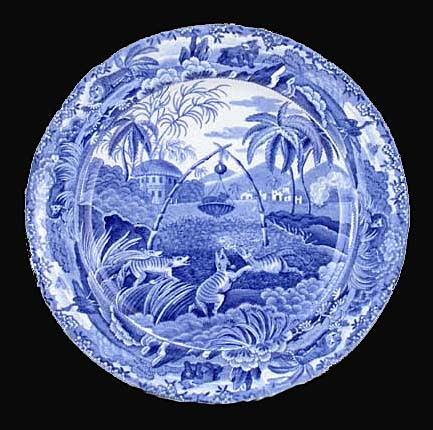
In June 1805, there appeared the first of 20 monthly issues of a publication called Oriental Held Sports, Wild Spurts of the East, published by Edward Orme of Bond Street, London.  Each issue included a printed story and two large aquatint prints engraved from drawings by Samuel Howitt, a distinguished animal painter. Spode adapted the prints to his dinnerware depicting various hunting scenes with animals and birds. Some views show mounted hunters carrying spears with native bearers on foot. The ’Indian Sporting’ series alone had 21 different hunting scenes.

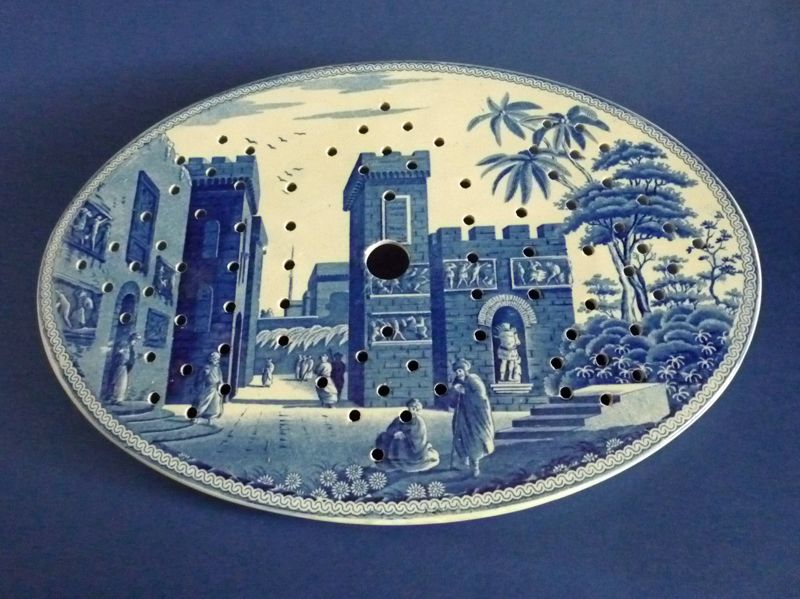
Another popular series formed a travelogue of views in the Eastern Mediterranean. Spode based these on engravings in Mayer's Views in Asia Minor, Mainly in Caramania, published in 1803. "The Castle of Boudron;" The City of Corinth" and “Antique Fragments at Lissimo” were all part of this series. 

From around 1800, most of the patterns painted by Spode's artists were recorded in Pattern books.  These books contained watercolor paintings of tens of thousands of patterns made from about 1800 up to the end of production. Many are beautiful works of art in their own right, but they also acted as a historic document of changing design styles over two centuries. Georgian simplicity, Regency opulence, Victorian Naturalism, sentimentality, Pre-Raphaelite styles, Japanese Revival, Arts and Crafts, Art Deco, and 1950s Modernism.

Spode introduced his more famous pattern, “Blue Italian,” around 1816. It became immediately popular and remained a best seller. Over the years, the company produced it on a wide variety of earthenware shapes. One Spode catalog from the 1920s and 1930s records over 700 different shapes available. 

Unlike many of the other classical scene patterns on Spode wares of the early 19th century, the origin of the view for the Italian pattern isn’t certain. Some experts believe Italian artist G.P. Pannini, well known for his painting style, inspired pictures of ruins and quiet pastoral Italian scenery fpor Spode pieces. The Spode engravers derived many of their pictorial subjects from scenes which had appeared as prints. Publications of prints of scenes associated with the Grand Tour became the inspiration for many patterns. Merigot's Views Of Rome and Its Vicinity, published in 1798, was the source for several Spode patterns, including Tower and Castle, but experts agree that none of these views inspired the Italian pattern.

Furthermore, there is no one location in Italy that seems to correspond to all the features included in the original “Blue Italian” scene. It seems to be a composition made up of several elements. The ruin on the left, although architecturally incorrect, might have been based on the Great Bath at Tivoli, near Rome. The row of houses along the left bank of the river is similar to those of the Latium area near Umbria, north of Rome. The castle in the distance is of a type which occurs only in Northern Italy in the regions of Piedmont and Lombardy.

Could it be that a traveling artist from Northern Europe made sketches of the scenes he encountered as he made his way through Italy? Upon returning home, did he combine his sketches into an attractive scene which, later, Spode used and chose to call the Italian Pattern? Unfortunately, there is no proof of this. The inspiration for the Italian scene may have even come from a print of a painting and then another painting taken from the print by a different artist.

In the early 19th century, most of the pieces Spode produced in the “Blue Italian” pattern were on dinnerware items used by the rich---asparagus servers, huge meat dishes, enormous soup tureens with ladles, cruet sets, foot baths, and more. Wealthy households set their dinner tables with Spode’s Italian. And there were many variations of the pattern. 

“Blue Italian” was an immediate success from its introduction. Though it’s impossible to say what created this strong appeal, it’s perhaps due to the unique combination of a classical scene with a Chinese border which had been directly copied from pieces of Chinese export porcelain, dating from around 1785.

By 1822, Spode had developed other colors, in addition to blue, that could withstand high-temperature firing.  The production of these additional printed colors enabled Spode to expand his line of wares.  While not nearly as popular as Spode's various blues, these new colors included green, brown, manganese purple, Payne's grey, and black.  

Soon afterwards,  in 1824, two-color underglaze printing began.  Spode also employed other methods to add color.  One method was to transfer print outline patterns and then paint in or between the lines of the pattern in other colors. Other methods included enameling with additional colors and gilded decoration over the glaze to further expand the variety of offerings.  Near the end of the early Spode period, the pottery also began producing wares in pink.

Spode introduced about 150 patterns a year.  By 1833 Spode, they numbered nearly 4,000. Most Spode wares bear a pattern number, as well as the name Spode printed, painted, or impressed on the bottom or reverse side.

Some Spode collectors collect just the “Blue Italian” pattern while others specialize in collecting only the oldest pieces dating from 1816 to 1833. Since Spode china continues to be made, newer pieces are often passed off as older ones. It’s important to check the provenance if possible. 

To read more articles on antiques, please visit the Antiques Articles section of my Web site.  And to stay up to the minute on antiques and collectibles, please join the over 30,000 readers by following my free online magazine, #TheAntiquesAlmanac. Learn more about "The Ancients" in the 2021 Spring Edition, online now. And to read daily posts about unique objects from the past and their histories, like the #Antiques and More Collection on Facebook.

Wednesday, May 12, 2021

The Delight of Bristol Blue


QUESTION: I recently purchased a piece of what was described as “Bristol Blue” glass through an online antiques auction. I collect antique glass but this vase struck me as something unique. Although it looked like Victorian enameled glass, it resembled porcelain and the description said it was made in England in the late 18th century. I would really like to know more about this piece. I didn’t think glassmakers produced enameled glass that early Was it produced in Bristol, England, and thus the name, and who made it? And just how far back does Bristol Blue glass go?

ANSWER: Those are all very good questions. Let’s begin with the name. Even though this type of glass has Bristol in its name, glassmakers throughout most of England produced it. The blue in the name refers to the coloring used in the glass.

In the first half of the 18th century, near Redcliffel Backs, Temple Meads, Bedminster and other suburbs of Bristol, England, the squat chimneys of glasshouses and potteries silhouetted the landscape like giant beehives. But it was the age of porcelain, and anyone who could afford to buy it did so. Porcelain factories enjoyed the protection of kings, and European elite emptied their purses for priceless porcelain treasures. The arrival of an affordable substitute in decorated rnilch glass from Germany delighted Bristol glassmakers. For the first time, they had a perfect porcelain substitute  within their reach. 

The Venetians first made glass as an imitation of porcelain prior to 1500. Experts believe they used tin oxide as the agent to produce the white opacity in their glass. Eighteenth-century English white glass, called enamel glass in advertisements of the 1760s, was an intensely white, brittle material, generally a potash-lead mix, rendered opaque by the addition of lead arsenate. The porcelain-like, opaque glass  produced by the glassmakers of Bristol, was soft and smooth to the touch yet retained the fine heaviness of English crystal. It was an instant success, forcing the Bristol glassmen to borrow decorators from neigh-boring potteries to keep up with the public's demand.

England's glass excise tax of 1746 raised the duty on clear glass but didn’t tax opaque and colored glass because there was so little of it being made. This offered an excellent economic incentive for its increased production.

Chemists long knew that a powdered coloring could be premixed and supplied to glassmakers for addition to clear glass of their own making. But it was 18th-century German chemists from Saxony, who refined impure oxide of cobalt to produce a blue powder of unparalleled purity and uniform consistency. They exported their product, called “smalt,” to England, where a British merchant distributed it under the name "Bristol Blue."

The Bristol glassmakers quickly added the new deep-blue color to their already successful line of opaque white glass. Vigor & Stevens, of Thomas Street and Lazarus Jacobs, and later his son Isaac, of Temple Street, produced pieces primarily in deep Bristol Blue.

By the end of the 18th century the manufacture of blue glass became fairly common throughout England and continued to be marketed under the name of Bristol Blue. This makes it difficult, if not impossible, to identify glass made in Bristol from a piece manufactured elsewhere. The original term “Bristol Blue" referred simply to the coloring agent sold to glassmakers rather than to their finished products.

The early shapes, manufactured around 1770, emulated Chinese and English porcelain—pear-shaped covered vases, trumpet-mouthed beakers, and cruets—all   produced in sets. Glassmakers also produced scent or smelling bottles and snuff boxes, often facet-cut, with enameling and gilding, in both white and blue glass.

Early Chinese porcelain painters greatly influenced the 18th-century Bristol designs. The Chinese artists working at the Imperial Porcelain Factory excelled in delicate miniature enameled decoration on their opaque white glass. They often employed motifs of figures, birds, and European flowers much admired by the Emperor Chi’en Lung, who ruled from 1736 to 1795. Since most English glasshouses made their opaque white glass in competition with porcelain, most used the same styles and even the same artists to decorate both.

Glass decorator Michael Edkins linked the white and blue glass under the mutual name of "Bristol." At first, he apprenticed to an enameling firm in Birmingham, England, but at the age of 20, he took up residence in Bristol and settled down to decorate pottery dishes and tiles. At that time, artists painted the pieces with pencils made of bristles from the noses and eyelids of oxen. Graduating to glass, Edkins began decorating "enamel and blue glassware." He worked both independently and for Isaac Jacobs, Little & Longman, and Williams, Dunbar & Company from 1782 onwards. Instead of using enamel paints that needed to be fired, Edkins used standard oil colors, or plain gold gilt motifs, applied with unfired varnish, which he called "cold" decoration. 

Generally, artists decorated Bristol Blue ware with unfired or lightly fired gold varnish. Cruets and decanters often sported the name of their contents as well as intricate garlands and wreaths of plain gold. 

To read more articles on antiques, please visit the Antiques Articles section of my Web site.  And to stay up to the minute on antiques and collectibles, please join the over 30,000 readers by following my free online magazine, #TheAntiquesAlmanac. Learn more about "The Ancients" in the 2021 Spring Edition, online now. And to read daily posts about unique objects from the past and their histories, like the #Antiques and More Collection on Facebook.


Thursday, August 13, 2020

As a River Flows, So Does Flow Blue


QUESTION: My mom loved collecting odd pieces of old china. She died recently and now I have her collection. Among the many pieces are some with designs that are all dark blue and blurry. Are these mistakes or are they some sort of china I’ve never heard of?

ANSWER: No, those blurry pieces are not mistakes. They’re what’s known as Flow Blue. And while many people call this type of ceramics “china,” it’s actually pottery not porcelain. Beginning in 1820, potters in Staffordshire, England, began making it as a way to provide a more affordable alternative for middle-class people who coveted the fine blue and white porcelains being imported from China. As dinnerware, it enjoyed its greatest popularity between the mid-19th century and the beginning of the 20th century. And as an antique, it has gained popularity in recent years.

Potters used cobalt oxide pigment to create the darker hue of flow blue. The porous earthenware absorbed it and blurred when the pottery glaze fired. Although it blurred by itself, potters discovered that it could be made to really flow by the addition of a cup of lime or chloride of ammonia during glaze firing. This had the additional advantage of covering over printing faults, bubbles, and other defects in the pottery. As a result, some flow blue is so blurred that all details are invisible.

Josiah Wedgwood first produced Flow Blue around 1820. But it wasn’t until 15 years later that mass production began. Since flow blue was a decidedly Victorian era phenomenon, its production fell into three time periods.—early Victorian from 1835 to 1850, mid-Victorian from   1860 to 1879, and late Victorian from 1880 to 1900. During the early Victorian period, the most popular styles imitated the Chinese porcelains. But they were largely inaccurate depictions of the Chinese designs, mixing Chinese, Arabic and Indian motifs. Scenics and florals were also  popular during this time.


The mid-Victorian period brought greater creativity to Flow Blue wares, as potters mixed styles and ornamentation became elaborate and varied. Also during the mid-Victorian period, styles began to mix and merge with one another. So, there were things like Oriental-style plates with floral, Gothic, or scenic borders. Other elaborate motifs, like scrolls, pillars, columns, urns and wreaths became quite common. The pieces themselves included toilet wares and teapots, plates and platters, vases and garden seats, and even dog bowls.

Flow blue designs of the late Victorian period exhibited a marked Art Nouveau influence, with stylized florals and beautiful symmetry.

By the end of the Victorian Era, there were thousands of Flow Blue patterns. Though most Flow Blue wares came from English potteries, those in Germany, France, Belgium, the Netherlands, and the United States all made it as well. The most noted English potteries included such names as  Wedgwood, Grindley, Davenport and the Johnson Brothers, while in the United States, Wheeling, Mercer, and Warwick. 
By World War I, U.S. potteries were producing most of the flow blue for the domestic market, causing English potters to close up shop since these wares had never been popular in England. The desirability of the ware waned in both countries between the wars, but interest picked up again in the U.S. in the 1960s.

Antique dealers determine the price of Flow Blue wares mostly based on their pattern, color, and rarity. Patterns range from Blue Danube to Iris and Classic Willow. Especially sought after ones include Amoy, Cashmere, Scinde, Shell, and The Temple, as well as the La Belle pattern by American maker, Wheeling Pottery Company.

Collectors are always on the hunt for the early patterns from the 1840s. Unusual items such as rare shapes, egg baskets and egg cups, large sized platters and early tea and coffeepots command high prices. Egg baskets with eggcups will fetch over $1,000. A single eggcup in a rare pattern can fetch over $400, whereas a not so rare one would fetch maybe $65. Rare coffeepots could he worth over $2,000, and large turkey platters from the 1890s, $600 to $800 if the pattern is right.

To read more articles on antiques, please visit the Antiques Articles section of my Web site.  And to stay up to the minute on antiques and collectibles, please join the over 30,000 readers by following my free online magazine, #TheAntiquesAlmanac. Learn more about  world's fairs in the 2020 Summer Edition, online now. And to read daily posts about unique objects from the past and their histories, like the #Antiques and More Collection on Facebook.


Thursday, December 5, 2019

Onions Galore


QUESTION: I have several plates by Meissen with what I believe is called the Blue Onion pattern. Can you tell me more about it?


ANSWER: The Blue Onion pattern is the Meissen company’s most popular and has been for over 250 years.  Because Meissen never copyrighted it, more companies have copied it than any other ceramic pattern. But the pieces made by Meissen, itself, stand above the others because of the way its workers meticulously hand painted the design on each piece.


After Marco Polo introduced Chinese blue and white porcelains to Europe, the demand rose until by the beginning of the 18th century, Europeans clammered for more and more of the finely painted pieces. To satisfy this demand, the East India Company established trade with China and brought to Europe as much of the blue and white porcelain as it could.

But try as it might, the East India Company couldn’t keep up with the demand, so in 1710 Augustus the Strong formed a new porcelain company to produce blue underglaze decorations like those of the Chinese. Johann Gregor Höroldt, a talented porcelain painter who had worked for the Du Paquier Porcelain Company, a competitor of Meissen’s, perfected the blue underglaze paint, which the Meissen Company used to decorate its wares with the Blue Onion pattern, in 1739.

The model for this unique pattern most likely came from a flax bowl from the Chinese K'ang Hsi period, dating from 1662-1722. Originally, Meissen called it the “bulb” pattern. However, since Europeans were unfamiliar with the fruits and flowers shown on the original Chinese pieces, the Meissen artists created hybrids that were more familiar to the company’s customers. The so-called "onions" really aren’t onions at all, but stylized peaches and pomegranates modeled after the original Chinese pattern. They made the flower in the design a cross between a chrysanthemum and a peony and wove the stems of both the fruits and the flower around a stalk of bamboo.

As production continued, Meissen changed the pattern slightly. Originally, the fruits on the border pointed inward with the stem on the edge. But they altered this design by pointing the fruits alternatively inward and outward.

Not only did the Blue Onion pattern become Meissen’s most popular, but it also was its least expensive to produce. The company made money by using lower-paid “blue painters” as well as   apprentices to do the decorating. In addition, the pieces decorated with the pattern didn’t need a third firing which was necessary to fix the enamel decoration on Meissen’s other wares, plus the company decided not to add gilding to the standard pattern.

The Blue Onion pattern achieved popularity again during Victorian times when home furnishings became darker and heavier. It complemented the more elaborate Victorian furniture styles preferred by the new wealthy middle class. Immediately after the Civil War, the pattern took off. Everything from napkins to tablecloths, utensil handles to enameled cooking pots featured it. By the 1870s, the Meissen Company had adapted it to fit nearly every shape of porcelain ware it produced. To distinguish its Blue Onion pattern from those of its competitors, the company put its now famous emblem of Blue Crossed Swords at the foot of the design’s bamboo trunk in 1888.

To read more articles on antiques, please visit the Antiques Article section of my Web site.  And to stay up to the minute on antiques and collectibles, please join the other 24,000 readers by following my free online magazine, #TheAntiquesAlmanac. Learn more about antique clocks in the Fall 2019 Edition, "It's That Time Again," online now. And to read daily posts about unique objects from the past and their histories, like the #Antiques & More Collection on Facebook.


Monday, August 29, 2016

The Mystique of Cobalt Blue


QUESTION: I’ve always loved objects made of cobalt blue glass. The shimmer of the deep blue glass as the sunlight filtered through it used to fascinate me as a kid. So it’s no accident that I began to collect various glass objects made of it. But even though I have a modest collection of glasses, pitchers, vases, and the like, I really don’t know much about cobalt glass. Can you please give me some background on it and perhaps tell me what’s really collectible and what isn’t?

ANSWER: Cobalt blue glass offers something for everyone. It’s color is distinctive and the variety of pieces available is great. People often associate cobalt glass with 19th and early 20th-century medicine bottles, as well as ink bottles. But the number of different objects made of it goes well beyond these two mundane things.

The addition of a small amount of cobalt to molten glass turns it a deep blue. Its use goes back thousands of years. It was the Egyptians who first developed a process to color glass using impurities found in raw materials. The Romans copied and perfected this method. In Mycenae, around 1400 B.C.E., the production of cobalt glass reached its peak. The large amount of jewelry and dishes made of cobalt blue glass found at archaeological sites show how popular it was. However, today’s collectors look to more recent times and the glass objects made during the Great Depression.

While not all cobalt glass is Depression Glass, a lot of it is. This is the most fertile area for beginning collectors because so much of it appears on the market. Besides being known as “cobalt blue,” Depression glassmakers also referred to it as Deep Blue, Dark Blue, and Ritz Blue.

Depression glass collectors particularly like to collect the Royal Lace Pattern, made by the Hazel Atlas Glass Company in the 1930s. They continued to produce this elegant pattern until 1941.

Many companies created Depression-Era cobalt glass. In the late 1920s, the Diamond Glassware Company offered cobalt blue pieces in the Victory pattern. Hazel Atlas Glass Company introduced cobalt blue glass pieces in its Aurora line, New Century, Florentine No. 1, Florentine No. 2, Hairpin, Ships and Sailboats, and Starlight. The Fenton Glass Company added cobalt blue glass to its Lincoln Inn pattern. The Moondrops and Radiance patterns by New Martinsville Glass Company provided cobalt blue pieces. Paden City Glass Company's offered cobalt blue glass pieces in their Orchid and the Peacock & Wild Rose patterns. Westmoreland Glass Company showcased cobalt blue glass in the English Hobnail line. Everyone, it seems, got in on the act.

Many companies also made beautiful cobalt blue glassware for more formal dining and entertaining. For example, Morgantown Glass Company created a line of elegant glassware in the Golf Ball pattern. The Cambridge Glass Company, on the other hand, created glassware with overlay designs.

Many companies have produced eye-catching decorative items made of cobalt blue glass. During the 1940s and 1950s, the Fenton Glass Company, of Parkersburg, West Virginia, began including cobalt blue glass pieces in its line of eggs and slippers as well as baskets. Another company that created distinctive looking slippers and other decorator pieces was the Degenhart Glass Company. Animals in every shape and size have remained popular with collectors. The Imperial Glass Co. was only one of many companies producing animals in cobalt blue.

Avon Products Inc. took advantage of the popularity of cobalt blue glass and offered a variety of items, including cruets, cologne bottles, and salt and pepper shakers, to its customers over the years, To reach those looking for more elegant items, Avon had the Fostoria Glass Company, long known for its quality glass, produce glassware in the George and Martha Washington pattern.

Lastly, some people collect cobalt blue glass kitchenware, including mixing bowls, rolling pins, refrigerator boxes, and measuring cups, produced by well-known glass manufacturers.

While some people collect cobalt glass for its value, many collect it for its beauty, especially when displayed in a window so the sunlight can shine through it, giving the room a mystical blue glow.