Wednesday, September 15, 2021

Collecting is More Than a Passion


QUESTION: My passion for collecting seems to becoming an obsession. How can I control this? And how can I judge what things are worth collecting?

ANSWER: You’ve obviously been bitten hard by the collecting bug. Ever since the launching of the Antiques Roadshow and Pawn Stars, as well as eBay, Ruby Lane, and other antiques and collectibles, many people think that everything is worth something. And if something is old, it must certainly be valuable. If you believe this, then you’re wrong on both counts.

The first question you need to ask yourself is “Why do you collect things?” Is it for their intrinsic or monetary value, is it for the pleasure they give you, or is it for some vague idea of self-worth?

Asking avid collectors why they do what they do is like asking, "Why do you breathe?" They might reply that something about human behavior wants—or is fated—to gather and accumulate, to crave and classify, to seek out and hoard. Passion plays a part in many serious collectors' pursuits, as does, many admit, the thrill of the hunt.

This can be true even, or perhaps especially, when time is long between looking, finding and acquiring. The rarer an object of desire, the less frequent or instant the gratification of its discovery; for some determined collectors, though, pleasure resides in the long, unpredictable search for a coveted item. Inexplicably, it may also dissolve when it leads to a find.

For many people, collecting is a way of getting in touch with a past era, even if they didn't live through that particular period themselves. Some enjoy owning objects from what they may imagine was a simpler, less stressful age. Or they may have a strong nostalgic or family connection to a certain period and place.

Some people collect with investment value in mind, others to develop an informed knowledge of a our material culture. Either way, passion plays a part in many serious collectors' pursuits, as does the thrill of the hunt. Identifying personally with the objects one admires can also feed the collecting impulse.

Some collectors embrace—and celebrate—their magnificent obsessions. Like entertainers, they enjoy displaying what they have amassed and sharing their enthusiasm with friends. Conversely, many people keep their treasured collections to themselves.

Collecting has broaden in scope over the decades. It used to be that antiques included only decorative objects and furnishings. Today, collectors consider any object 100 years old or older an antique. Anything newer a collectible. And while some antiques may be considered collectibles, not all collectibles are antiques. Take typewriters, for instance. The oldest ones are antiques but newer ones from the late 20th century are technically collectibles.

What's old is new in the evermore-diverse collectibles market, and as long as someone, somewhere values something enough to acquire it and stimulate trading in its field, it can become a common practice to do so. Thus, along with such old favorites as stamps and coins, items like Barbie dolls, comic books, and computers, in fact, just about everything can be deemed a collectible.

So where do you draw the line.  The first rule of collecting is collect what you like. The second rule is to be knowledgeable about your collection. The third rule is buy low and sell high. 

Understand why you’re collecting what you do. What got you started? Have you kept up with your collection or has it run its course? If your collection is languishing, then perhaps you’ve lost interest. Life changes. You change. 

Do you know a lot about what you collect? Have you studied up on the history of the objects? Do you know the makers and the marks? Do you know the last word on the subject? Have you kept up with the market value?

Too many people get caught up in the entertainment value of auction sites like eBay. For some it’s like playing poker. They even get to “win.” Many pay far more than an object is worth just because they want to be the winner. If you’re a true collector, you’ll not even bid on an item unless you know you can get it for a good deal below market value. And that means you have to know what it’s worth before you bid. 

Do you just collect things or do you keep an inventory of your collection? To understand the true value of your collection, you need to know when and where you purchased each piece, how much you paid and how much it’s worth now. You may even want to photograph each item as a record for insurance purposes.

Of course, as any collector knows, there’s a price to pay. Thus, beginners and seasoned veterans alike usually pursue their collecting passion at some cost. No matter what your field is, there's something all of us inevitably collect and unless you pick the pieces off the junk pile, you’ll have to pay for them.

To read more articles on antiques, please visit the Antiques Articles section of my Web site.  And to stay up to the minute on antiques and collectibles, please join the over 30,000 readers by following my free online magazine, #TheAntiquesAlmanac. Learn more about railroad antiques in "All Aboard!" in the 2021 Summer Edition, online now. And to read daily posts about unique objects from the past and their histories, like the #Antiques and More Collection on Facebook.


Friday, September 10, 2021

How Do Antiques Dealers Price Their Items?


QUESTION: I’ve always wondered how dealers decide on the price of an antique. Sometimes, the prices seem deliberately inflated. And at other times, they seem downright cheap. What governs pricing in the antiques business?

ANSWER: That’s a great question. Most of the time, collectors dwell on the value of an antique. They usually don’t think about the price, unless it has a direct relationship to that value. 

The important thing to remember is that buying and selling antiques is a business. And just like any other business, dealers have overhead—if operating a shop, then electricity, heating, phone, and other utilities; if selling at shows, then the booth fee, advertising, etc. 

The key to making a profit in any retail business is to buy low and sell high. Most dealers mark up the price of their antiques by 50 percent over the buying price. But the higher the buying price, the less they can mark items up. High-end dealers selling antique for four to six figures often only use a 20 percent or less mark up. In this case, they need to sell the item quickly to make enough turnover to make a profit.

But a lot of dealers have antiques inventory that’s been in their shops too long. The longer an item remains unsold, the less the dealer makes on it because unlike the static price of an antique, the cost of running a business continues to change. 

And what about sales and bargaining? Many antiques dealers will bargain with a customer over the price of an antique. They know how much they must make on the item and won’t go below a certain price. Bargaining lowers the mark up and cuts into overhead costs.

Some antiques dealers, much like other retail business owners, will occasionally have sales to move merchandise. But don’t expect deep discounts on these items. Remember the mark up. Usually, sales bring customers into the shop who most likely will find something else that they like and buy that instead. Or they may buy several smaller items.

Generally, the higher the prices of the antiques, the less likely a dealer will bargain much for them. And those same dealers will not have sales.

Unlike antiques dealers who operate shops and do shows, flea market and antiques mall dealers usually deal in much smaller and less expensive merchandise. They’re more willing to bargain the price down a bit to make a sale. And often will lower prices on items that have been in their inventory for too long.

Antiques are such subjective items that prices vary tremendously depending on demand, current trends, and rarity. Prices can vary from dealer to dealer, so it’s difficult to compare the price of one piece with that of a similar or identical one. Antiques appreciate over the long term. Like the stock market, antiques rise and fall in value depending on demand and trends.

So how do antiques dealers ultimately figure the price of the items in their inventory? First and foremost is what the dealer paid for the item. Obviously, the higher the original price, the higher the retail price. And thanks to T.V. shows like The Antiques Roadshow and Pawnbrokers, the buying public has an inflated idea of what an antiques value actually is. 

The value of an antique is what someone is willing to pay for it. So the value is essentially what the last person paid for the piece. Values for high-end pieces usually result from auction sales while those for lesser valued collectibles may result from books dealing with a specific category of collectibles such as Depression Glass or world’s fair collectibles. While the prices of the former are kept in proprietary, subscription-only databases, those of the latter are available to the general public. And then there are auction/buy-it-now sites like eBay online. 

And many antiques dealers consult online auction results and other sites to determine what the going rate will be for the items they’re pricing. 

Finally, dealers add the percentage of markup, determined by the amount of their overhead and what their local market will bear.

One of the reasons many antiques sell for many times over their auction estimate is that many live on-site antiques auctions now include phone bids while many online auctions allow bidders to bid in real time. These phone and live online bids now come from anywhere, thus the final selling price of the item isn’t affected by the local market.

So the next time you’re out antiquing and come across that piece that you just can’t live without, remember the complexities of antiques pricing. And if you can purchase the piece for a reasonable price in the end, all the better. 

To learn more about what it’s like to start your own antiques business, read How to Start a Home-Based Antiques Business.

To read more articles on antiques, please visit the Antiques Articles section of my Web site.  And to stay up to the minute on antiques and collectibles, please join the over 30,000 readers by following my free online magazine, #TheAntiquesAlmanac. Learn more about railroad antiques in "All Aboard!" in the 2021 Summer Edition, online now. And to read daily posts about unique objects from the past and their histories, like the #Antiques and More Collection on Facebook.


Thursday, September 2, 2021

Stuck on Beauty


18th-century paper 

QUESTION: While touring some historic houses, I’ve often marveled at the beautiful wallpapers on their interior walls. I’ve always loved wallpaper. In fact, every room in the house I grew up in had wallpaper on the walls. But getting it off was such a chore that many people turned to painted walls instead. I’d love to know how wallpaper originated and some of the history behind its use. Can you help me?

ANSWER: People have adorned their walls for centuries. During the Middle Ages, the wealthy hung woolen tapestries to help keep out the cold. Later, painted cloths came into fashion. And through the evolution of interior decoration—wallpaper. 

Early on, makers of wallpaper used the same wooden printing blocks used on textiles on heavy paper. Most likely its introduction to Europe occurred in the 16th century, following the Dutch trade with China and Japan. Dutch ships returned from the Far East with exotic decorated papers when they then exported to England and France. 

Hanging wallpaper sheet

The first wallpapers to appear in Europe were small, approximately 12 to 18 inches square and very expensive. Merchants used the earliest wallpapers to decorate the insides of cupboards and smaller rooms in their houses. 

Up until the late 18th century, creators of these small squares of wallpaper hand painted them. That made hanging the paper difficult because many times those smaller pieces didn’t join together very well. As a result, there were gaps, and designs and patterns didn’t meld together that well.

Others attached pieces to frames and let them hang freely. The dark, damp halls of chateaus and manor houses were usually drafty, so people placed these hanging papers where they might cut down on drafts that blew through the large open areas and hallways.

Ancient Roman scene in frame

Many early wallpapers featured stylized floral motifs and simple pictorial scenes copied from contemporary embroideries and other textiles. Makers printed them in monochrome, in black ink on small sheets of paper. It wasn’t until the mid-17th century that wallpaper makers joined the single sheets together to form long rolls, a development that also encouraged the production of larger repeats and the introduction of block-printing. In this process, printers engraved onto the surface of a rectangular wooden block. Then they inked the block with paint and placed it face down on the paper for printing. Polychrome patterns required the use of several blocks----one for every color. They printed each color separately along the length of the roll, which they then hung up to dry before the next color could be applied. “Pitch” pins on the corners of the blocks helped the printer to line up the design. The process was laborious and required considerable skill.

French wallpapers

A number of fine French wallpapers offered different themes than those of the classic English papers. Often, the French papers displayed floral patterns, and many rendered figures from history and literature, whereas the English wallpapers favored landscape and bucolic compositions.

When wallpaper arrived in Colonial America, it was much too expensive for many to afford. Rather than pay the expensive costs for the wallpaper, many continued to paint or stencil their walls. However, some people found the imitation French papers affordable and applied them to their walls in small pieces instead.

Out of proportion design

The floral designs and landscape scenes commonly found were sometimes primitive, with houses and trees out of proportion. The skill of the artist or paperhanger directly affected the appearance of wallpaper. The progression leading to those long rolls of wallpaper allowed people to decorate large expanses of wall space without dividing the areas into those small panels.

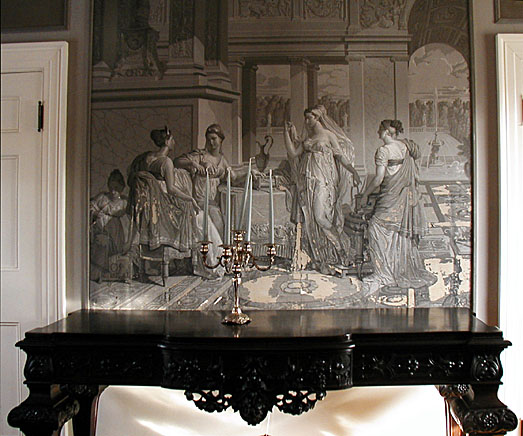
By the early 19th century, expensive, imported wallpapers decorated the walls of prominent New England homes. Those papers were of various designs and patterns, and some of them depicted scenes from Greek and Roman mythology. American historical scenes were also popular.

Block printing wallpaper

Up until 1840 all wallpaper makers employed the slow, labor intensive block printing process. So manufacturers wanted to find ways to speed up production. Potters & Ross, a cotton printing firm based in Darwen, Lancashire, England, patented the first wallpaper printing machine in 1839. Adapting the methods used in the printing of calico fabric, the paper passed over the surface of a large cylindrical drum and received an impression of the pattern from a number of rollers arranged around its base. Troughs beneath each one simultaneously inked the rollers with colors. The first machine-printed papers appeared thin and colorless beside the richer and more complex effects of block-printing and most had simple floral and geometric designs with small repeats.

Wallpaper evolved into an art form. One example depicted the Scottish Highlands, complete with sportsmen stalking deer. Another showed a scene of Italian peasants dancing and harvesting grapes. And yet another depicted riders leaping fences.

Historic panorama scene wallpaper
Victorian wallpaper floral

The frieze-filling-dado wallpaper scheme highlights the popularity of wallpaper in Victorian homes. In 1868 as a way of breaking up the monotony of a single pattern on the wall, and by 1880 it was a standard feature in many fashionable interiors. The dado paper covered the lower part of the wall, between the skirting board and chair rail; above this hung the filling, and above this the frieze. And as if three different wallpapers weren’t enough decoration for any room, the scheme was often combined with ceiling papers to complete the densely-patterned effects. Ideally, the frieze should have been light and lively, the filling, a retiring, all-over pattern, and the dado should be darker to withstand dirt and wear and tear. Co-ordinating papers, printed in muted greens, reds, yellows and golds, could be extremely attractive but the frieze-filling-dado-ceiling combination often led to visual overload. Hallways and stairs benefitted best from this wallpaper treatment. But by 1900 ceiling papers had disappeared and, in artistic interiors, wide friezes hung above plain or simple paneled walls.

Antique wallpapers are of interest to several kinds of collectors. Some might be interested in specific themes or designs, such as papers depicting historical scenes, or those displaying floral patterns; wallpapers from England or France or some other country might engage the attention of others; still, some individuals like to collect papers produced by certain manufacturers, such as Cole & Son or William Morris. And some of  those assembling a collection might be interested in a certain time period such as wallpapers manufactured in the 17th or 18th century.

To read more articles on antiques, please visit the Antiques Articles section of my Web site.  And to stay up to the minute on antiques and collectibles, please join the over 30,000 readers by following my free online magazine, #TheAntiquesAlmanac. Learn more about railroad antiques in "All Aboard!" in the 2021 Summer Edition, online now. And to read daily posts about unique objects from the past and their histories, like the #Antiques and More Collection on Facebook.