Tuesday, January 7, 2025

Form Follows Function


QUESTION: While I normally associated blonde furniture with the 1950s, I was surprised to see a chest at a recent antique show that the dealer said dated to the early 19th century. She referred to it as Biedermeier, after a design movement in Vienna. Austria. Can you tell me more about this style of furniture/? I’ve never seen anything like it. 

ANSWER: Biedermeier was a German-based decorative movement which spread throughout Europe from 1815 to 1848. The style’s name came from Ludwig Eichrodt and Adolf Kussmaul, who depicted the typical bourgeois of the period under the name "Gottfried Biedermeier."–"Gott" meaning "God," fried" meaning "peace," "Bieder" meaning "commonplace,"_meier" meaning "steward"—in their Fliegende Blatter (Pamphlets), a Viennese journal of the day. However, it wasn’t called Biedermeier until 1886, when Georg Hirth wrote a book about 19th-century interior design and used the word "Biedermeier" to describe domestic German furniture of the 1820s and 1830s.

Biedermeier furniture suited the modest size and needs of comfortable bourgeois households.  In middle-class homes, with fewer separate rooms, the concept of the Wohninsel, or "living island," became popular. This made it possible to perform a number of activities in one room—writing, sewing, music making—each characterized by different furniture.

The “living island,” or as it’s known today living room, usually included an ottoman, several armchairs and chairs upholstered in woolen material, sometimes in silk or damask; a round table, a mirror and where possible a glass-fronted case for silver and a piano. The less severe appearance of Biedermeier furniture led to a less formal arrangement of rooms as a whole. Flowers, screens, worktables and knickknacks of all sorts helped to give a sense of family life. The bourgeoisie began to form a personal style, thus creating what’s now known as interior design.

People arranged suites of furniture in the corners, creating areas for eating, chatting,  reading, and doing embroidery. Each had a sofa, table and chairs—the most numerous items created in the Biedermeier style.

Prior to 1830, Viennese cabinetmakers began using mahogany in their furniture, gradually replacing walnut. They gave their finished pieces a light finish, often applying matching stains and finishes to pieces made in walnut, pear wood, and Hungarian "watered" ash.

Cabinetmakers used boards to construct their pieces, which meant that they designed furniture to be seen from the front and executed its ornamentation, such as relief pillars, pilasters, and caryatids, with this in mind.

And by 1830 Viennese craftsmen no longer relied upon French, German, and Italian designers for inspiration. Instead, they used native products, creating pieces based on Directoire and Empire designs, showing a good understanding of form, balance and the use of ornament in gilded bronze.

Viennese cabinetmakers used mostly veneers over a soft wood frame. Inlay served as the main decorative element, featuring the patterned graining of walnut and often reduced to a light-colored border. Sometimes, craftsmen used black poplar or bird's eye maple and colored woods such as cherry and pear also became popular.

Biedermeier furniture makers used gold and black paint to decorate their pieces. They constructed drawers and their housings so perfect and fitted that, even today, when someone pulls out a larger drawer and returns it, the other drawers in the same bank are propelled forward by the force of air created. They also dovetailed, molded and finished drawer linings, making intervening partitions flush on top and paneled beneath.

Cabinetmakers also employed less expensive stamped brass wreaths and festoons rather than bronze for decorative effect and gilded wooden stars instead of the elaborate metal ornaments of the Empire style. Sometimes, they chose cheaper, new materials such as pressed paper.

No previous period produced such a wealth of different types of seating, with a myriad of variations on the basic scheme of four legs, a seat, and a back. From 1815 to 1835, Biedermeier craftsmen discovered that a chair could be given literally hundreds of different shapes. Upholsterers padded their creations with horse-hair and covered them with brightly colored velvet and calico. Pleated fabrics covered furniture, walls, ceilings, and alcoves.

By the 1840s the Biedermeier style became romanticized—straight lines became curved and serpentine; simple surfaces became more and more embellished beyond the natural materials; humanistic form became more fantastic; and textures became experimental.


An identifying feature of Biedermeier furniture is its extremely restrained geometric appearance. Some furniture took on new roles; for example, a table became the family table, around which chairs were set for evening activities. Or table tops could be placed against the wall in a vertical position. A portable piano had a drawer for sewing things, while the upper drawer of a chest of drawers might be converted into a writing desk.

Next to the secretary, the sofa was one of the most popular of Biedermeier pieces. Rectangular, with a high back and sides, sofas looked deceptively hard. In fact, their depth and solidity made them very comfortable.

Armchairs, too, became more comfortable as changing fashions permitted men to sit back and take their ease.

Secretaries were popular as more people wrote letters. While designs varied, most featured a central niche, a mirror, and secret drawers. Cabinetmakers also produced veneered cupboards, vitrines, and wardrobes. 

To read more articles on antiques, please visit the Antiques Articles section of my Web site.  And to stay up to the minute on antiques and collectibles, please join the over 30,000 readers by following my free online magazine, #TheAntiquesAlmanac. Learn more about "Return to Toyland" in the 2024 Holiday Edition, online now. And to read daily posts about unique objects from the past and their histories, like the #Antiques and More Collection on Facebook.


Wednesday, December 25, 2024

Sweet Tooth Santas


QUESTION: I found this old-world German Santa candy container in an antique shop a couple of months ago. He’s made of papier mache  and stands about 6 inches tall. He’s wearing a cone-shaped hat and carries a small Christmas tree. A faint stamp on the bottom says “Made in Germany.” This little Santa comes apart in the middle to reveal a lined interior. Can you tell me more about this little gem?

ANSWER: You have indeed discovered a little Christmas gem. What you have is a Santa candy container made in Germany around the turn-of-the-20th-century. Called a Springhead, this little novelty features a Santa wearing a red-flocked coat and a cone-shaped hat. He also carries a small Christmas tree decorated with colored beads.

Of all the holiday decorations produced since the mid-19th century, few remain as cherished as early German Santa Claus candy containers. These handmade characterizations of Father Christmas remain a popular collectible.                           

The manufacture of Santa candy containers began in the 1880s. Makers sold them to an eager American market. By the end of the decade, U.S. retailers offered their customers German-made Santas in a variety of sizes and styles.   

Selling for a mere five cents, these Santas represented old Kris Kringle in snow-covered garb. Sometimes makers added gold tinsel to represent sparkling snow. Santa containers came in a variety of sizes, from five to seven-and-a-half inches tall. Santa, himself, had a finely painted red face and white beard and wore a heavy coat. Other Santas wore felt robes trimmed with lamb's wool or felt. Purple crepe paper sometimes lined the inside of the outfit. Some of the Santas carry a tiny wicker basket at their waist or on their back.

The Germans couldn't make them fast enough. The making of these early candy containers involved eight to ten families, each responsible for different areas of production. One family might fashion the boots, another would create Santa's clothing, while another would add Santa's rabbit-fur beard. But the most important step involved painting the face.

Over the years the details of Santa’s face changed. One of the biggest influences was the poem “A Visit from St. Nicholas,” that portrayed Santa as a jolly old elf with a thick, flowing white beard and a white fur-trimmed suit. The public's impression of Father Christmas as a stern, thin old man changed dramatically in the late 19th century when Thomas Nast began illustrating St. Nick as a fat, jolly elf-like character for Harper's Weekly.

People originally saw St. Nicholas, the patron saint of children, as a gift-giving old man who rode a white horse and gave goodies to children. Father Christmas took the initial image of St. Nicholas and gave it a twist, making him an old bearded man who doled out punishments as well as rewards.

Residents of certain parts of Germany saw Christkindchen, the German Christ child, as a gift giver. The English butchered the pronunciation of the name, so that today he’s popularly known as Kris Kringle. This figure traditionally wore a white robe and a white jeweled crown, traveling the countryside on a mule. He was said to have been accompanied by Pelze Nicol, a boy with a blackened face. Yet even Pelze Nicol developed into his own personality, becoming Belsnickle, a sinister-looking Santa who punished bad children.

Important scientific discoveries have also been incorporated into these Christmas figures, the most notable being the invention of the light bulb. Between1907 and 1910, the Germans made Santa candy containers featuring an electric lantern strapped to Santa's chest. The figure also held a feather tree decorated with three electric bulbs. A battery operated all four lights.

Likewise, Santa's means of transportation hasn't remained static over the years. Some candy containers show Santa on a sheep, donkey or mule, while others had him riding a sleigh made of moss. The Germans crafted log sleighs with the bed of the sleigh large enough to hold both candy and small wooden toys known as Ergebirge.

Where makers placed the candy and dried fruit and how they made them accessible varied from one container to another. Santas also carried different types of baskets. Some simply had a cloth or felt bag for goodies. Some candy containers came in two pieces, having removable heads or a cardboard tube that separated when Santa's legs and torso, enabling them to be pulled apart. Other examples, such as those showing Santa on a chimney, had a plug on the bottom or a paper seal.

Regardless of the type, people gave Santa candy containers mostly as gifts. After the receiver ate the  candy, they used the container as a holiday decoration. Even though people brought out these Santas for the holidays each year, they could be easily damaged not only by overzealous children allowed to play with the Santas, but also by prolonged exposure to sunlight. While children might physically destroy the candy container, the sun did consider-able harm by fading bright-red coats to a light-brown or turning the interior of the garment from purple to blue.

What destroyed the great artistry of German candy containers, however, was competition from foreign countries. By the 1920s the public was more willing to accept plainer-looking Santas, and the Japanese provided them. Although the Japanese based their candy containers on German examples, the fine details soon became too expensive to produce. The public accepted cheaper imitations, trading savings for a loss in quality.

It's that loss of true artistry over the years that makes vintage German-made Santa candy containers so collectible today. Prices begin at about $375 but rarer ones often sell for several thousand dollars.

To read more articles on antiques, please visit the Antiques Articles section of my Web site.  And to stay up to the minute on antiques and collectibles, please join the over 30,000 readers by following my free online magazine, #TheAntiquesAlmanac. Learn more about "Return to Toyland" in the 2024 Holiday Edition, online now. And to read daily posts about unique objects from the past and their histories, like the #Antiques and More Collection on Facebook.

Monday, December 16, 2024

Bizarre Victorian Holiday Greetings


QUESTION: I was browsing in an antique shop recently and came across a box with some old Victorian Christmas cards. Among the usual ones showing Santa Claus and children sledding were some really bizarre ones depicting mice and rats and insects doing some strange things. What prompted the Victorians to create such horrific cards for a festive holiday.

ANSWER: The Victorians as a whole were not the happy people sitting by a cozy fire or playing in the snow that most Victorian B&Bs and historic shopping districts portray them to be. They had a dark side, too. They were a curious lot and had a wacky sense of humor. So it stands to reason that this eventually made it onto their holiday greeting cards, like these insects performing scenes from “Macbeth.”  They thought nothing unusual about sending their loved ones bizarre and creepy images with the words “May yours be a joyful Christmas.”

During that time, Christmas was hardly celebrated, at least, not in a way people would recognize it today. Many businesses didn’t consider it to be a holiday.

One of the most significant seasonal traditions to emerge from the Victorian era is the Christmas card. The first Christmas cards, modeled after Victorian visiting cards, didn’t fold. Instead, designers created small rectangles of pasteboard, about the size of an index card, decorated on one side with a lithographed or etched drawing, a greeting, and blank space for the names of both the sender and the addressee. By the 1870s, manufacturers had started producing larger cards and folded cards. Some opened out like cupboard doors; others fell into accordion folds.

Early British cards rarely showed winter or religious themes, instead favoring flowers, fairies, and other fanciful designs that reminded the recipient of the approach of spring.

The Victorians loved natural things and used other images on their cards that focused less on Christmas, such as flowers, shrubs, and trees. Animals, often portrayed as humans, provided another popular subject for the Victorian Christmas card. Images of children, playing with angelic expressions, also adorned many cards.

Since they lived during the Industrial Age, Victorians loved Christmas cards featuring new inventions, such as the motorcar or bicycle. And though Victorian morals frowned upon pubic sexual expression, some cards had portraits of beautiful girls dressed in flimsy robes or partially nude. Some cards were just downright bizarre with dark themes.

This trend led to Victorian Christmas cards that appear more unsettling to the modern eye. People sent and received ones that showed, among other odd pictures, the aftermath of one frog murdering another, a plate of dead birds, and humans emerging from the stomachs of creepy snowmen. Also featured were bizarre images of animals, fruits, and vegetables, such as sinister walking potatoes and Christmas dinner ingredients dancing to the music of a violin-playing rabbit.

One of the strangest images found on late 19th-century Christmas cards was a dead robin lying in the snow. Perhaps the Victorian’s obsession with death and fondness for images that evoked pity can explain this unique custom.

The dark nature of this sort of image also reflects differences between Victorian values and those of today. The inclusion of images of dead robins may be unsettling today, but for people of the 19th century, it was meant to signify a good luck ritual that was sometimes performed: To celebrate St. Stephen’s Day on the day after Christmas, people would kill a small bird, either a robin or a wren. Sending those images of the deceased beasts was actually intended to bestow good fortune.

Some newspapers ran reviews of each season’s designs, in the way that films might be reviewed today, which increased the urgency for designers to create ever more unusual imagery in order to be competitive. 

To read more articles on antiques, please visit the Antiques Articles section of my Web site.  And to stay up to the minute on antiques and collectibles, please join the over 30,000 readers by following my free online magazine, #TheAntiquesAlmanac. Learn more about "Return to Toyland" in the 2024 Holiday Edition, online now. And to read daily posts about unique objects from the past and their histories, like the #Antiques and More Collection on Facebook.

Thursday, December 5, 2024

Choo Choo Chugging Around the Christmas Tree


QUESTION: Every Christmas since I can remember, our family has got out an old tine train set that belonged to my grandfather and set it up under the Christmas tree. It still runs and is in good condition. All we know is that the set was made by a German company named Märklin. What can you tell us about this company?

ANSWER: From the looks of your train, I’d say it dates from the 1920s or 1930s. At the time, these trains were more toys than authentic models. Their design reflects the boxy look of European trains rather than the sleeker, simpler lines of American ones.

As the 1930s dawned, the Great Depression forced millions of people out of work. Owning an electric toy train was the ultimate. Kids even loved observing the trains displayed in department store windows. What could be more rewarding to a young boy than to receive a model train for Christmas? But these little trains were expensive so were out of reach of many families. 

Manufacturers lovingly handcrafted the earliest toy trains, made prior to 1850, of shining brass to run on the bare floor. But by the late 1830's, a number of prosperous toy companies began producing toy trains.  Around 1856, George W. Brown, a Connecticut firm, produced the first self-propelled train made of iron and  coated with tin to prevent rust. A wind up clockwork motor drove the engine and carriages on plush Victorian carpets on straight or curved tracks.

In 1859, tin smith Theodor Friedrich Wilhelm Märklin began producing doll house accessories made of lacquered tinplate. Although the Märklin Toy Company of Germany originally specialized in doll house accessories, It became known for its toy trains.

By the 1870's, the most popular trains were powered by steam. Utilizing alcohol or sometimes coal to propel. they duplicated the might and energy of their big, big brothers.

The tin toy makers in both Europe and the U.S. realized that profits could be made by selling toy trains to the masses and jumped on the toy model bandwagon. Early on, they set their sights on wealthier people by promoting their products’ snob appeal.

In 1891, Märklin began producing wind-up toy trains that ran on expandable sectional tracks and the following year created a sensation by making the first figure eight track layout. It also established a track gauge settings numbered from 0 to 4, which it presented that year at the Leipzig Toy Fair. These track gauges soon became international standards. Märklin began producing 0 gauge trains as early as 1895 and H0 scale in 1935. In 1972, the company rolled out diminutive Z scale trains, the smallest in the world in competition to  Arnold Rapido's introduction of N gauge.

Märklin’s owners noted that toy trains, like doll houses, offered the potential for future profits when, after the initial purchase, owners would expand by purchasing accessories for years to come. So, the company offered additional rolling stock and track with which to expand its boxed sets.

Electric trains became commercially successful by 1897 when the Cincinnati, Ohio, firm of Carlisle and Finch manufactured and sold a two-gauge unit for only three dollars, It also was the first to issue a model railway builder's instruction manual.

Many consider the years prior to World War I to be the "Golden Age" of quality model trains. As the war approached, manufacturers converted their factories to produce war monitions, rifles and replacement parts. The Depression that followed the war precluded many of these operators from coming back and many disappeared.

But Märklin continued producing toy trains until May 11, 2006 when Kingsbridge, a London venture capital company, took it over. The company filed for bankruptcy on February 4, 2009, but on February 5, 2010, after purchasing the rival LGB Company, announced it had returned to profitable state. Many consider Märklin's older trains highly collectible today.


To read more articles on antiques, please visit the Antiques Articles section of my Web site.  And to stay up to the minute on antiques and collectibles, please join the over 30,000 readers by following my free online magazine, #TheAntiquesAlmanac. Learn more about "Lady Luck" in the 2024 Fall Edition, online now. And to read daily posts about unique objects from the past and their histories, like the #Antiques and More Collection on Facebook.


Wednesday, November 27, 2024

The Perfect Platter


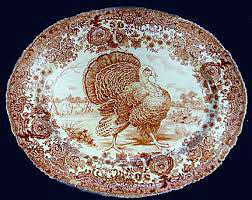
QUESTION : For many American families, Thanksgiving has become a landmark holiday marking the beginning of the holiday season. It’s a time when family members begin planning the event as early as October. At the center of it all lay the traditional dinner, with its array of foods surrounding a plump brown roasted  turkey which sat on a grand platter, which had been handed down for generations. Can you tell me how these platters came to be, who made them, and why they became so popular?

ANSWER: Many families still use a large turkey platter. Though large but not very sophisticated, it often features a 22-inch pattern manufactured by Homer Laughlin. It’s got high sides and can hold a very large turkey, and by now it’s even got a few rim chips, but it’s part of the family.

The first turkey platters appeared in the early 1870s, when East Liverpool, Ohio, was the setting for the founding of several important American potteries due to the existence of raw materials such as clay, coal and natural gas. One of the largest and most successful, was the Homer Laughlin China Company, founded by brothers Homer and Shakespeare Laughlin in 1897. It went on to become one of the world's major producers of institutional china, including Fiesta ware. They based their holiday platters on several of their most popular dinnerware lines and decorated them with colorful printed transfers.


Thus, the same image often appeared on many of their turkey platters—a bird with its tail feathers fanned out fully, set against a rural farmyard background. The platters featured wide rims in Harlequin yellow and turquoise blue.

In the mid-1950s, a similar design appeared on Thanksgiving platters made by Taylor, Smith & Taylor, which the company sold to retailers to use as an advertising premium. 

In its "Historical America" series, Laughlin also produced an elaborate scene from 1621 called "The First Thanksgiving," transfer printed in rose pink and sold exclusively through F.W. Woolworth. The company also produced a similar "Bountiful Harvest" platter showing Pilgrims and Indians gathering and sharing food.


A somewhat scrawnier bird appears on platters and plates made by Southern Potteries Inc., a Tennessee firm formerly known as Clinchfield Potteries. It began in 1917 by producing commercial, semi-vitreous china tableware decorated with stock transfers. 

Its better-known trademark, Blue Ridge, debuted in 1932. By the late 1930s, it had switched from transfers to underglazed hand-painted decoration. Within 15 years, it had become the largest American producer of hand-painted china, with an annual production of 24 million pieces. Some of the firm’s top artists signed a limited number of special designs, and these are among the most coveted pieces for collectors. 


For example, there’s a wild turkey platter painted and signed by artist Mildred L. Broyles, depicting a standing, long-necked bird eyeing a bug, valued at over $2,000. Another, signed by Louise Gwinn called “Turkey Gobbler,” shows a bird in a woods and sells for over $1,750.

While Homer Laughlin and Southern Potteries dominated the market, there were several other companies, from California and elsewhere; that staked their own claims. Among these are platters produced by the Nelson McCoy Pottery Comapny of Roseville, Ohio, featuring a solid brown embossed relief of Tom Turkey, the Delano Studios of Long Island, featuring a soaring bird in flight, and the Hadley of Louisville platter, with its whimsical, schematic turkey in blue on vitrified stoneware.

To read more articles on antiques, please visit the Antiques Articles section of my Web site.  And to stay up to the minute on antiques and collectibles, please join the over 30,000 readers by following my free online magazine, #TheAntiquesAlmanac. Learn more about "Lady Luck" in the 2024 Fall Edition, online now. And to read daily posts about unique objects from the past and their histories, like the #Antiques and More Collection on Facebook.